

Shein Group Ltd spent years trying to distance itself from China, only to discover that the supply chain underpinning its success was the one thing it could not leave behind. That very ecosystem appears to be the main beneficiary of a long, tortuous listing.
For everyone else, the journey has been costly — starting with the company itself. The Singapore-based online retailer priced the Hong Kong initial public offering (IPO) at HK$48.56 (US$6.19) per share on Thursday, valuing it at just more than US$26 billion. That is about a quarter of the US$100 billion it was worth at its private-market peak four years ago.
Some existing shareholders are being cushioned from the collapse in value, but that hardly makes them winners. Shein had agreed to pay as much as US$3.5 billion to pre-IPO investors. Their purchases included protections against a steep markdown. As a result, the hefty payout could amount to about double the US$1.7 billion raised in the IPO.
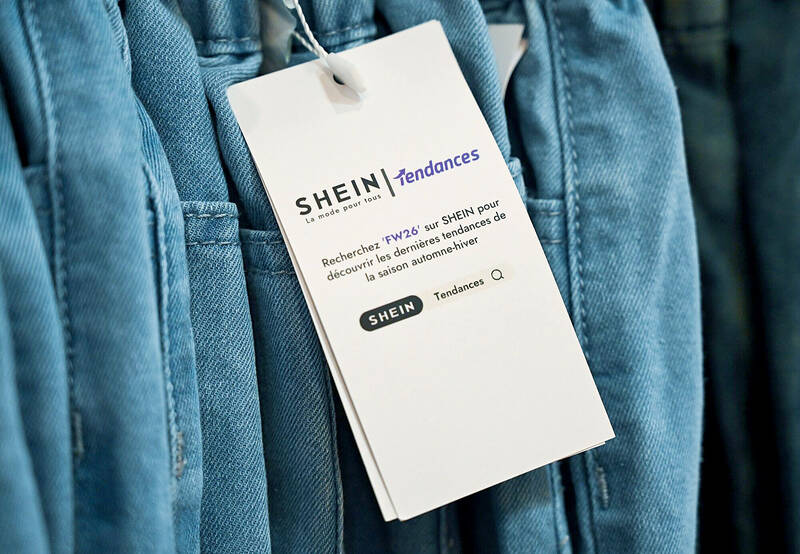
Photo: Bloomberg
However, there is one group with reason to celebrate: The vast network of suppliers in southern China that powers the retail juggernaut. Concentrated in the southern part of Guangzhou, thousands of small factories, making mostly clothing, are the muscle behind the ultra-fast-fashion model. A close-knit, tightly integrated supply chain located in a compact area allows Shein to identify trends, place tiny initial orders and get them ready for delivery within two weeks.
The irony is that this is the network that the fashion giant had once tried to play down by moving to Singapore and rebranding as a global company to appeal to Western investors. That strategy failed due to fierce US opposition, as well as an inability to reproduce in countries such as Brazil and Turkey the speed, flexibility and low costs of its production base.
The IPO should bind those suppliers even more closely to Shein. The company plans to devote 40 percent of the proceeds to technology, including investments designed to improve the manufacturing network at the heart of the business.
Shein’s next act would only deepen the relationship. With growth in the US and Europe, two of its biggest regions, slowing due to greater protectionism and competition, the company is telling investors that future expansion would come from offering the Guangzhou supplier network to other brands. The approach calls for acquiring labels and plugging them into the same group of factories or providing those services to other firms.
However, turning its manufacturing prowess into someone else’s growth engine might be harder than it sounds. The retailer launched a fashion incubator for budding designers in 2021. Two years later, it evolved into the Xcelerator program, which offers product fulfillment, production support and access to the sales platform. The results have been modest, accounting for no more than 1 percent of sales last year. It is hard to see how the scheme could move the needle.
Buying brands might be a better bet. An established label comes with something that Shein’s factories cannot make: recognition and a ready-made customer base. But this strategy also comes with caveats. The deal to purchase US millennial clothing brand Everlane, announced in May and subject to a US security review, looks like an awkward fit.
The US label built its fanbase on supply-chain transparency and sustainable production, attributes that clash with an ultra-fast-fashion ethos. Plugging it into the same manufacturing machine risks eroding the very qualities that made the brand worth buying in the first place.
The subdued response to the IPO suggests investors are not totally convinced that Shein has found its next growth engine. At this price, the company trades a 13 times trailing earnings, a considerable discount to Zara owner Inditex SA, Swedish retailer Hennes & Mauritz AB and Japan’s Fast Retailing Co. The retailer has the difficult task of proving that the manufacturing system that transformed fashion can do so again.
The listing has already delivered one verdict. Shein spent years recasting itself as a global company, only to discover that its greatest strength remains unmistakably Chinese. Its valuation might have shrunk, but the value of the manufacturing ecosystem behind it has never been clearer.
Juliana Liu is a columnist for Bloomberg Opinion’s Asia team, covering corporate strategy and management in the region. She was previously CNN’s senior business editor for Asia, and a correspondent at BBC News and Reuters. This column reflects the personal views of the author and does not necessarily reflect the opinion of the editorial board or Bloomberg LP and its owners.

HAND-IN-HAND: Nvidia’s inability to hold the line on prices reflects how much leverage memorychip makers have amid the surge in demand for AI infrastructure Some of Nvidia Corp’s biggest customers have been told that the prices of servers containing its artificial intelligence (AI) chips are going up more than 15 percent in many cases with memory costs soaring. The price hikes would go into effect on systems shipped early next year and impact systems including those with the flagship Vera Rubin and Grace Blackwell chips, people familiar with the process said on condition of anonymity. The increases would depend on the generation of Nvidia chips and the memory configurations, they said. Companies who build the servers under contract for large data center operators such as Microsoft
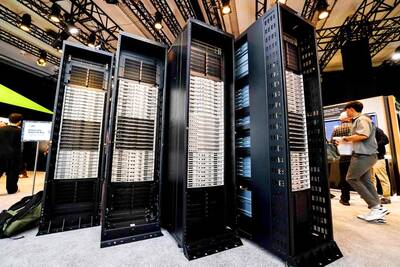
AM Intelligence, an Indian artificial intelligence (AI) infrastructure company, has ordered 9,000 Nvidia Corp Vera Rubin systems, seeking to become one of the first adopters of the advanced computing platform in Asia. Servers equipped with the rack-scale systems are slated to come online next year in southern India, the Hyderabad-based company said in a statement yesterday. Customers include major cloud service providers, AI labs and organizations aiming to develop homegrown Indian AI models, it said. Supplies of high-end Nvidia compute clusters remain tight. Demand from data centers and companies such as Microsoft Corp, Alphabet Inc’s Google and Amazon.com Inc to train AI models
The market debut of artificial intelligence (AI) start-up Anthropic PBC, a chief rival to OpenAI, could break the record set by Space Exploration Technologies Corp (SpaceX), US media have reported. Businessman Elon Musk’s SpaceX went public in June at a value of US$1.77 trillion and raised US$85.7 billion in its blockbuster initial public offering (IPO), the largest in history. Anthropic, maker of the Claude AI models, “expects to match or beat the size” of SpaceX’s deal, Bloomberg reported. The company’s bankers have told potential investors it could seek to raise “more than US$100 billion” in its IPO, which could put the company’s

Xiaomi Corp (小米) has launched a mobile processor for its marquee devices, putting pressure on Qualcomm Inc and MediaTek Inc (聯發科), which for years supplied the key component to the Chinese company. The Xring O3 system-on-a-chip advances Xiaomi’s in-house semiconductor design efforts with more power-efficient image processing and better artificial intelligence capabilities, the Beijing-based company said in a post on Sina Weibo yesterday. The company’s new silicon is made using a 3-nanometer fabrication process, Xiaomi founder Lei Jun (雷軍) said in a WeChat post . That is closer to the node used for Apple Inc’s most recent A19 Pro chips and well ahead


 RSS