

The government would consider raising its average annual electricity demand growth forecast through 2035 above the 2.5 percent it projected in June based on a high-demand scenario, Minister of Economic Affairs Kung Ming-hsin (龔明鑫) said yesterday.
Kung did not specify a growth projection, saying that further details would be announced later, and that the government would ensure sufficient and stable power supply.
The minister’s remarks came after Premier Cho Jung-tai (卓榮泰) on Wednesday said that the government would raise the growth forecast beyond the 2.5 percent annual rate, as demand for electricity from the artificial intelligence (AI) and semiconductor industries continues to grow.
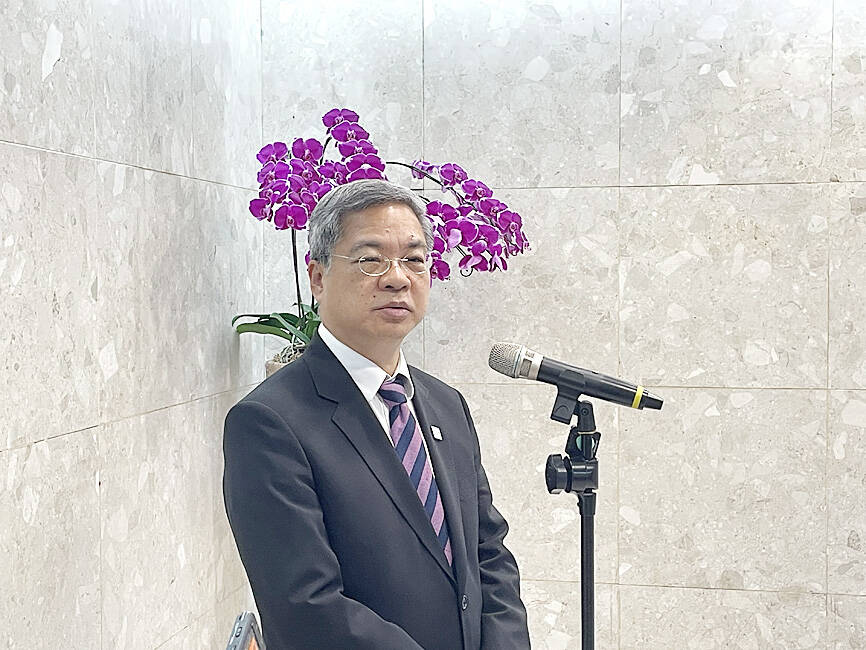
Photo: Meryl Kao, Taipei Times
The government initially projected average annual electricity demand growth of 1.7 percent from last year to 2034, before raising the forecast in June to 2.5 percent from this year through 2035.
Power demand forecasts take into account economic growth, actual electricity consumption and energy-saving efforts according to demand scenarios, Kung said.
Ensuring stable power supply remains Taiwan Power Co’s (Taipower, 台電) top priority, he said.
On Taipower’s recent proposals to supply electricity to large AI data centers through direct lines, Kung said the key is data center site selection and local grid conditions.
North of Hsinchu, grid conditions are tight and new large-scale AI data centers could face restrictions and require assessments, while central and southern Taiwan are less likely to face those constraints, he said.
Separately, regarding a fire involving a single turbine at Orsted Taiwan Ltd’s (沃旭能源) Greater Changhua offshore wind farm on Aug. 8, Kung said it was the first such incident among more than 500 turbines in Taiwan.
The fire resulted from an equipment malfunction, but the exact cause remains under investigation, he said.

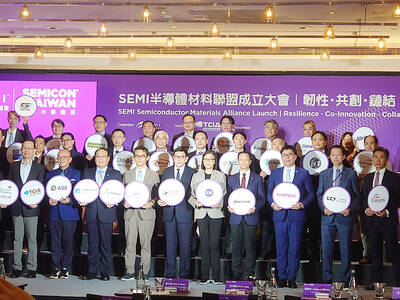
SPECIALTY SUPPLIES: Taiwan is ushering in a major shift in industrial upgrades and a local alliance will reinforce supply chain resilience, SEMI president Terry Tsao said SEMI Taiwan launched a semiconductor materials alliance yesterday to fortify industry resilience, capitalizing on surging domestic demand fueled by advanced nodes and next-generation packaging. Taiwan has been the world’s largest semiconductor materials consumer for 16 years in a row, the industry association said. Taiwan purchased about US$21.7 billion of semiconductor materials last year, driven by artificial intelligence (AI)-related demand, SEMI data showed. The spending accounted for 30 percent of global semiconductor materials consumption, totaling US$73.2 billion, the data showed. “Demand for specialty gases, chemicals and key raw materials are rising in Taiwan, fueled by the technology advancements to 2-nanometer and advanced packaging technologies,” SEMI
HAND-IN-HAND: Nvidia’s inability to hold the line on prices reflects how much leverage memorychip makers have amid the surge in demand for AI infrastructure Some of Nvidia Corp’s biggest customers have been told that the prices of servers containing its artificial intelligence (AI) chips are going up more than 15 percent in many cases with memory costs soaring. The price hikes would go into effect on systems shipped early next year and impact systems including those with the flagship Vera Rubin and Grace Blackwell chips, people familiar with the process said on condition of anonymity. The increases would depend on the generation of Nvidia chips and the memory configurations, they said. Companies who build the servers under contract for large data center operators such as Microsoft

YouTube is offering millions of dollars to popular channels if they upload their videos to the site exclusively for a certain period of time, in an effort to halt Netflix Inc’s pursuit of its biggest stars, people familiar with the conversations said. The payment would come in a couple of different forms. YouTube has discussed directly financing some programs, and it has also offered to allot a portion of major brand deals to creators. Although YouTube has not finalized deals with any creators, it is close an agreement with several partners, said the people, who declined to be identified because

The market debut of artificial intelligence (AI) start-up Anthropic PBC, a chief rival to OpenAI, could break the record set by Space Exploration Technologies Corp (SpaceX), US media have reported. Businessman Elon Musk’s SpaceX went public in June at a value of US$1.77 trillion and raised US$85.7 billion in its blockbuster initial public offering (IPO), the largest in history. Anthropic, maker of the Claude AI models, “expects to match or beat the size” of SpaceX’s deal, Bloomberg reported. The company’s bankers have told potential investors it could seek to raise “more than US$100 billion” in its IPO, which could put the company’s


 RSS
RSS