

Morgan Stanley has raised its forecast for Taiwan’s economic growth this year to 11.6 percent from 8.9 percent, putting the economy on track for its fastest expansion in almost four decades as the artificial intelligence (AI) boom drives exports, investment and consumer spending.
Morgan Stanley expects private investment to increase 17.7 percent this year, with real capital formation accelerating to 23 percent in the second half from about 12 percent in the first half of the year.
Imports of capital equipment are forecast to surge 41.33 percent this year, while semiconductor equipment imports are expected to rise 29.41 percent and capital equipment output to jump 67.22 percent, it said.
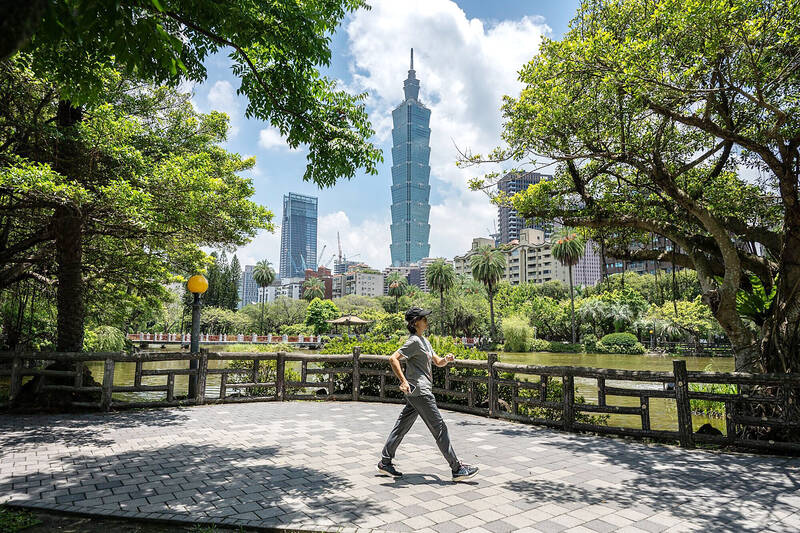
Photo: Lam Yik Fei, Bloomberg
“The figures suggest that AI and high-performance computing demand is translating into actual equipment purchases and capacity expansion, rather than remaining confined to export orders,” Morgan Stanley said in a report this week.
Taiwan’s exports rose 44.7 percent in the first seven months from a year earlier, Ministry of Finance data showed. Morgan Stanley expects full-year exports to grow 20.7 percent this year, with shipment growth slowing to 13 percent in the second half from about 28 percent in the first six months.
The slowdown mainly reflects higher comparison bases and shipment timing, rather than a clear weakening in the semiconductor cycle, it said.
Private consumption is also gaining momentum, growing 5.38 percent in the first half from a year earlier.
Morgan Stanley expects consumption to expand 3.2 percent this year, up from 1.4 percent last year.
Still, inflation is emerging as a constraint. Morgan Stanley forecasts consumer prices to rise 2.1 percent this year and 2.2 percent next year, keeping inflation above the central bank’s 2 percent threshold. It expects the central bank to raise its benchmark discount rate to 2.125 percent in December from the current 2 percent, three months earlier than previously forecast.
“The central bank may need to act pre-emptively and keep rates higher for longer,” Morgan Stanley said, adding that the rate-hike cycle might be limited because credit controls and supply-side measures have already cooled the housing market.
The government’s plan to distribute another NT$10,000 cash handout to all residents next year could add about 0.3 percentage point to GDP growth next year, while the expansionary budget could also add to inflationary pressures, it said.
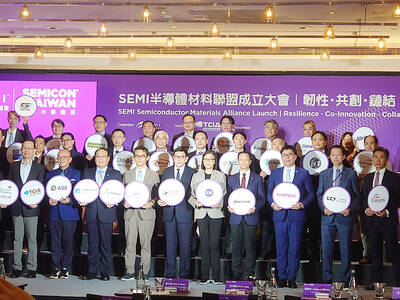
SPECIALTY SUPPLIES: Taiwan is ushering in a major shift in industrial upgrades and a local alliance will reinforce supply chain resilience, SEMI president Terry Tsao said SEMI Taiwan launched a semiconductor materials alliance yesterday to fortify industry resilience, capitalizing on surging domestic demand fueled by advanced nodes and next-generation packaging. Taiwan has been the world’s largest semiconductor materials consumer for 16 years in a row, the industry association said. Taiwan purchased about US$21.7 billion of semiconductor materials last year, driven by artificial intelligence (AI)-related demand, SEMI data showed. The spending accounted for 30 percent of global semiconductor materials consumption, totaling US$73.2 billion, the data showed. “Demand for specialty gases, chemicals and key raw materials are rising in Taiwan, fueled by the technology advancements to 2-nanometer and advanced packaging technologies,” SEMI
HAND-IN-HAND: Nvidia’s inability to hold the line on prices reflects how much leverage memorychip makers have amid the surge in demand for AI infrastructure Some of Nvidia Corp’s biggest customers have been told that the prices of servers containing its artificial intelligence (AI) chips are going up more than 15 percent in many cases with memory costs soaring. The price hikes would go into effect on systems shipped early next year and impact systems including those with the flagship Vera Rubin and Grace Blackwell chips, people familiar with the process said on condition of anonymity. The increases would depend on the generation of Nvidia chips and the memory configurations, they said. Companies who build the servers under contract for large data center operators such as Microsoft

YouTube is offering millions of dollars to popular channels if they upload their videos to the site exclusively for a certain period of time, in an effort to halt Netflix Inc’s pursuit of its biggest stars, people familiar with the conversations said. The payment would come in a couple of different forms. YouTube has discussed directly financing some programs, and it has also offered to allot a portion of major brand deals to creators. Although YouTube has not finalized deals with any creators, it is close an agreement with several partners, said the people, who declined to be identified because
The market debut of artificial intelligence (AI) start-up Anthropic PBC, a chief rival to OpenAI, could break the record set by Space Exploration Technologies Corp (SpaceX), US media have reported. Businessman Elon Musk’s SpaceX went public in June at a value of US$1.77 trillion and raised US$85.7 billion in its blockbuster initial public offering (IPO), the largest in history. Anthropic, maker of the Claude AI models, “expects to match or beat the size” of SpaceX’s deal, Bloomberg reported. The company’s bankers have told potential investors it could seek to raise “more than US$100 billion” in its IPO, which could put the company’s


 RSS
RSS