

Judges watch a humanoid robot perform at the gymnastics floor exercise competition during the second World Humanoid Robot Games at the National Speed Skating Oval in Beijing yesterday.
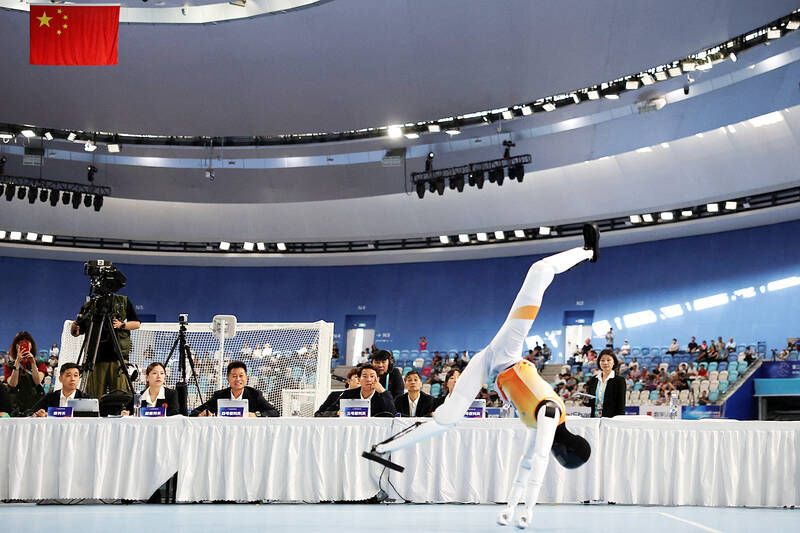
Photo: REUTERS
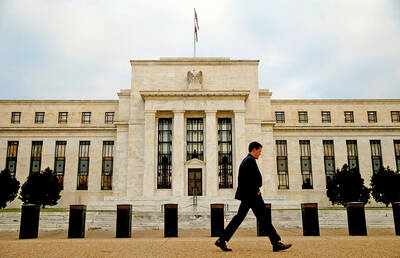
Federal Reserve Bank of Philadelphia President Anna Paulson on Thursday joined the chorus of policymakers saying additional interest-rate increases may be needed to ensure inflation returns to the central bank’s 2 percent goal. “Looking ahead, if conditions evolve as I expect, some modest further tightening may be warranted,” Paulson said on Thursday at an event in Philadelphia. Earlier on Thursday, New York Fed President John Williams said he and his colleagues “still have a lot of work to do” in dealing with lingering inflation risks. Several other officials have aired similar comments, in line with the signal given last week when policymakers voted
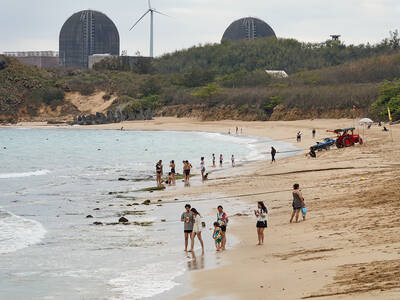
COURSE CHANGE: The shift comes amid pressure from chipmakers for stable, low-carbon electricity. Officials said Ma-anshan could be restarted as early as 2028 Taiwan has approved a preliminary plan to restart an idled atomic power plant, marking a reversal of the ruling party’s anti-nuclear stance as the nation pursues greater energy security. The Nuclear Safety Commission has cleared its review of an initial proposal to restart the Ma-anshan Nuclear Power Plant, it said in a statement on Thursday. Taiwan Power Co (台電) will still need to carry out follow-up work including safety inspections, before submitting another report on implementation for review, the commission said. The earliest the plant could resume operations is 2028, according to previous reports in local media, citing Minister of Economic Affairs
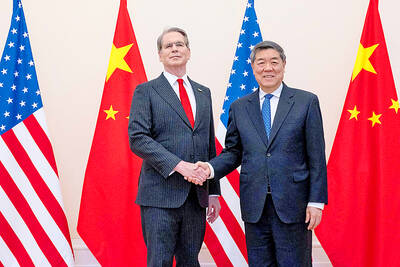
MINIMAL EXPECTATIONS: Analysts think that the two sides are likely to aim for ‘status quo’-level agreements, maintaining civility, without major trade breakthroughs US Secretary of the Treasury Scott Bessent and Chinese Vice Premier He Lifeng (何立峰) were set to meet yesterday to try to set up potential agreements on artificial intelligence (AI), tariffs and critical minerals for a summit in Washington this week between US President Donald Trump and Chinese President Xi Jinping (習近平). The meetings at JPMorgan Chase & Co’s headquarters in Manhattan, which included US Trade Representative Jamieson Greer, were due to start at about 10:30am on Sunday morning and were expected to run all day. Key topics would be the status of a US-China trade truce that is set to expire
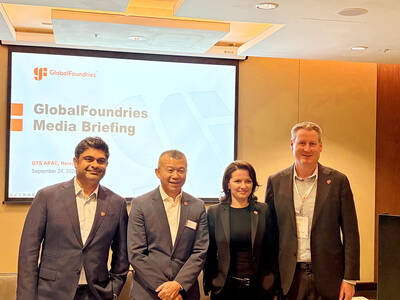
GlobalFoundries Inc yesterday said it plans to accelerate global capacity optimization and expansion to accommodate exponential growth in radio frequency (RF) and other chips driven by the artificial intelligence (AI) boom. Singapore will pay a vital role in the company’s capacity expansion, alongside production line optimizations across its manufacturing sites, GlobalFoundries Asia Pacific head Vincent Feng (范曾文) told a news conference in Hsinchu City. “Many might be surprised to hear that the RF market is thriving now. We are gearing up for a massive capacity expansion, and it is all being driven by AI,” Feng said. He declined to disclose details of the


 RSS
RSS