

Shares of Unitree Robotics (宇樹科技), one of China’s largest humanoid robot makers, initially soared as much as 629 percent in its public stock trading debut yesterday in Shanghai, in the latest highlight of investor optimism over China’s technological advances.
The company, founded in 2016 by entrepreneur Wang Xingxing (王興興) in the eastern Chinese technology hub of Hangzhou, raised around 6.1 billion yuan (US$904 million) in its listing on the Shanghai Stock Exchange’s NASDAQ-style STAR market. The shares were priced at 150.80 yuan a share and closed 460 percent higher at 845 yuan.
Advanced robotics, often referred to as “embodied” artificial intelligence (AI), is a key sector in the heated technology rivalry between China and the US. China leads the US in terms of production capacity of humanoid robots and the ability to scale up manufacturing.
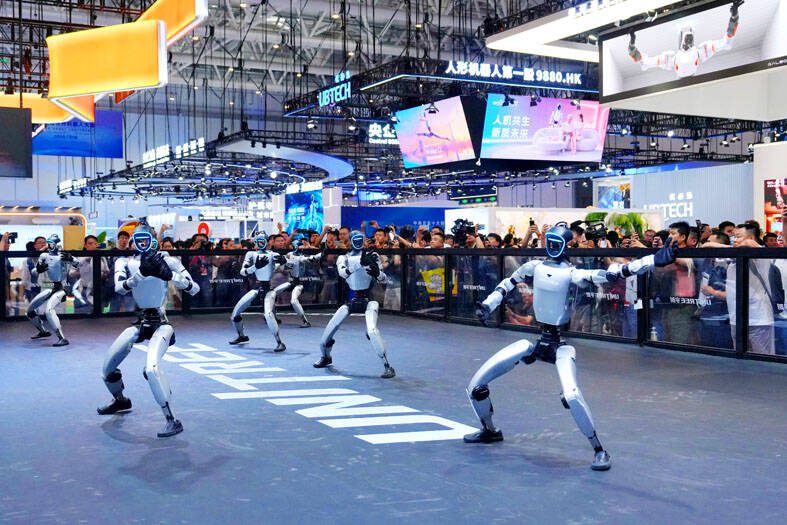
Photo: Andy Wong, AP
Last year, of the roughly 15,000 humanoid robots shipped globally, Unitree and Agibot Innovation (Shanghai) Technology Co (智元創新), another major Chinese humanoid robot maker, each shipped more than 5,000, according to technology research and advisory group Omdia, way ahead of their US counterparts. For the first half of this year, Omdia’s estimates put Chinese humanoid robot makers’ total global shipments at around 18,500 units.
But analysts say for now, many of these humanoid robots are still mainly used for demonstrations, performances and research rather than real-world applications. “The real competitive test will be whether companies — Chinese or American — can achieve reliable performance and attractive returns on investment in large-scale industrial and commercial deployments,” Morningstar Inc analyst Kangyuxiao Li (李康宇孝) said in a commentary.
Unitree said proceeds from the initial public offering (IPO) will be used for advanced robot research and development and development of its robot manufacturing base.
The company is the first publicly traded humanoid robotics maker in mainland China. Analysts believe the IPO could set a precedent for valuations of other robotic company stock offerings.
It “gives mainland investors direct exposure to one of the sector’s leading companies,” Li said.
Unitree’s debut coincided with the World Robot Conference in Beijing, featuring more than 300 exhibitors. Chinese leaders made robots a development priority.
UBTech Robotics Inc (優必選科技), another major Chinese humanoid robot maker, has shares traded in Hong Kong. Its shares fell more than 10 percent yesterday.
Unitree reported about 1.7 billion yuan in revenue last year, mainly from sales of its humanoid robots and quadruped robots, often referring to four-legged robot dogs. More than 40 percent of that revenue was from overseas.
Last year, the US accounted for roughly 13 percent of Unitree’s revenue, the company said. But that was before the US Federal Communications Commission banned imports of new foreign-made humanoid and quadruped robots last month on national security grounds.
Unitree cautioned that the US ban, which it said applies to its new models, could affect its future sales in the US market. Existing models of its advanced robots can still be sold, but Unitree faces the risk that the US could further expand its restrictions.
Omdia analyst Lian Jye Su (蘇連傑) said Chinese robot makers will likely seek to expand in major markets outside of the US, such as Europe.

E.Sun Financial Holding Co (玉山金控) is to formally merge with Mercuries Life Insurance Co (三商美邦人壽) on Sept. 1, creating Taiwan’s fifth-largest listed financial holding company by assets and paving the way for capital injections totaling NT$22 billion (US$683.91 million) to shore up the insurer’s finances, top executives said yesterday. “The first priority after the merger will be to bring the insurer back to health through capital injections,” E.Sun Financial chairman Joseph Huang (黃男州) told a news conference in Taipei ahead of a company earnings call. E.Sun would inject NT$16 billion into Mercuries Life next month, followed by another NT$6 billion next year,
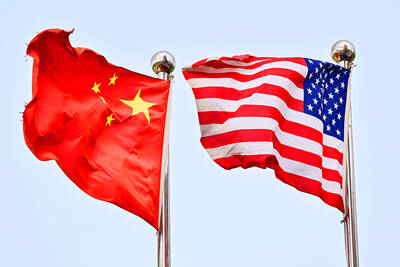
RIVAL BLOCS: Kazakhstan has signed on to the US’ and China’s AI frameworks; a US official said it was difficult to see how a country can be trusted while in a competing pact The US is preparing to tell dozens of countries they must pick sides in the artificial intelligence (AI) race with China, warning they would be excluded from a US-led AI coalition if they also sign up for Beijing’s competing framework, according to a US official and an internal draft reviewed by Reuters. Washington last year launched the Pax Silica initiative aimed at securing supply chains for AI models, semiconductors and critical minerals, amid a fierce technology rivalry with Beijing. About two dozen countries have joined, including Kazakhstan, a key potential source of critical minerals that has also joined China’s coalition,
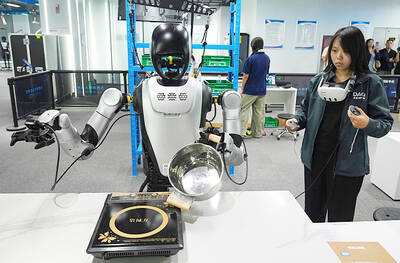
Taiwan and other technology democracies have a "golden but narrowing" three-to-five-year window to lay the foundations for an advanced robotics supply chain outside China, particularly for humanoid robots, a Taiwan-based researcher said yesterday. A report released on Monday by the Research Institute for Democracy, Society and Emerging Technology (DSET) examines China-West competition in physical artificial intelligence (AI) and Taiwan’s potential role in developing alternatives to Chinese robot supply chains. Humanoid robots remain unproven, meaning China’s lead in shipments currently has a limited impact on the real economy, Nathanael Cheng (鄭秉信), a policy analyst in the DSET Economic Security Program, said in a
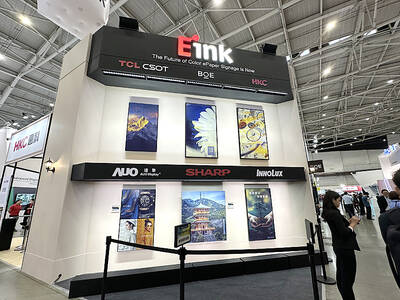
E-PAPER TRANSITION: Increasing memory prices have caused customers to postpone new product launches, with the firm expecting a later peak season this year E Ink Holdings Inc (元太科技), the world’s biggest e-paper display supplier, yesterday revised downward its revenue growth forecast for this year to between 10 and 15 percent, from the 20 to 25 percent it previously estimated, as surging memory prices are hurting demand for its e-readers and e-notes. The company had expected a transition from monochrome color e-paper displays to color displays used in e-readers and e-notes to continue this year. However, rapidly increasing memory prices have caused customers to postpone new product launches, while demand for models from previous generations has also dwindled due to higher prices, E Ink said. That created


 RSS
RSS