

Extreme heat and unreliable water supplies are threatening asset valuations across a growing number of sectors as everything from labor productivity to energy costs gets impacted, an analysis by Moody’s released on Friday showed.
“Heat and water are no longer separate perils moving on separate timelines,” Moody’s managing director and head of catastrophe modeling for insurance solutions Mohsen Rahnama said. “They are converging, and doing so quickly.”
For investors, “both perils translate into operational risk, earnings volatility and stranded-asset exposure,” he said.
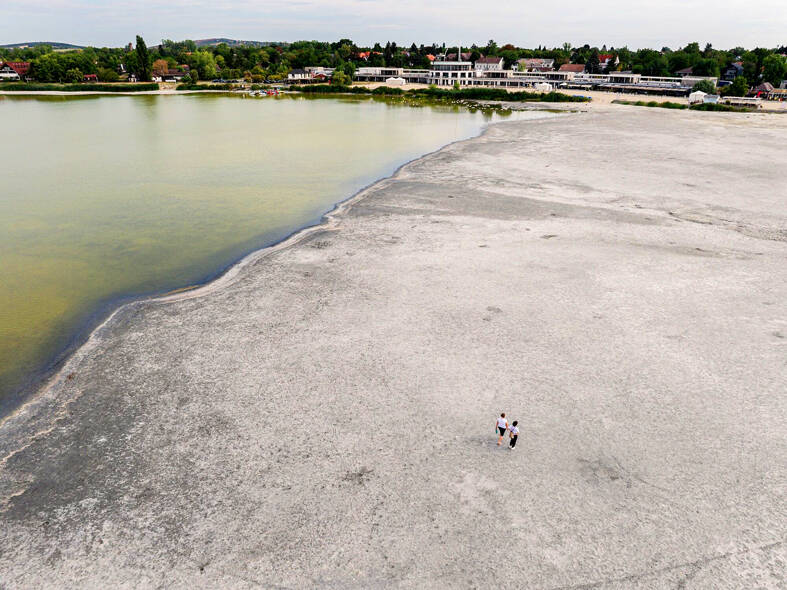
Photo: Bloomberg
This year is on track to be the hottest recorded in human history. In Europe, the fastest-warming continent, heat has exposed huge gaps in the region’s preparedness as its infrastructure buckles. Economists are already warning that disruptions to harvests, commodity supplies and the ability of humans to function would hit inflation and GDP.
Heat and water risk are starting to “weigh on values” in the real estate sector, Rahnama said.
Such impacts, left unpriced, “can quietly erode cash flows and portfolio returns” for firms in sectors spanning agriculture, the manufacture of apparel and of semiconductors, he said.
The upshot is that investors need to adapt to a “new risk landscape” created by extreme weather conditions, as the impact of heat and water scarcity morph into permanent risk features, Rahnama said.
“Reinsurers, banks and investors are watching these same trends closely, given their reach across regions and their role in how capital moves in response to physical risk,” he said.
In the US, Moody’s said a sample of about 159,000 water-intensive facilities revealed that close to 49,000 might face high or very high water stress in the decades ahead.
Most are concentrated in Texas and California, while more than 60 percent of the facilities reviewed are used for heavy manufacturing and processing.
About one-quarter are used for producing food and drinks, while 14 percent are for mining and quarrying, the report said.
Such risks can be hard for insurers to capture, due to the slow-moving nature of the damage done.
“Traditional indemnity cover sits awkwardly with chronic risk,” Rahnama said.
However, “losses from heat and water stress build slowly, are hard to model precisely, and tend to strike many policyholders in a region at once, overwhelming the usual diversification,” he said.

E.Sun Financial Holding Co (玉山金控) is to formally merge with Mercuries Life Insurance Co (三商美邦人壽) on Sept. 1, creating Taiwan’s fifth-largest listed financial holding company by assets and paving the way for capital injections totaling NT$22 billion (US$683.91 million) to shore up the insurer’s finances, top executives said yesterday. “The first priority after the merger will be to bring the insurer back to health through capital injections,” E.Sun Financial chairman Joseph Huang (黃男州) told a news conference in Taipei ahead of a company earnings call. E.Sun would inject NT$16 billion into Mercuries Life next month, followed by another NT$6 billion next year,
WELL MATCHED: The joint venture would lower Sony’s spending burden to stay relevant in chips, while TSMC secures steady revenue, said an analyst, calling it ‘virtually risk-free’ Taiwan Semiconductor Manufacturing Co (TSMC, 台積電) and Sony Group Corp are in talks to spend a combined ¥1 trillion (US$6.3 billion) on their planned image sensor factory in Japan, a person familiar with the matter said. The companies are seeking to begin production in 2029, the person said, asking not to be named because the talks are private. No time frame was given for the investment under discussion, they said. TSMC and the Japanese company’s chip arm, Sony Semiconductor Solutions Corp, are eyeing demand for artificial intelligence (AI)-wielding robots and self-driving vehicles, which are expected to require more sensors to
Taiwan Semiconductor Manufacturing Co (TSMC, 台積電) yesterday said its board of directors has approved investment of ¥282 billion (US$1.77 billion) to form a joint venture with Sony Semiconductor Solutions Corp to develop and manufacture next-generation image sensors for smartphones in Japan. The joint venture, Advanced Vision Semiconductor Manufacturing Corp, would be sited in Koshi City, Kumamoto Prefecture, TSMC said in a statement. It should commence volume production in 2029, TSMC said. Sony Semiconductor would invest ¥465 billion in the joint venture through a combination of cash and assets, the statement said. These capital contributions are expected to be made in phases based

China’s humanoid robot makers commanded more than 97 percent of global shipments in the first half of this year, according to new industry data affirming the country’s early lead against US rivals in the burgeoning field. Global humanoid robot shipments totaled about 19,100 units in the first half of this year, more than triple the 5,100 units shipped in the same period last year, data from Smart Analytics Global showed. The California-based research firm said it expects shipments to rise to around 60,000 units this year and reach 500,000 by 2030. Agibot Innovation (Shanghai) Technology Co (智元創新) overtook Hangzhou-based Unitree


 RSS
RSS