

Financial technology (fintech), including stablecoins, could help accelerate the movement of funds across global semiconductor and artificial intelligence (AI) supply chains, allowing manufacturers to operate more efficiently, industry leaders said yesterday.
Speaking at a news conference in Taipei ahead of the second edition of the Asia FinTech Alliance (AFA) Summit, AFA chairwoman Jaclyn Tsai (蔡玉玲) said Taiwan is the "heart" of semiconductor and AI server manufacturing, and that faster production must be matched by faster financial transactions.
"We cannot just move goods around quickly. We have to move the money quickly as well," she said, adding that fintech could improve supply chain efficiency and strengthen the competitiveness of manufacturing economies.
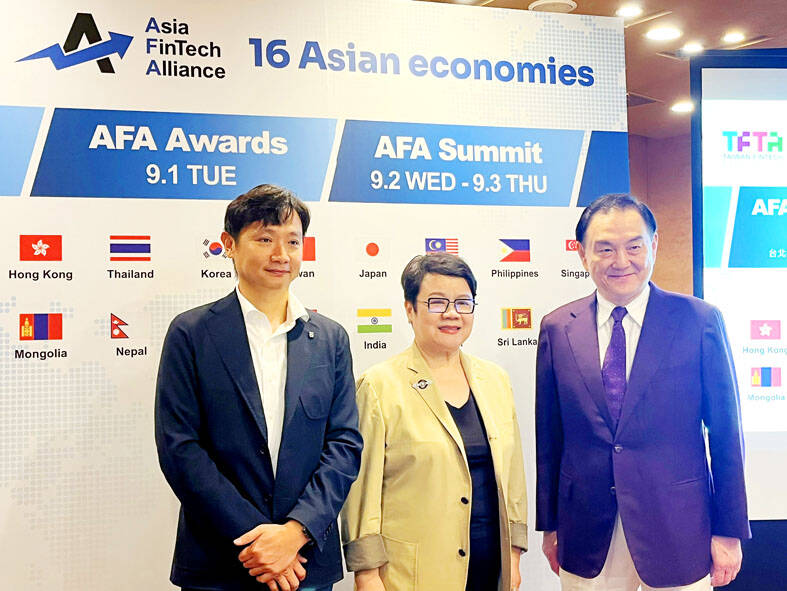
Photo: CNA
Echoing Tsai, Etron Technology Inc chairman Nicky Lu (盧超群) said speed is critical for technology companies operating across different time zones, where banking and settlement hours could delay transactions.
"How quickly can we pay? How quickly can we receive?" Lu said, adding that financial delays could affect production, deliveries, suppliers and customers across several countries when transactions are held up by banking cut-off times.
"In Taiwan, 3:30 in the afternoon is like a cut-off point for everything about semiconductors. We have to wait for the next day," Lu said, referring to the afternoon transaction cut-off observed by many local banks.
He said the financial infrastructure supporting global technology supply chains therefore needs to become faster while maintaining "security, reliability, and resiliency."
During a Q&A session, Tsai said emerging technologies including AI, blockchain and virtual assets could offer new tools to improve manufacturing and supply chain efficiency.
She said regulatory approaches across Asian economies are also becoming more aligned, creating opportunities for greater interoperability in areas such as stablecoins and cross-border payments.
Stablecoins are digital tokens designed to maintain a stable value, typically by being pegged to a fiat currency such as the US dollar. The Legislative Yuan passed the Virtual Asset Services Act (虛擬資產服務法) on June 30, establishing Taiwan’s first legal framework governing stablecoin issuance.
Tsai said the framework could allow both New Taiwan dollar and foreign currency-backed stablecoins, although there has yet to be a decision on which type would be more widely issued.
Pointing to their potential use in supply chains, Tsai said a Taiwanese company could, for example, receive a US dollar-backed stablecoin from an overseas customer and convert it into a NT dollar-backed stablecoin to pay suppliers, employees and other expenses.
Stablecoin payments, which could help make cross-border transactions faster by providing a "new rail" for settlement alongside traditional payment systems, are "very likely" to become more common as early as next year, not only in Taiwan but also in other countries, she added.
Founded in 2023, AFA brings together fintech associations from 16 Asian economies, with one association from each, and promotes cross-border collaboration, regulatory dialogue and financial innovation.
The inaugural AFA Awards will be held in Taipei on Sept. 1, followed by FinTechOn 2026 and the second edition of the AFA Summit on Sept. 2-3, with a focus on virtual asset and fintech regulation, global supply chains, cross-border payments and AI.

South Korea’s SK Hynix Inc is considering options for its Chongqing, China-based facility, including bringing in an investor to help accelerate growth, people with knowledge of the matter said. The company, a key supplier of high-bandwidth memory chips to Nvidia Corp, is speaking with prospective advisers to help review the business, the people said, asking not to be identified discussing private information. A potential stake sale could value the facility at about US$3 billion, the people said. The Chongqing facility provides a large scale semiconductor packaging and testing base, helping boost the company’s NAND flash back-end production to grow globally. Suitors may include

CATCHING UP: The market consensus of 20 percent growth in global DRAM capacity by 2028 would not meet AI demand, given AI’s rapid development, Winbond said Winbond Electronics Corp (華邦電) yesterday said it plans to start expanding its Kaohsiung fab next year to boost DRAM capacity as the artificial intelligence (AI) boom drives a memorychip supercycle. Construction is scheduled to start in January, with pilot production set for the end of 2029, the company said. The Module B fab would have an initial installed capacity of 10,000 12-inch wafers per month, with total capacity of 50,000 wafers per month, Winbond said. The company plans to use extreme ultraviolet (EUV) lithography to further scale up DRAM production in the later phases of the expansion, it said. The
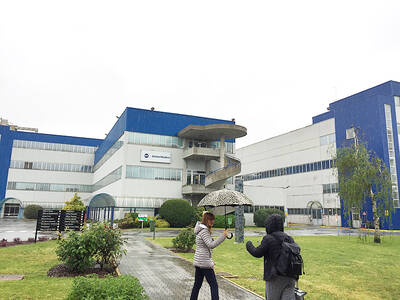
SECURING SUPPLY: Customers are seeking longer-term contracts, while the company discusses potential price hikes amid rising energy, logistics and labor costs, it said GlobalWafers Co (環球晶圓) on Tuesday said it expects revenue to grow at a “meaningful” rate next year, rather than in the second half of this year as previously anticipated, after a blaze at its fab in Novara, Italy, slowed its sales momentum. While the incident should have minimal impact on the company’s 8-inch wafer manufacturing equipment, production would take time to recover, the world’s third-largest silicon wafer supplier said. “Our revenue [this year] should be flat or slightly higher than last year ... because of the fire. Otherwise, we are supposed to have much higher revenue,” GlobalWafers chairperson Doris Hsu
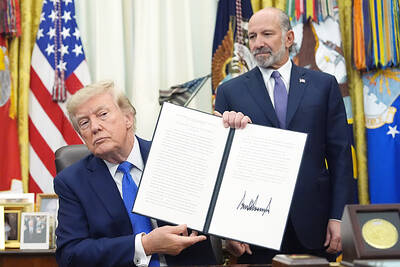
Taiwanese solar manufacturers yesterday said that new US import tariffs on silicon and related products would have a limited impact. The comments came after the White House on Thursday imposed a series of price floors and a 15 percent tariff on products made from polysilicon, the raw material used in semiconductors and solar panels that is primarily produced by China. US President Donald Trump’s decision under Section 232 of the Trade Expansion Act of 1962 is aimed at supporting domestic chip and solar supply chains needed to compete with Beijing on artificial intelligence and energy. Polysilicon, an ultra-pure form of silicon, sits at


 RSS
RSS