

Winbond Electronics Corp (華邦電) yesterday said it plans to start expanding its Kaohsiung fab next year to boost DRAM capacity as the artificial intelligence (AI) boom drives a memorychip supercycle.
Construction is scheduled to start in January, with pilot production set for the end of 2029, the company said.
The Module B fab would have an initial installed capacity of 10,000 12-inch wafers per month, with total capacity of 50,000 wafers per month, Winbond said.
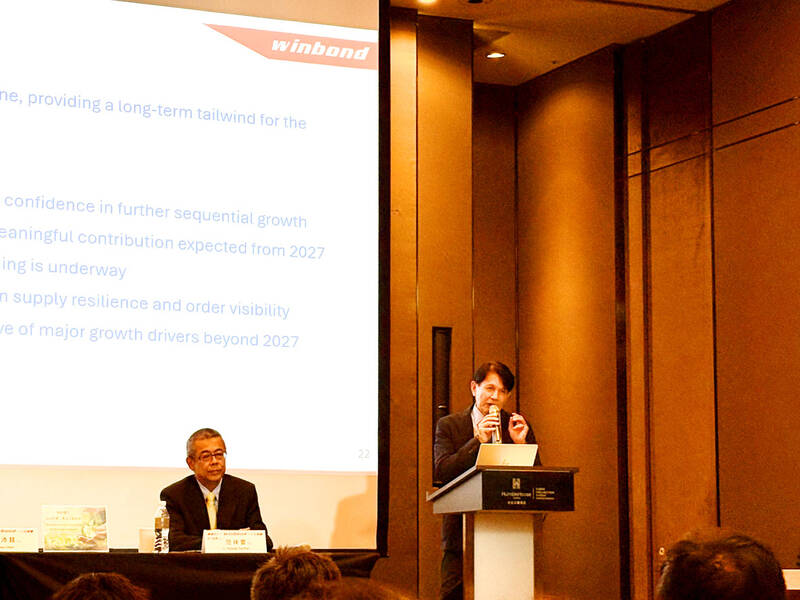
Photo: Lisa Wang, Taipei Times
The company plans to use extreme ultraviolet (EUV) lithography to further scale up DRAM production in the later phases of the expansion, it said.
The company did not disclose the expansion’s total capital expenditure or how it would be financed.
“We have a bullish view of the [upcycle]. There is the possibility that it will last longer as long as [our new fab] enters volume production from 2030,” Winbond president James Chen (陳沛銘) said on the sidelines of an earnings conference in Taipei. “I never thought we would need EUV equipment. Now we want to buy” a machine.
The company does not think the market consensus forecast that global DRAM capacity would grow 20 percent by 2028 would be enough to meet AI demand, given that AI development has largely outpaced industry expectations, he said.
“The DRAM supply should continue to be very tight,” Chen said, after the shortage has last for two-and-a-half years.
To mitigate supply constraints, Winbond plans to expand its Module A capacity to about 24,000 12-inch wafers per month by the end of this year, from the current 15,000 wafers per month.
The company expects supply constraints to extend to NOR and NAND flash memory chips, which are mostly produced at the company’s Taichung fab.
As customer demand continues to surge, Winbond expects memory prices to rise further this quarter, after soaring 100 percent quarter-on-quarter last quarter. That would further boost the gross margin of its memory business above last quarter’s 70.3 percent.
The company reported a consolidated gross margin of 66.2 percent last quarter, diluted by its logic-chip business of subsidiary Nuvoton Technology Corp (新唐).
Net profit last quarter soared 140.4 percent to NT$24.32 billion (US$753.9 million) from NT$10.11 billion in the first quarter, with the increase attributable to memory price hikes and strong demand for AI applications. That reversed a loss of NT$1.31 billion in the second quarter last year.
Earnings per share rose to NT$5.4 from NT$2.25 in the first quarter. It reported a loss per share of NT$0.29 a year earlier.
Revenue expanded 56.4 percent quarter-on-quarter, and 184.7 percent year-on-year, to NT$59.84 billion last quarter.

South Korea’s SK Hynix Inc is considering options for its Chongqing, China-based facility, including bringing in an investor to help accelerate growth, people with knowledge of the matter said. The company, a key supplier of high-bandwidth memory chips to Nvidia Corp, is speaking with prospective advisers to help review the business, the people said, asking not to be identified discussing private information. A potential stake sale could value the facility at about US$3 billion, the people said. The Chongqing facility provides a large scale semiconductor packaging and testing base, helping boost the company’s NAND flash back-end production to grow globally. Suitors may include

CATCHING UP: The market consensus of 20 percent growth in global DRAM capacity by 2028 would not meet AI demand, given AI’s rapid development, Winbond said Winbond Electronics Corp (華邦電) yesterday said it plans to start expanding its Kaohsiung fab next year to boost DRAM capacity as the artificial intelligence (AI) boom drives a memorychip supercycle. Construction is scheduled to start in January, with pilot production set for the end of 2029, the company said. The Module B fab would have an initial installed capacity of 10,000 12-inch wafers per month, with total capacity of 50,000 wafers per month, Winbond said. The company plans to use extreme ultraviolet (EUV) lithography to further scale up DRAM production in the later phases of the expansion, it said. The
‘IRREVERSIBLE TREND’: The AI boom would drive revenue growth in 2026 and 2027, but wafer price hikes would be steeper next year, a company executive said Foundry service provider Vanguard International Semiconductor Corp (世界先進) yesterday said that it is accelerating new capacity ramp-up to address "structural" chip demand amid the frenzy of artificial intelligence (AI) infrastructure deployment. The chipmaker, which focuses on producing power management chips, this year plans capital expenditure of NT$60 billion to NT$70 billion (US$1.85 billion to US$2.16 billion), moslty on a new 12-inch chip plant in Singapore, it said. “This has become an irreversible trend. It is structural growth, not [just] a short-term upcycle,” Vanguard chairman Fang Leuh (方略) told an earnings conference. “The AI demand is significantly exceeding the combined capacity that companies
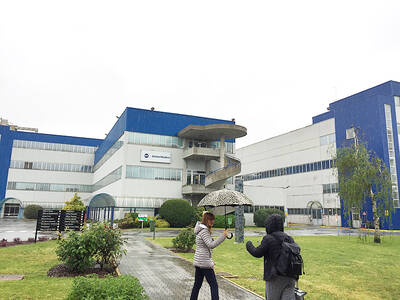
SECURING SUPPLY: Customers are seeking longer-term contracts, while the company discusses potential price hikes amid rising energy, logistics and labor costs, it said GlobalWafers Co (環球晶圓) on Tuesday said it expects revenue to grow at a “meaningful” rate next year, rather than in the second half of this year as previously anticipated, after a blaze at its fab in Novara, Italy, slowed its sales momentum. While the incident should have minimal impact on the company’s 8-inch wafer manufacturing equipment, production would take time to recover, the world’s third-largest silicon wafer supplier said. “Our revenue [this year] should be flat or slightly higher than last year ... because of the fire. Otherwise, we are supposed to have much higher revenue,” GlobalWafers chairperson Doris Hsu


 RSS
RSS