

Taiwanese investors stepped up regular monthly purchases of exchange-traded funds (ETFs) last month despite a sharp market pullback, suggesting that they viewed the volatility as a buying opportunity rather than a reason to retreat from equities, Taiwan Depository and Clearing Corp (TDCC, 台灣集中保管結算所) data showed.
The number of investors making regular purchases of ETFs increased 1.24 million last month from the previous month, TDCC data showed. So far this year, the figure has grown by 6.37 million, the data showed.
Of the 94 ETFs listed in Taiwan, investors in Yuanta/P-shares Taiwan Top 50 ETF (0050) rose by the most of 324,400, followed by Capital Taiex Daily Leveraged 2X ETF (00685L) by 185,700 and Yuanta/P-shares Taiwan Dividend Plus ETF (0056) by 91,200, the data showed.
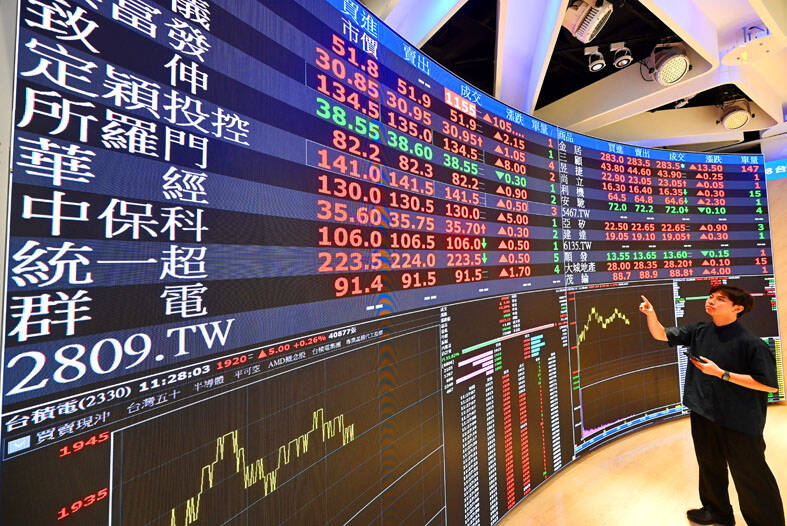
Photo: Tien Yu-hua, Taipei Times
The resilience of regular ETF investing highlights how the strategy has gained traction among retail investors. By investing a fixed amount regularly, investors gain more ETF units when prices fall, potentially lowering their average purchase cost over time.
Among the 10 most widely held ETFs, Capital Taiwan Growth ETF (00981A) posted the strongest return so far this year, gaining 76.29 percent including dividends, the data showed.
Cathay Taiwan Technology Leaders ETF (00881) ranked second with a 74.28 percent return, while Fubon Technology ETF (0052), which has a heavy weighting in Taiwan Semiconductor Manufacturing Co (台積電), gained 64.42 percent, the data showed.
The two major market-cap-weighted ETFs — Yuanta/P-shares Taiwan Top 50 ETF (0050) and Fubon FTSE TWSE Taiwan 50 (006208) — also delivered remarkable returns of more than 60 percent. By comparison, Capital Taiwan Selected High Dividend ETF (00919), a favorite among income-focused investors, posted a return of 43.57 percent year to date, the data showed.
The performance gap reflects a market increasingly driven by artificial-intelligence (AI) demand, as technology-heavy ETFs have benefited from sharp gains in Taiwan’s semiconductor and other technology stocks, while high-dividend funds generally have less exposure to some of the market’s strongest-performing growth shares.
Taiwan Stock Exchange said ETFs with heavier technology exposure have benefited disproportionately from the AI boom, while dividend-focused products have offered a different balance of income and diversification.
Still, the strong year-to-date gains of many ETFs provided a cushion against last month’s market pullback. For investors using regular monthly plans, the decline may have made ETFs even more attractive by allowing them to accumulate more units at lower prices, the exchange said.
Overall, the continued growth in regular ETF investment suggests that retail investors are increasingly treating the funds as a core vehicle for long-term equity exposure, and many appear willing to stay invested and use price declines to build their holdings rather than abandoning the market during periods of volatility, it said.

South Korea’s SK Hynix Inc is considering options for its Chongqing, China-based facility, including bringing in an investor to help accelerate growth, people with knowledge of the matter said. The company, a key supplier of high-bandwidth memory chips to Nvidia Corp, is speaking with prospective advisers to help review the business, the people said, asking not to be identified discussing private information. A potential stake sale could value the facility at about US$3 billion, the people said. The Chongqing facility provides a large scale semiconductor packaging and testing base, helping boost the company’s NAND flash back-end production to grow globally. Suitors may include

CATCHING UP: The market consensus of 20 percent growth in global DRAM capacity by 2028 would not meet AI demand, given AI’s rapid development, Winbond said Winbond Electronics Corp (華邦電) yesterday said it plans to start expanding its Kaohsiung fab next year to boost DRAM capacity as the artificial intelligence (AI) boom drives a memorychip supercycle. Construction is scheduled to start in January, with pilot production set for the end of 2029, the company said. The Module B fab would have an initial installed capacity of 10,000 12-inch wafers per month, with total capacity of 50,000 wafers per month, Winbond said. The company plans to use extreme ultraviolet (EUV) lithography to further scale up DRAM production in the later phases of the expansion, it said. The
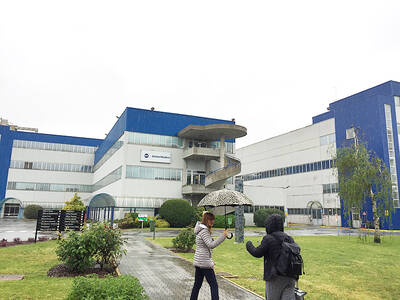
SECURING SUPPLY: Customers are seeking longer-term contracts, while the company discusses potential price hikes amid rising energy, logistics and labor costs, it said GlobalWafers Co (環球晶圓) on Tuesday said it expects revenue to grow at a “meaningful” rate next year, rather than in the second half of this year as previously anticipated, after a blaze at its fab in Novara, Italy, slowed its sales momentum. While the incident should have minimal impact on the company’s 8-inch wafer manufacturing equipment, production would take time to recover, the world’s third-largest silicon wafer supplier said. “Our revenue [this year] should be flat or slightly higher than last year ... because of the fire. Otherwise, we are supposed to have much higher revenue,” GlobalWafers chairperson Doris Hsu

Taiwanese solar manufacturers yesterday said that new US import tariffs on silicon and related products would have a limited impact. The comments came after the White House on Thursday imposed a series of price floors and a 15 percent tariff on products made from polysilicon, the raw material used in semiconductors and solar panels that is primarily produced by China. US President Donald Trump’s decision under Section 232 of the Trade Expansion Act of 1962 is aimed at supporting domestic chip and solar supply chains needed to compete with Beijing on artificial intelligence and energy. Polysilicon, an ultra-pure form of silicon, sits at


 RSS
RSS