

Overtime hours at Taiwan’s electronics companies hit their highest level for June since records began in 1980 as the artificial intelligence (AI) boom continues to drive demand, data released on Monday by the Directorate-General of Budget, Accounting and Statistics (DGBAS) showed.
Employees in the electronic components industry worked an average of 28.7 hours of overtime in June, far beyond the national average of 9.1 hours across the industrial and service sectors, the DGBAS said.
Average overtime in the computer and optoelectronics industry also reached a record high for June at 17.7 hours, the highest since 1980, the data showed.
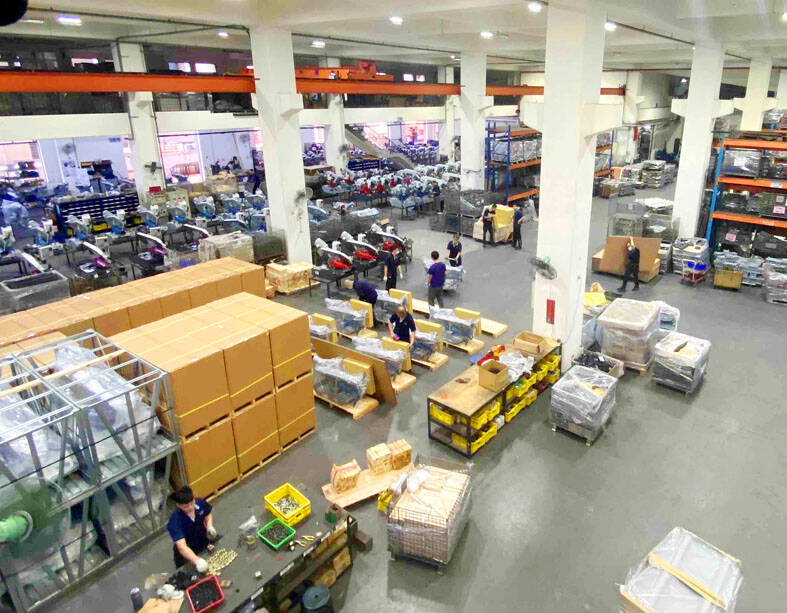
Photo: Huang Shu-lei, Taipei Times
The DGBAS said sustained global enthusiasm for AI has driven a surge in orders received by technology companies, prompting employers to rely heavily on overtime. It said that overtime hours are often a barometer of activity in the sector.
In June, average overtime in the manufacturing sector stood at 18.0 hours, up 0.5 hours from a year earlier, but down 0.3 hours from May. Across the industrial and service sectors, average overtime was 9.1 hours, up 0.5 hours year on year but down 0.2 hours from the previous month, the agency said.
For the first half of the year, average overtime nationwide stood at 9.1 hours, up 0.4 hours from a year earlier, while average overtime in the manufacturing sector rose 0.8 hours year on year to 17.8 hours, it said.
Employment in Taiwan’s industrial and service sectors was 8.58 million at the end of June, up 10,000, or 0.12 percent, from the end of May. Manufacturing reported the largest monthly increase, adding 4,000 jobs, the DGBAS said.
Within manufacturing, employment trends varied in June: The number of workers in the electronic components industry rose 0.6 percent from a month earlier and the number of employees in the computer and optoelectronics industry rose 0.27 percent, while employment in the rubber and plastics products industry fell 0.37 percent and employment in the plastics industry declined 0.13 percent, the data showed.
DGBAS Census Department Deputy Director-General Tan Wen-ling (譚文玲) said employment declines in some traditional industries indicated that conditions in those sectors needed time to improve.

South Korea’s SK Hynix Inc is considering options for its Chongqing, China-based facility, including bringing in an investor to help accelerate growth, people with knowledge of the matter said. The company, a key supplier of high-bandwidth memory chips to Nvidia Corp, is speaking with prospective advisers to help review the business, the people said, asking not to be identified discussing private information. A potential stake sale could value the facility at about US$3 billion, the people said. The Chongqing facility provides a large scale semiconductor packaging and testing base, helping boost the company’s NAND flash back-end production to grow globally. Suitors may include

CATCHING UP: The market consensus of 20 percent growth in global DRAM capacity by 2028 would not meet AI demand, given AI’s rapid development, Winbond said Winbond Electronics Corp (華邦電) yesterday said it plans to start expanding its Kaohsiung fab next year to boost DRAM capacity as the artificial intelligence (AI) boom drives a memorychip supercycle. Construction is scheduled to start in January, with pilot production set for the end of 2029, the company said. The Module B fab would have an initial installed capacity of 10,000 12-inch wafers per month, with total capacity of 50,000 wafers per month, Winbond said. The company plans to use extreme ultraviolet (EUV) lithography to further scale up DRAM production in the later phases of the expansion, it said. The
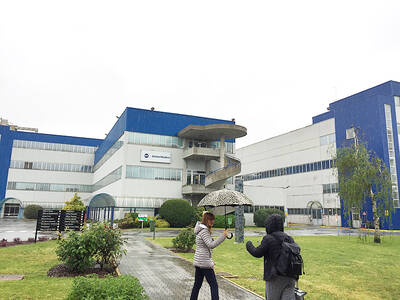
SECURING SUPPLY: Customers are seeking longer-term contracts, while the company discusses potential price hikes amid rising energy, logistics and labor costs, it said GlobalWafers Co (環球晶圓) on Tuesday said it expects revenue to grow at a “meaningful” rate next year, rather than in the second half of this year as previously anticipated, after a blaze at its fab in Novara, Italy, slowed its sales momentum. While the incident should have minimal impact on the company’s 8-inch wafer manufacturing equipment, production would take time to recover, the world’s third-largest silicon wafer supplier said. “Our revenue [this year] should be flat or slightly higher than last year ... because of the fire. Otherwise, we are supposed to have much higher revenue,” GlobalWafers chairperson Doris Hsu
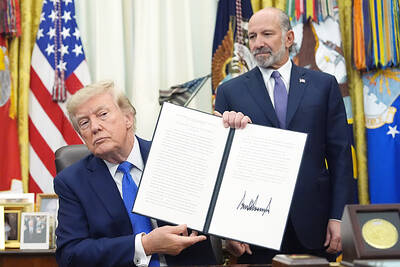
Taiwanese solar manufacturers yesterday said that new US import tariffs on silicon and related products would have a limited impact. The comments came after the White House on Thursday imposed a series of price floors and a 15 percent tariff on products made from polysilicon, the raw material used in semiconductors and solar panels that is primarily produced by China. US President Donald Trump’s decision under Section 232 of the Trade Expansion Act of 1962 is aimed at supporting domestic chip and solar supply chains needed to compete with Beijing on artificial intelligence and energy. Polysilicon, an ultra-pure form of silicon, sits at


 RSS
RSS