

Taiwan’s tax revenue was robust in the first seven months of this year, fueled by a stock-market boom and strong corporate earnings, even as last month’s collections declined because of an unusually high comparison base created by last year’s extended income-tax filing deadline, the Ministry of Finance said yesterday.
Tax revenue was NT$289.1 billion (US$8.96 billion) last month, down 67 percent from a year earlier, the ministry’s data showed.
“The sharp decline was largely a statistical effect rather than a sign of weakening collections,” ministry statistician Liu Shun-rong (劉訓蓉) said.
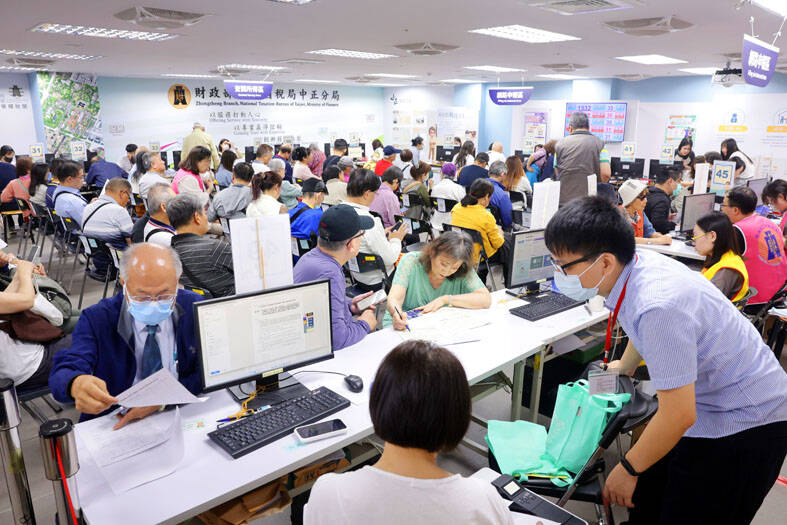
Photo: CNA
For the first seven months of the year, revenue was NT$2.88 trillion, or 72.9 percent of the full-year budget target, putting collections 15.6 percentage points ahead of the government’s budget schedule, Liu said.
The figures highlight the strength of tax receipts despite the sharp monthly swings, she said.
Securities transaction tax was a key driver in tax revenue last month amid investors’ heavy trading in Taiwanese stocks, fueled by strong demand for artificial intelligence-related companies, the data showed.
Average daily trading turnover on Taiwan’s stock market surged 1.8 times the value of a year earlier to NT$1.15 trillion last month, lifting securities transaction tax revenue 1.7 times to NT$65.1 billion.
For the first seven months, securities transaction tax revenue jumped 1.9 times to NT$398.7 billion, reaching 277 percent of the government’s budget target for the period, the ministry said.
Corporate income tax revenue remained strong, rising 24.1 percent from a year earlier to NT$788.9 billion in the first seven months, mainly reflecting higher tax payments by companies, the ministry said.
Individual income tax revenue increased 11.2 percent to NT$689.9 billion in that same period, it said.
From January to last month, business tax collections climbed 20.8 percent to NT$487.2 billion, helped by steady domestic spending and higher taxes on imports of information and communications technology and audiovisual products, as well as electronic components.
However, land value increment tax revenue was a notable exception, falling 8.5 percent to NT$39.2 billion during the first seven months as property transactions declined, Liu said.
The ministry expects tax revenue to remain elevated this year, supported by strong stock-market turnover and resilient exports from Taiwan’s technology and industrial sectors.

South Korea’s SK Hynix Inc is considering options for its Chongqing, China-based facility, including bringing in an investor to help accelerate growth, people with knowledge of the matter said. The company, a key supplier of high-bandwidth memory chips to Nvidia Corp, is speaking with prospective advisers to help review the business, the people said, asking not to be identified discussing private information. A potential stake sale could value the facility at about US$3 billion, the people said. The Chongqing facility provides a large scale semiconductor packaging and testing base, helping boost the company’s NAND flash back-end production to grow globally. Suitors may include

WELL MATCHED: The joint venture would lower Sony’s spending burden to stay relevant in chips, while TSMC secures steady revenue, said an analyst, calling it ‘virtually risk-free’ Taiwan Semiconductor Manufacturing Co (TSMC, 台積電) and Sony Group Corp are in talks to spend a combined ¥1 trillion (US$6.3 billion) on their planned image sensor factory in Japan, a person familiar with the matter said. The companies are seeking to begin production in 2029, the person said, asking not to be named because the talks are private. No time frame was given for the investment under discussion, they said. TSMC and the Japanese company’s chip arm, Sony Semiconductor Solutions Corp, are eyeing demand for artificial intelligence (AI)-wielding robots and self-driving vehicles, which are expected to require more sensors to
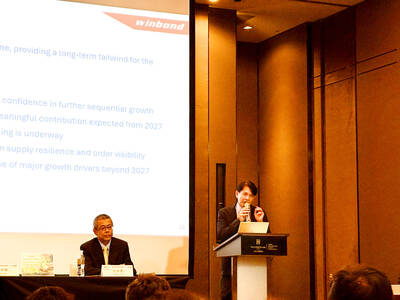
CATCHING UP: The market consensus of 20 percent growth in global DRAM capacity by 2028 would not meet AI demand, given AI’s rapid development, Winbond said Winbond Electronics Corp (華邦電) yesterday said it plans to start expanding its Kaohsiung fab next year to boost DRAM capacity as the artificial intelligence (AI) boom drives a memorychip supercycle. Construction is scheduled to start in January, with pilot production set for the end of 2029, the company said. The Module B fab would have an initial installed capacity of 10,000 12-inch wafers per month, with total capacity of 50,000 wafers per month, Winbond said. The company plans to use extreme ultraviolet (EUV) lithography to further scale up DRAM production in the later phases of the expansion, it said. The

China’s humanoid robot makers commanded more than 97 percent of global shipments in the first half of this year, according to new industry data affirming the country’s early lead against US rivals in the burgeoning field. Global humanoid robot shipments totaled about 19,100 units in the first half of this year, more than triple the 5,100 units shipped in the same period last year, data from Smart Analytics Global showed. The California-based research firm said it expects shipments to rise to around 60,000 units this year and reach 500,000 by 2030. Agibot Innovation (Shanghai) Technology Co (智元創新) overtook Hangzhou-based Unitree


 RSS
RSS