

Compal Electronics Inc (仁寶電腦) yesterday said it expects artificial intelligence (AI) servers to account for 30 to 40 percent of revenue next year, up from about 10 percent this year, as it expands production capacity in Taiwan, the US and Vietnam.
In the first quarter, server revenue was NT$10 billion (US$309.8 million), accounting for 5 percent of the company’s revenue, Compal chairman Ray Chen (陳瑞聰) told reporters as the company inaugurated its new plant in Taoyuan's Daxi District (大溪).
“We are targeting triple-digit annual growth for our AI-related business this year and next year,” Chen said.
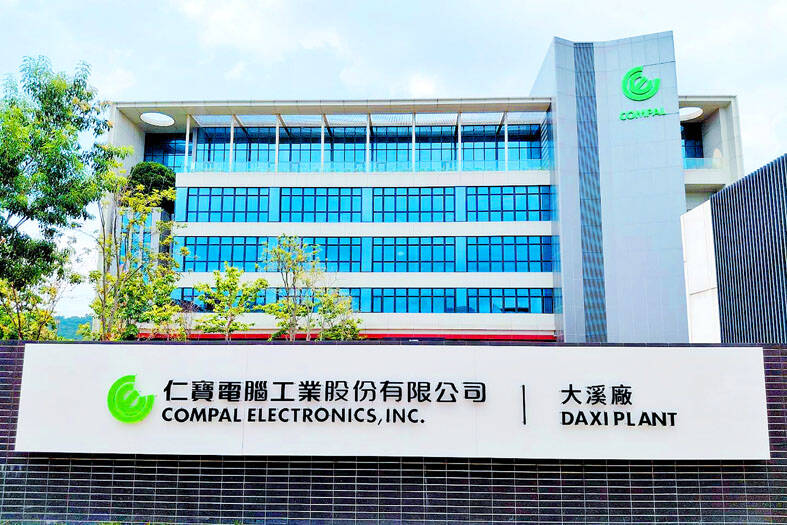
Photo: CNA
Compal in May said it would invest NT$4.03 billion (US$124.89 million) in the Daxi plant, covering property acquisition, plant renovation and advanced manufacturing equipment.
The new plant would serve as a key site for Compal’s AI server research, development and production, featuring fully automated production lines for Level 10 (L10) AI server systems and Level 11 (L11) server racks, Chen said yesterday.
It should start contributing revenue from next quarter, he said.
Amid strong demand for AI servers, Compal expects the new plant to reach full utilization as early as the second half of next year, Chen said.
The company is evaluating AI server capacity expansion in Taoyuan, although the location and scale have yet to be determined, he added.
Compal’s AI server business remains focused on L10 products, with shipments mainly to neocloud customers such as GMI Cloud and Verda, while L11 shipments are slated to begin next quarter, he said.
Alongside expansion in Taiwan, Compal is increasing AI server capacity in Vietnam and Texas, Chen said.
In Vietnam, where Compal mainly handles Level 6 (L6) server node production, the company operates four surface-mount technology lines and plans to add another six, with construction of its second factory nearing completion, he said.
Compal is building two plants in Taylor and Georgetown, Texas, focused on the production of L6, L10 and L11 models. Trial production is slated to begin next quarter, followed by mass production in the first quarter of next year, Chen said.
The company had planned to ship some L6 products from Vietnam to Texas for assembly, but is adding L6 capacity in Texas as some US customers seek more localized production, he said.
The move would allow Compal to handle production from L6 through L11 rack-level integration in Texas, he said.
The Texas plants would mainly serve US hyperscalers and enterprise customers, while Taiwan primarily serves neocloud customers, Chen said.
The PC industry faces headwinds this year from tight DRAM supply and rising component costs, with International Data Corp forecasting global PC shipments to fall 10 to 12 percent year-on-year.
Chen said DRAM supply is likely to remain tight next year, but rising component costs are pushing up average selling prices, meaning Compal’s PC revenue might not fall at the same pace as shipments.

South Korea’s SK Hynix Inc is considering options for its Chongqing, China-based facility, including bringing in an investor to help accelerate growth, people with knowledge of the matter said. The company, a key supplier of high-bandwidth memory chips to Nvidia Corp, is speaking with prospective advisers to help review the business, the people said, asking not to be identified discussing private information. A potential stake sale could value the facility at about US$3 billion, the people said. The Chongqing facility provides a large scale semiconductor packaging and testing base, helping boost the company’s NAND flash back-end production to grow globally. Suitors may include

WELL MATCHED: The joint venture would lower Sony’s spending burden to stay relevant in chips, while TSMC secures steady revenue, said an analyst, calling it ‘virtually risk-free’ Taiwan Semiconductor Manufacturing Co (TSMC, 台積電) and Sony Group Corp are in talks to spend a combined ¥1 trillion (US$6.3 billion) on their planned image sensor factory in Japan, a person familiar with the matter said. The companies are seeking to begin production in 2029, the person said, asking not to be named because the talks are private. No time frame was given for the investment under discussion, they said. TSMC and the Japanese company’s chip arm, Sony Semiconductor Solutions Corp, are eyeing demand for artificial intelligence (AI)-wielding robots and self-driving vehicles, which are expected to require more sensors to

China’s humanoid robot makers commanded more than 97 percent of global shipments in the first half of this year, according to new industry data affirming the country’s early lead against US rivals in the burgeoning field. Global humanoid robot shipments totaled about 19,100 units in the first half of this year, more than triple the 5,100 units shipped in the same period last year, data from Smart Analytics Global showed. The California-based research firm said it expects shipments to rise to around 60,000 units this year and reach 500,000 by 2030. Agibot Innovation (Shanghai) Technology Co (智元創新) overtook Hangzhou-based Unitree
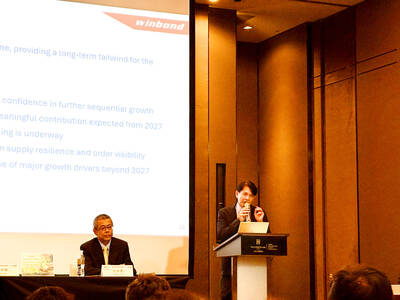
CATCHING UP: The market consensus of 20 percent growth in global DRAM capacity by 2028 would not meet AI demand, given AI’s rapid development, Winbond said Winbond Electronics Corp (華邦電) yesterday said it plans to start expanding its Kaohsiung fab next year to boost DRAM capacity as the artificial intelligence (AI) boom drives a memorychip supercycle. Construction is scheduled to start in January, with pilot production set for the end of 2029, the company said. The Module B fab would have an initial installed capacity of 10,000 12-inch wafers per month, with total capacity of 50,000 wafers per month, Winbond said. The company plans to use extreme ultraviolet (EUV) lithography to further scale up DRAM production in the later phases of the expansion, it said. The


 RSS
RSS