

Qisda Corp’s (佳世達) revenue is expected to improve sequentially this quarter, driven by growth in its business solutions, medical and artificial intelligence (AI) infrastructure products, after second-quarter revenue fell 1 percent year-on-year to NT$52.73 billion (US$1.64 billion), Qisda chairman Peter Chen (陳其宏) said yesterday.
As growth momentum is projected to continue through the rest of this year, revenue in the second half is expected to surpass NT$104.3 billion in the first half, Chen told an online earnings conference.
In the first half, its information technology (IT) business, including projectors, monitors and displays, accounted for 42 percent of total revenue, followed by business solutions at 21 percent, medical at 15 percent, networking and communications at 10 percent, high-value-added IT at 7 percent and others at 5 percent, company data showed.
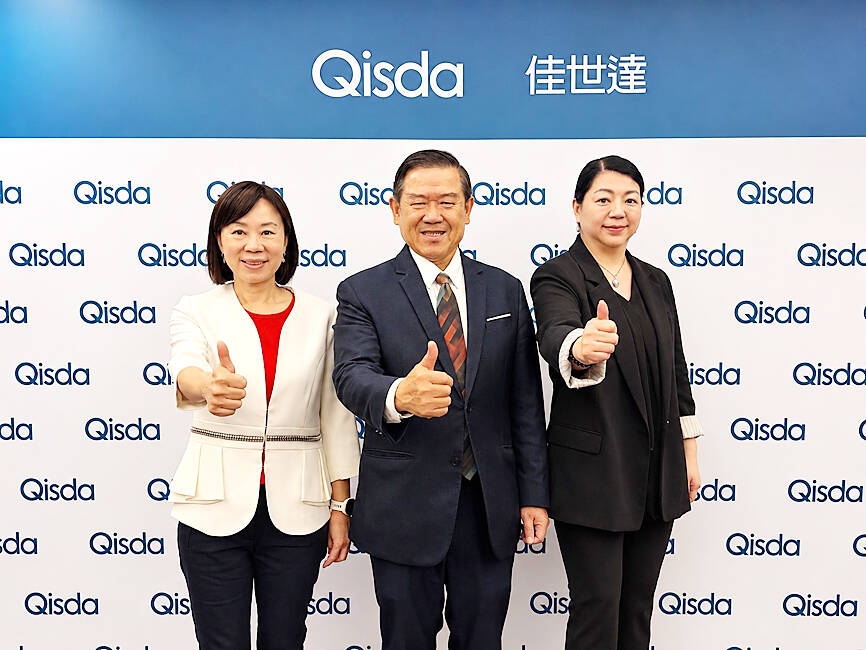
Photo: CNA
Business solutions, which include AI server products, are expected to post the strongest growth in the second half, followed by the medical business and the networking and communications business, Chen said.
Qisda has received orders for new AI server products through subsidiary AEWIN Technologies Co Ltd (其陽科技), with shipments expected to begin next quarter, he said.
The company is also developing liquid-cooled AI servers and cooling products, including a two-phase direct liquid-cooling solution, and is preparing to deliver samples to customers, he said.
Qisda has also expanded into high-speed networking switches for AI data centers, with samples of its 1.6-terabit switches expected to be delivered to a major North American customer by the end of this month, Chen said.
Small-volume shipments are slated to begin by the end of this year, he added.
The company expects AI products to make a more meaningful contribution to its revenue and profit next year if small-volume production proceeds smoothly this year, he said.
Amid sluggish demand for desktop monitors in its IT business, Qisda would increasingly focus on AI vision and display applications, AI infrastructure, AI solutions and smart manufacturing, and AI-related healthcare products, Qisda president Cally Ko (柯淑芬) said.
That includes high-end, rugged and medical displays for AI vision and display applications, autonomous mobile robots for smart manufacturing, smart retail solutions for cashierless stores, and ultrasound systems, intelligent rehabilitation systems and liquid biopsy products for healthcare, she said.
Qisda reported that net profit last quarter surged 87 percent quarter-on-quarter and 67 percent year-on-year to NT$594 million. Earnings per share rose to NT$0.38 from NT$0.20 in the previous quarter and NT$0.18 a year earlier, and gross margin improved to 17.27 percent from 16.67 percent in the previous quarter and 16.14 percent a year earlier.
South Korea’s SK Hynix Inc is considering options for its Chongqing, China-based facility, including bringing in an investor to help accelerate growth, people with knowledge of the matter said. The company, a key supplier of high-bandwidth memory chips to Nvidia Corp, is speaking with prospective advisers to help review the business, the people said, asking not to be identified discussing private information. A potential stake sale could value the facility at about US$3 billion, the people said. The Chongqing facility provides a large scale semiconductor packaging and testing base, helping boost the company’s NAND flash back-end production to grow globally. Suitors may include
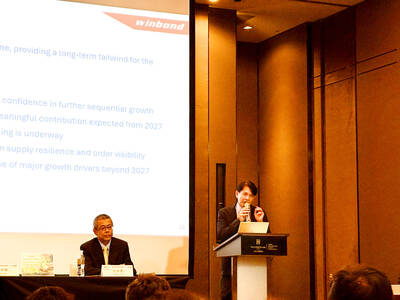
CATCHING UP: The market consensus of 20 percent growth in global DRAM capacity by 2028 would not meet AI demand, given AI’s rapid development, Winbond said Winbond Electronics Corp (華邦電) yesterday said it plans to start expanding its Kaohsiung fab next year to boost DRAM capacity as the artificial intelligence (AI) boom drives a memorychip supercycle. Construction is scheduled to start in January, with pilot production set for the end of 2029, the company said. The Module B fab would have an initial installed capacity of 10,000 12-inch wafers per month, with total capacity of 50,000 wafers per month, Winbond said. The company plans to use extreme ultraviolet (EUV) lithography to further scale up DRAM production in the later phases of the expansion, it said. The
‘IRREVERSIBLE TREND’: The AI boom would drive revenue growth in 2026 and 2027, but wafer price hikes would be steeper next year, a company executive said Foundry service provider Vanguard International Semiconductor Corp (世界先進) yesterday said that it is accelerating new capacity ramp-up to address "structural" chip demand amid the frenzy of artificial intelligence (AI) infrastructure deployment. The chipmaker, which focuses on producing power management chips, this year plans capital expenditure of NT$60 billion to NT$70 billion (US$1.85 billion to US$2.16 billion), moslty on a new 12-inch chip plant in Singapore, it said. “This has become an irreversible trend. It is structural growth, not [just] a short-term upcycle,” Vanguard chairman Fang Leuh (方略) told an earnings conference. “The AI demand is significantly exceeding the combined capacity that companies

Taiwanese solar manufacturers yesterday said that new US import tariffs on silicon and related products would have a limited impact. The comments came after the White House on Thursday imposed a series of price floors and a 15 percent tariff on products made from polysilicon, the raw material used in semiconductors and solar panels that is primarily produced by China. US President Donald Trump’s decision under Section 232 of the Trade Expansion Act of 1962 is aimed at supporting domestic chip and solar supply chains needed to compete with Beijing on artificial intelligence and energy. Polysilicon, an ultra-pure form of silicon, sits at


 RSS
RSS