

Solomon Technology Corp (所羅門) is expanding its artificial intelligence (AI)-powered systems for humanoid robots, with chairman Johnny Chen (陳政隆) saying that the company aims to address one of the biggest hurdles to wider adoption — machine perception.
Rather than manufacturing humanoid robots, Solomon develops AI-powered 3D vision modules and machine vision software that enable robots to perceive, understand and interact with their surroundings.
The company is also applying the technology to drones, autonomous mobile robots (AMRs) and industrial inspection systems.
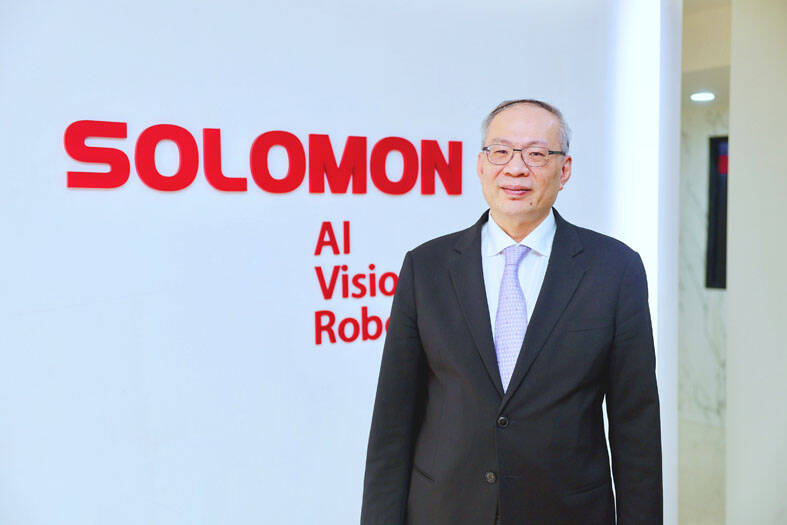
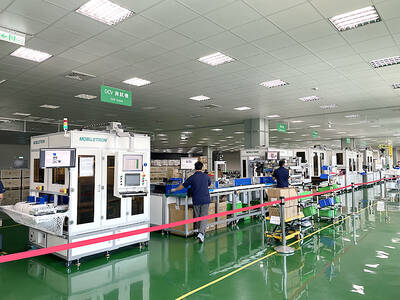
Photo: CNA
In an interview, Chen cited an intelligent drone inspection system for solar farms in southern Taiwan as one of Solomon’s latest commercial applications.
Drones equipped with the company’s 3D machine vision and AI software can automatically detect obstructions on solar panels that reduce power generation, he said.
The drones identify potential problems during aerial inspections and transmit high-resolution images to maintenance crews, allowing faults to be addressed more quickly and improving the efficiency of solar farm operations, according to Chen.
The same AI vision technology has also been deployed in AMRs, robotic arms, pan-tilt-zoom cameras and quadruped robots used in industrial inspection projects in markets including the US and Japan, he said.
Humanoid robots must combine three core capabilities to perform practical industrial tasks: reasoning, active perception and action, Chen said.
Although advances in large language models and vision-language models have improved robots’ ability to understand instructions, perception remains a major challenge because robots still struggle to identify distant or partially obscured objects in complex environments, he said.
To address the problem, Solomon has developed generative AI vision technology that uses synthetic images to train AI models, reducing training time while improving robots’ ability to recognize unfamiliar objects and adapt to different real-world scenarios.
The company has also developed an “active perception” system that replaces conventional single-image recognition with a continuous cycle of searching, selecting, zooming and evaluating before searching again if necessary.
The approach enables robots to identify objects from several meters away before moving closer, reducing unnecessary movement and improving accuracy, Chen said.
During a rare public demonstration at its headquarters, Solomon showcased a bipedal humanoid robot that received spoken or written instructions, located an object about five meters away using its vision system, moved toward it and grasped it without relying on pre-programmed scripts.
The robot also read analog gauges, counted inventory items and relocated objects that had been moved, demonstrating the integration of reasoning, perception and action, the company said.
Unlike many industry demonstrations that rely on edited videos or remote control, Solomon’s robot completed the tasks autonomously after receiving human instructions, the company said.
AI software for humanoid robots is advancing more quickly than hardware, and broader commercial adoption is likely to begin in 2028, Chen said.
He expects logistics and warehousing to be among the first sectors to deploy the technology, with hybrid robots featuring a humanoid upper body and wheeled base likely to meet operational and safety requirements more effectively.
Taiwanese manufacturers already have strengths in key humanoid robot components, including gear reducers, joint modules, sensors and servo motors, although opportunities remain to develop complete robotic systems, Chen said.
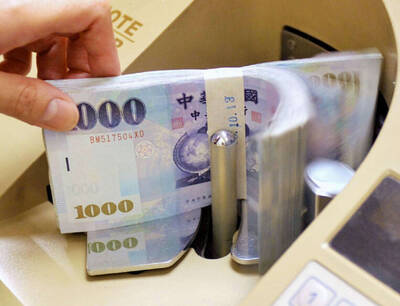
TURBULENCE: Many Taiwanese exporters took advantage of a weaker NT dollar to sell US dollars, while the central bank stepped in late to smooth volatility, dealers said The New Taiwan dollar fell sharply against the US dollar yesterday to move past NT$32.4 due to large fund outflows, dealers said. The NT dollar dropped NT$0.146 to close at NT$32.438 against the US dollar after reaching an intraday low of NT$32.490. Combined turnover on the Taiwan Foreign Exchange and the Cosmos Foreign Exchange totaled US$3.92 billion. The US dollar initially weakened against the NT dollar as the US dollar index, which tracks the greenback against the currencies of six major trading partners, declined, dealers said. However, after the US dollar dipped to the day’s low, the currency rebounded as
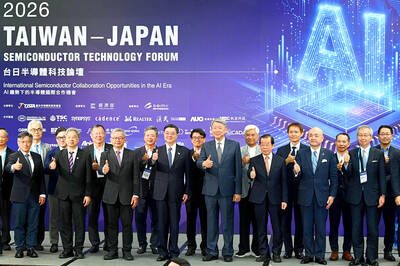
Artificial intelligence (AI) is reshaping competition in the semiconductor industry, shifting the focus beyond transistor scaling to advanced packaging, materials and system-level integration, experts said at a Taiwan-Japan semiconductor technology forum yesterday. Taiwan Semiconductor Research Institute (TSRI) deputy director-general Tsai Hann-huei (蔡瀚輝) said advances in process-node technology were slowing while AI-driven demand for bandwidth continued to surge. “Leadership will come from system-level co- optimization, not transistor scaling alone,” Tsai said at the forum in Taipei. Future semiconductor systems will increasingly need to combine computing, sensing, power management and connectivity for applications such as automobiles, humanoid robots, AI glasses and drones, according to his
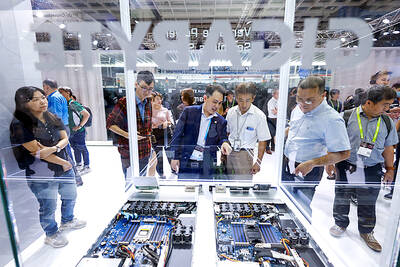
Global artificial intelligence (AI) server shipments are expected to grow 31 percent this year to nearly 2.8 million units, driven by surging investment in AI infrastructure by major cloud service providers (CSPs) and stronger demand for rack-scale AI server systems, TrendForce Corp (集邦科技) said yesterday. The forecast is an increase from the 28 percent growth TrendForce predicted in January, when it said global AI server shipments could reach more than 2.7 million units this year. Combined capital expenditures by the world’s nine major CSPs are expected to grow about 90 percent to exceed US$886.7 billion this year, the Taipei-based research
GROWING PAINS: Despite improving orders, manufacturers still face challenges such as shortages of key materials, rising input costs and prolonged delivery times, CIER said Taiwan’s manufacturing activity accelerated last month, as robust demand for artificial intelligence (AI) applications and semiconductors continued to lift orders and production despite persistent supply constraints. The Taiwan manufacturing purchasing managers’ index (PMI) climbed 0.8 points from the previous month to 61.5, marking the 10th consecutive month of expansion and the highest reading since September 2021, a report released yesterday by the Chung-Hua Institution for Economic Research (CIER, 中華經濟研究院) showed. Among the major components, new orders and production stayed firmly in expansion territory at 63.3 and 62.7 respectively, while supplier delivery times lengthened further. Employment and inventories also continued to


 RSS
RSS