

The Taiwan Stock Exchange (TWSE) on Monday eased the rules governing the cooling period for “disposition stocks,” effective from Monday next week.
The cooling period for a stock placed in disposition would be shortened to five trading sessions from 10 trading sessions, the exchange said.
The matching interval would be cut to two minutes from five minutes for a stock that is designated as a disposition stock for the first time, it said.
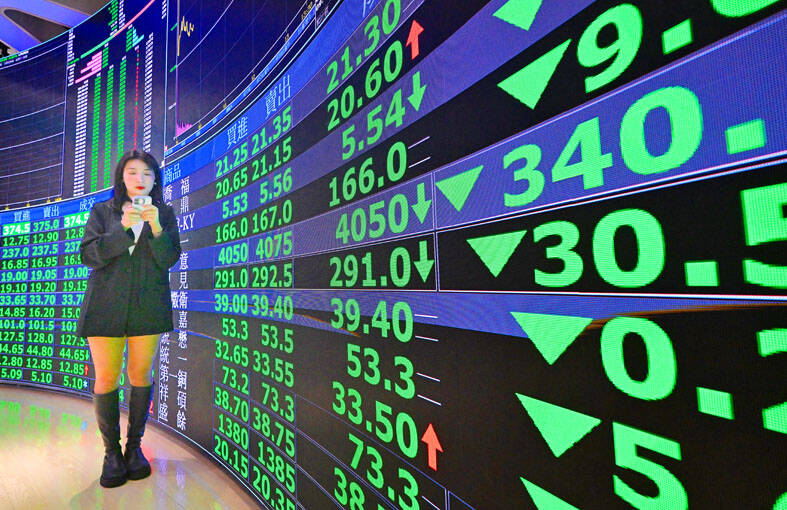
Photo: Fang Pin-chao, Taipei Times
For stocks designated as disposition stocks for the second time, the matching interval would be shortened to two minutes from 20 minutes, it said.
Disposition stocks are those that have shown extreme volatility and are subject to trading restrictions to cool them down. The restrictions include using manual rather than automatic matching of buy and sell offers, and increasing the matching interval, the TWSE said.
The exchange’s rules stipulate that a company’s stock must be placed on a watch list if it rises or falls more than 25 percent in six trading sessions; has an accumulated turnaround rate topping 50 percent in six trading sessions; has a single-session turnaround rate that tops 5 percent; or has a single-session turnover greater than five times the average of the previous 60 sessions.
A stock is designated as a disposition stock if those conditions persist for three consecutive trading sessions, for six trading sessions in 10 trading days, or for 12 trading days within 30 trading days, the exchange said.
The disposition stock regulations were put in place in 1995 to raise awareness among investors of risks in times of volatile trading, TWSE senior executive vice president Tu Hui-chuan (杜惠娟) said.
The exchange expects the adjustments to continue to be a reminder of risks for investors and help maintain liquidity in the market, Tu said.
The TWSE plans to set up a review mechanism in which the exchange would, in principle, review the rules every six months, she said.
Critics have argued that the previous rules made it difficult for investors who wanted to trim their positions by taking advantage of technical rebounds at a time when the local stock market faced volatility.
The easing of disposition rules could reduce panic-led selling in a down market and moderate losses suffered by investors holding stocks placed in disposition, Fubon Securities Investment Services Co (富邦投顧) chairman Edward Chen (陳奕光) said.
However, the changes could cut both ways, as risks would increase in a volatile market in which investors are no longer protected by a 10-day cooling period, Chen said.
It would also be easier for major market players to dictate the market by taking advantage of the adjustments, he added.
Taiwan Securities Association chairman Joey Chen (陳俊宏) praised the TWSE for promptly responding to investors’ demands by adjusting the disposition stock rules, saying the rule changes would help investors weather market volatility.
The TAIEX plunged 4,917.51 points, or 10.96 percent, in just five sessions from July 24 to Thursday last week before rebounding on Friday, when the market posted a record single-session point gain of 3,186.45.

When rival hedge funds face catastrophic losses, billionaire investor Ken Griffin has a habit of identifying opportunities and showing up with a checkbook. Citadel’s founder last week reprised his role as one of Wall Street’s rescue buyers, stepping in to salvage California hedge fund Situational Awareness as it buckled under souring bets on artificial intelligence (AI) stocks. Amid market rumblings that at least one firm was in trouble, Griffin, 57, assembled his top lieutenants to investigate, five people with knowledge of the matter said. By Wednesday morning, Citadel executives had reached out to Situational Awareness, and Griffin spoke directly with Leopold Aschenbrenner,
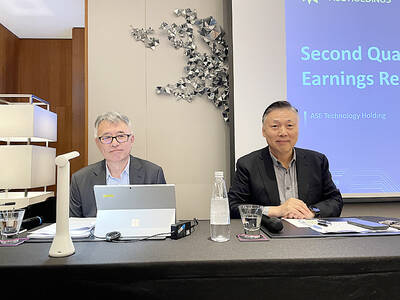
‘STRONGER DEMAND’ : Company executives said that a lot of new investments are needed, although there are capacity bottlenecks for automation and innovation ASE Technology Holding Co (日月光投控) yesterday increased its capital expenditure for this year to US$10.5 billion, up 23.5 percent from its previous budget of US$8.5 billion, amid robust demand for artificial intelligence (AI) applications. The world’s largest supplier of packaging and testing services plans to allocate about 70 percent of the increased spending to capacity expansion, mainly for leading-edge advanced packaging (LEAP) technology, with LEAP revenue forecast to exceed US$3.5 billion this year, ASE said. “Obviously we are seeing a stronger demand ... from not just customers, but also our foundry partner,” ASE chief financial officer Joseph Tung (董宏思) told an earnings
This year's Fortune Global 500 ranking listed Taiwan Semiconductor Manufacturing Co (TSMC, 台積電) among its top 100 companies for the first time. TSMC climbed 44 places to 82nd, with revenue of US$122.26 billion, a report published on Tuesday by New York-based Fortune magazine said. TSMC's entry into the top 100 for the first time underscored how surging demand for advanced chips is reshaping the scale and influence of companies in Asia and around the world, the report said. Besides TSMC, Taiwanese electronics manufacturer Wistron Corp (緯創) climbed 298 places to 198th on this year's list — the largest jump among all companies ranked
RUNNING HOT: The contract chipmaker is planning to both deepen and broaden its capacity, with more facility space and more advanced chips on offer United Microelectronics Corp (UMC, 聯電), the world’s fourth-largest contract chipmaker, plans to invest US$5 billion over the next two to three years to expand silicon photonics and advanced packaging capacity as artificial intelligence (AI)-driven demand accelerates. The company views silicon photonics and advanced packaging as vital businesses to its growth, and expects AI-related revenue to reach about US$300 million this year and surpass US$1 billion in three years, it said yesterday. “We actually feel pretty optimistic about advanced packaging, and that’s why we started facility deployment,” UMC CEO Jason Wang (王石) said at an earnings conference. “The overall [advanced packaging] addressable market


 RSS