

When rival hedge funds face catastrophic losses, billionaire investor Ken Griffin has a habit of identifying opportunities and showing up with a checkbook. Citadel’s founder last week reprised his role as one of Wall Street’s rescue buyers, stepping in to salvage California hedge fund Situational Awareness as it buckled under souring bets on artificial intelligence (AI) stocks.
Amid market rumblings that at least one firm was in trouble, Griffin, 57, assembled his top lieutenants to investigate, five people with knowledge of the matter said.
By Wednesday morning, Citadel executives had reached out to Situational Awareness, and Griffin spoke directly with Leopold Aschenbrenner, the fund’s young founder and a former OpenAI researcher.
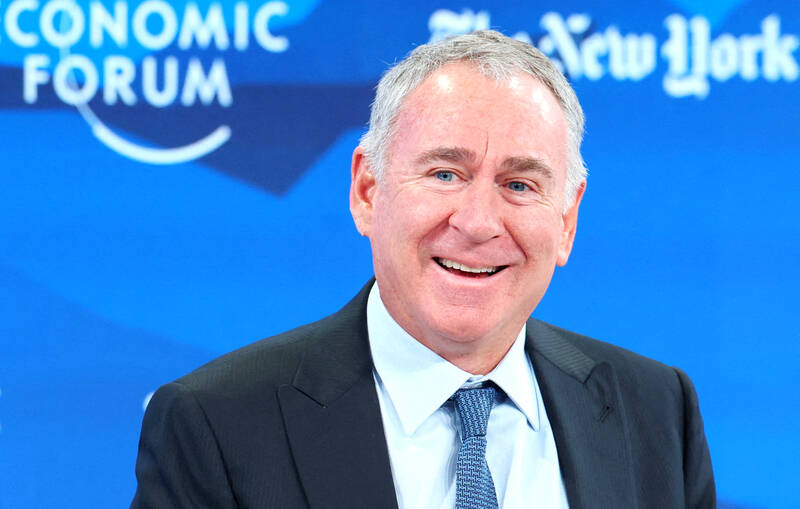
Photo: Reuters
Together with Citadel co-chief investment officer Pablo Salame, chief operating officer Gerald Beeson, Perry Vais, its head of equity quantitative research, and chief legal officer Shawn Fagan, Griffin pulled an all-nighter to analyze the trading book positions of Situational Awareness and how liquid the bets were, the sources said. After a selloff in AI stocks, the Situational Awareness portfolio lost 67 percent of its value last month, and the fund was forced to unwind most of its US$16 billion public equities book. By Thursday, Citadel had bought a chunk of its book.
“We let you down,” Aschenbrenner wrote to his investors in a letter seen by Reuters.
“We worked to keep the portfolio within our risk parameters, but gradually this became more difficult as positions rapidly moved against us and market liquidity dried up,” Aschenbrenner wrote in a letter to investors on late Thursday. “I take full responsibility for these events,” he said. “We took the steps that were necessary to fight another day.”
Word spread quickly on Wall Street that Citadel, one of the world’s largest hedge funds which prides itself on disciplined risk-taking and seizing market opportunities, had stepped in. Forbes estimates Griffin’s personal fortune at about US$52 billion.
“There are only a few firms that could take down this much risk,” one investor familiar with the situation said.
It was a familiar Citadel play, and one that Griffin has refined over the decades: see a firm in distress, swoop in fast, snag a great deal.
“Citadel isn’t acting as a white knight — it’s making calculated investments,” said Bruno Schneller, managing partner at multifamily office Erlen Capital Management AG. “Whether you describe that as being a savior or a vulture probably depends on your perspective, but it’s better understood as a sophisticated provider of crisis capital than either.”
Reuters could not ascertain how much money Citadel had made on the deal, although many AI stocks in the portfolio have risen since.
Representatives for Citadel and Situational Awareness declined to comment.
Additional reporting by Bloomberg
This year's Fortune Global 500 ranking listed Taiwan Semiconductor Manufacturing Co (TSMC, 台積電) among its top 100 companies for the first time. TSMC climbed 44 places to 82nd, with revenue of US$122.26 billion, a report published on Tuesday by New York-based Fortune magazine said. TSMC's entry into the top 100 for the first time underscored how surging demand for advanced chips is reshaping the scale and influence of companies in Asia and around the world, the report said. Besides TSMC, Taiwanese electronics manufacturer Wistron Corp (緯創) climbed 298 places to 198th on this year's list — the largest jump among all companies ranked
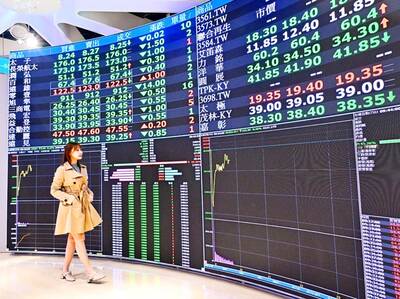
CRASH DIVE: Tech stocks across Asia are taking it in the teeth among war-induced uncertainties, worries about a bubble and more, as the TAIEX plunged precipitously The TAIEX suffered its third-largest point decline on record yesterday as investors continued a global retreat from tech shares amid concerns over the artificial intelligence (AI) boom, plunging 2,030.83 points, or 4.65 percent, to close at 41,603.36. The loss was exacerbated by a sharp selloff in global semiconductor stocks that triggered broad-based risk aversion across Asian markets, CTBC Securities Investment Service Co (中國信託證券投顧) said. The decline was driven mainly by market positioning rather than a deterioration in corporate fundamentals, CTBC said, citing the unwinding of leveraged trades and automated trading. “The selloff reflected panic in global markets, forced deleveraging and cascading program-driven selling
RUNNING HOT: The contract chipmaker is planning to both deepen and broaden its capacity, with more facility space and more advanced chips on offer United Microelectronics Corp (UMC, 聯電), the world’s fourth-largest contract chipmaker, plans to invest US$5 billion over the next two to three years to expand silicon photonics and advanced packaging capacity as artificial intelligence (AI)-driven demand accelerates. The company views silicon photonics and advanced packaging as vital businesses to its growth, and expects AI-related revenue to reach about US$300 million this year and surpass US$1 billion in three years, it said yesterday. “We actually feel pretty optimistic about advanced packaging, and that’s why we started facility deployment,” UMC CEO Jason Wang (王石) said at an earnings conference. “The overall [advanced packaging] addressable market
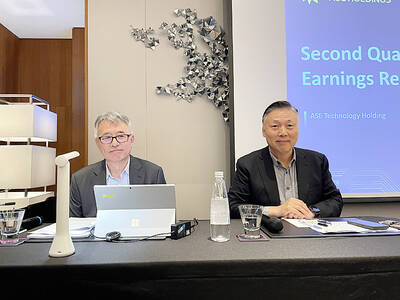
‘STRONGER DEMAND’ : Company executives said that a lot of new investments are needed, although there are capacity bottlenecks for automation and innovation ASE Technology Holding Co (日月光投控) yesterday increased its capital expenditure for this year to US$10.5 billion, up 23.5 percent from its previous budget of US$8.5 billion, amid robust demand for artificial intelligence (AI) applications. The world’s largest supplier of packaging and testing services plans to allocate about 70 percent of the increased spending to capacity expansion, mainly for leading-edge advanced packaging (LEAP) technology, with LEAP revenue forecast to exceed US$3.5 billion this year, ASE said. “Obviously we are seeing a stronger demand ... from not just customers, but also our foundry partner,” ASE chief financial officer Joseph Tung (董宏思) told an earnings


 RSS
RSS