

Japanese Minister of Finance Satsuki Katayama could announce as early as today that Tokyo and Washington are coordinating in the foreign exchange market to curb the yen’s weakness, a person familiar with the situation said.
The content of the announcement is still being finalized but could happen as early as this morning, the person said, declining to be identified as the information is not released yet. Reuters reported Katayama would confirm the joint action and vouch for the two sides’ commitment to battle what he called excessive declines in the yen.
Japanese authorities bought yen and sold US dollars during New York trading on Friday, Bloomberg reported earlier, citing one person with knowledge of the matter. At the close of New York trading on Friday, the yen was quoted at ¥157.40 to the US dollar, the strongest since early May. Just two days earlier, it was floating around the weakest levels since 1986.
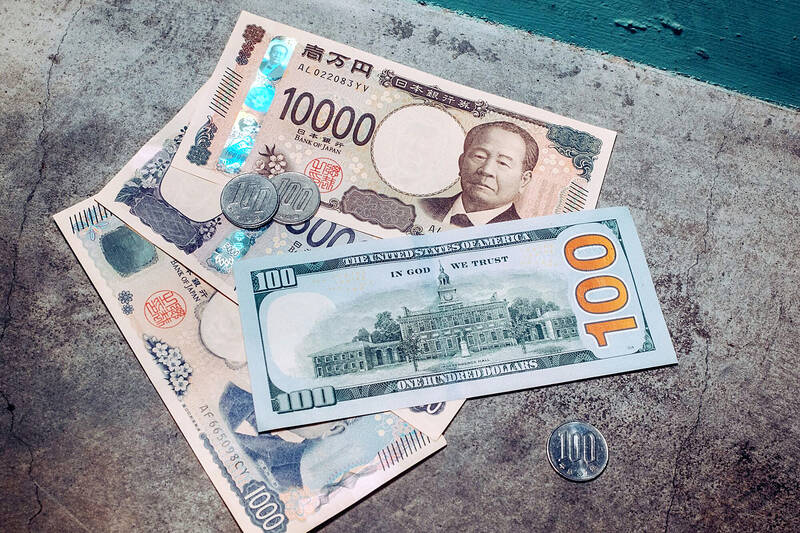
Photo: Bloomberg
The sharp gains were fueled by a combination of direct purchases of the yen, calls by officials to banks that trade the currency and appeals from US Secretary of the Treasury Scott Bessent and Katayama. Bessent signaled commitment to shoring up the yen when Reuters published a photograph of a notepad in front of him at a cabinet meeting in Camp David on Friday. Under a “To Do” title, it was written “Buy Japanese Yen (JPY) $5-10 bil.”
The operation on joint action is “still ongoing,” Reuters said, citing an unidentified government official.
The yen advanced more than 1 percent against the US dollar and the euro on Friday. It recorded an intraday jump of more than 3 percent versus the US dollar on Thursday, when Japan spent about ¥8.45 trillion (US$52.4 billion), according to Bloomberg and based on a comparison of Bank of Japan accounts and money brokers’ forecasts. That could be the biggest-ever intervention on a single day by Tokyo.
The Nikkei reported that the Japanese government and the Bank of Japan intervened to buy yen for a second straight day on Friday, while the Financial Times said separately that the US Federal Reserve Bank of New York sold euros to buy yen on behalf of the US Department of the Treasury. At least two major US banks were asked by the New York Fed to check the rate on the yen against the euro during the day, two people familiar with the matter told Bloomberg.
Separately, Japan’s Growth Strategy Minister Minoru Kiuchi said on Sunday Japan would step up two-way dialogue with markets this month to bolster investor confidence in its growth strategy.
“From this month onward, we intend to strengthen two-way communications with the markets,” Kiuchi said in a program on national broadcaster NHK, adding that losing confidence would push up interest rates. The government would explain its policies “consistently and transparently” to address market concerns, while responding appropriately to changing conditions, Kiuchi said.
This year's Fortune Global 500 ranking listed Taiwan Semiconductor Manufacturing Co (TSMC, 台積電) among its top 100 companies for the first time. TSMC climbed 44 places to 82nd, with revenue of US$122.26 billion, a report published on Tuesday by New York-based Fortune magazine said. TSMC's entry into the top 100 for the first time underscored how surging demand for advanced chips is reshaping the scale and influence of companies in Asia and around the world, the report said. Besides TSMC, Taiwanese electronics manufacturer Wistron Corp (緯創) climbed 298 places to 198th on this year's list — the largest jump among all companies ranked
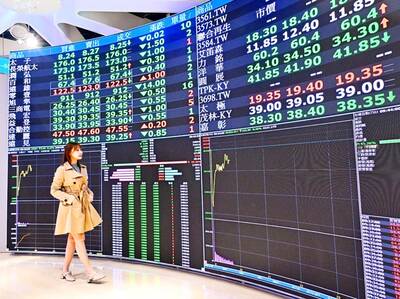
CRASH DIVE: Tech stocks across Asia are taking it in the teeth among war-induced uncertainties, worries about a bubble and more, as the TAIEX plunged precipitously The TAIEX suffered its third-largest point decline on record yesterday as investors continued a global retreat from tech shares amid concerns over the artificial intelligence (AI) boom, plunging 2,030.83 points, or 4.65 percent, to close at 41,603.36. The loss was exacerbated by a sharp selloff in global semiconductor stocks that triggered broad-based risk aversion across Asian markets, CTBC Securities Investment Service Co (中國信託證券投顧) said. The decline was driven mainly by market positioning rather than a deterioration in corporate fundamentals, CTBC said, citing the unwinding of leveraged trades and automated trading. “The selloff reflected panic in global markets, forced deleveraging and cascading program-driven selling
RUNNING HOT: The contract chipmaker is planning to both deepen and broaden its capacity, with more facility space and more advanced chips on offer United Microelectronics Corp (UMC, 聯電), the world’s fourth-largest contract chipmaker, plans to invest US$5 billion over the next two to three years to expand silicon photonics and advanced packaging capacity as artificial intelligence (AI)-driven demand accelerates. The company views silicon photonics and advanced packaging as vital businesses to its growth, and expects AI-related revenue to reach about US$300 million this year and surpass US$1 billion in three years, it said yesterday. “We actually feel pretty optimistic about advanced packaging, and that’s why we started facility deployment,” UMC CEO Jason Wang (王石) said at an earnings conference. “The overall [advanced packaging] addressable market

‘STRONGER DEMAND’ : Company executives said that a lot of new investments are needed, although there are capacity bottlenecks for automation and innovation ASE Technology Holding Co (日月光投控) yesterday increased its capital expenditure for this year to US$10.5 billion, up 23.5 percent from its previous budget of US$8.5 billion, amid robust demand for artificial intelligence (AI) applications. The world’s largest supplier of packaging and testing services plans to allocate about 70 percent of the increased spending to capacity expansion, mainly for leading-edge advanced packaging (LEAP) technology, with LEAP revenue forecast to exceed US$3.5 billion this year, ASE said. “Obviously we are seeing a stronger demand ... from not just customers, but also our foundry partner,” ASE chief financial officer Joseph Tung (董宏思) told an earnings


 RSS
RSS