

Hon Hai Precision Industry Co. said Friday that its subsidiary Visionbay.ai has begun commercial operations of a 5-megawatt AI cluster built using Nvidia’s HGX B300 systems, with more than 90 percent of its capacity already in use.
In a news release, Hon Hai, better known as Foxconn, said the AI cluster is the largest of its kind in Taiwan.
The cluster has received Nvidia’s Exemplar Cloud validation, a certification for AI training infrastructure, making Visionbay.ai one of the first 10 organizations worldwide -- and the second in Asia -- to earn the recognition, Hon Hai said.

Photo grab from https://visionbay.ai/zh-tw/home
Visionbay.ai, which focuses on supercomputing centers and cloud-computing platforms, said demand for AI infrastructure is shifting from simply owning graphics processing units (GPUs) to having systems capable of reliably supporting commercial applications.
The shift has been driven by the rapid development of generative AI, agentic AI and other multimodal foundation models, the company said.
Unlike traditional GPU cloud services, Visionbay.ai’s platform provides integrated tools for AI model training, fine-tuning, inference and AI agent deployment, Hon Hai said.
Looking ahead, Visionbay.ai said it plans to expand its AI infrastructure across the Asia-Pacific region using Nvidia’s Blackwell and Vera Rubin platforms, drawing on Hon Hai’s capabilities in AI hardware, infrastructure and software.

Qualcomm Inc, the biggest maker of smartphone processors, plans to increase prices by a percentage in the double digits, a move that is likely to ripple through much of the tech industry. The San Diego-based company sent a letter to customers on Friday informing them of price hikes, according to a copy of the document seen by Bloomberg News. The rise would go into effect for products shipped after Sept. 1, Qualcomm said. The company said it had exhausted its ability to absorb higher costs from suppliers and had made attempts to secure alternative components from new sources. Like the rest of the
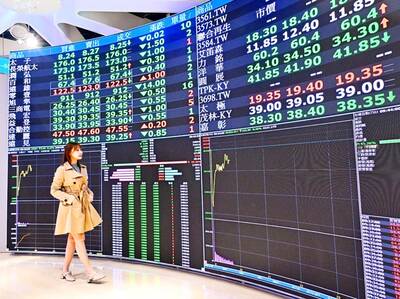
CRASH DIVE: Tech stocks across Asia are taking it in the teeth among war-induced uncertainties, worries about a bubble and more, as the TAIEX plunged precipitously The TAIEX suffered its third-largest point decline on record yesterday as investors continued a global retreat from tech shares amid concerns over the artificial intelligence (AI) boom, plunging 2,030.83 points, or 4.65 percent, to close at 41,603.36. The loss was exacerbated by a sharp selloff in global semiconductor stocks that triggered broad-based risk aversion across Asian markets, CTBC Securities Investment Service Co (中國信託證券投顧) said. The decline was driven mainly by market positioning rather than a deterioration in corporate fundamentals, CTBC said, citing the unwinding of leveraged trades and automated trading. “The selloff reflected panic in global markets, forced deleveraging and cascading program-driven selling
This year's Fortune Global 500 ranking listed Taiwan Semiconductor Manufacturing Co (TSMC, 台積電) among its top 100 companies for the first time. TSMC climbed 44 places to 82nd, with revenue of US$122.26 billion, a report published on Tuesday by New York-based Fortune magazine said. TSMC's entry into the top 100 for the first time underscored how surging demand for advanced chips is reshaping the scale and influence of companies in Asia and around the world, the report said. Besides TSMC, Taiwanese electronics manufacturer Wistron Corp (緯創) climbed 298 places to 198th on this year's list — the largest jump among all companies ranked
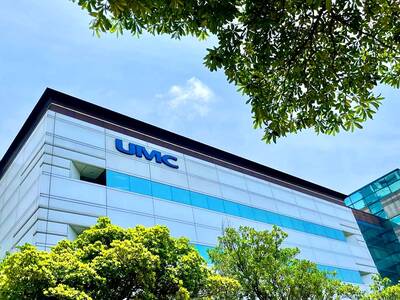
RUNNING HOT: The contract chipmaker is planning to both deepen and broaden its capacity, with more facility space and more advanced chips on offer United Microelectronics Corp (UMC, 聯電), the world’s fourth-largest contract chipmaker, plans to invest US$5 billion over the next two to three years to expand silicon photonics and advanced packaging capacity as artificial intelligence (AI)-driven demand accelerates. The company views silicon photonics and advanced packaging as vital businesses to its growth, and expects AI-related revenue to reach about US$300 million this year and surpass US$1 billion in three years, it said yesterday. “We actually feel pretty optimistic about advanced packaging, and that’s why we started facility deployment,” UMC CEO Jason Wang (王石) said at an earnings conference. “The overall [advanced packaging] addressable market


 RSS
RSS