

Taipei’s Grade A office space market is expected to be resilient in the second half of this year, despite a wave of new supply, with demand from technology companies and corporations seeking higher-quality workplaces expected to cushion the impact on vacancy rates, property consultant Jones Lang LaSalle Inc (JLL) said on Tuesday.
The market showed robust momentum in the first half of the year as companies expanded operations, upgraded office facilities and moved into newly completed buildings, JLL said.
Grade A office leasing transactions totaled 27,833 ping (918,489m2) in the first six months, up 37 percent from a year earlier, JLL said.
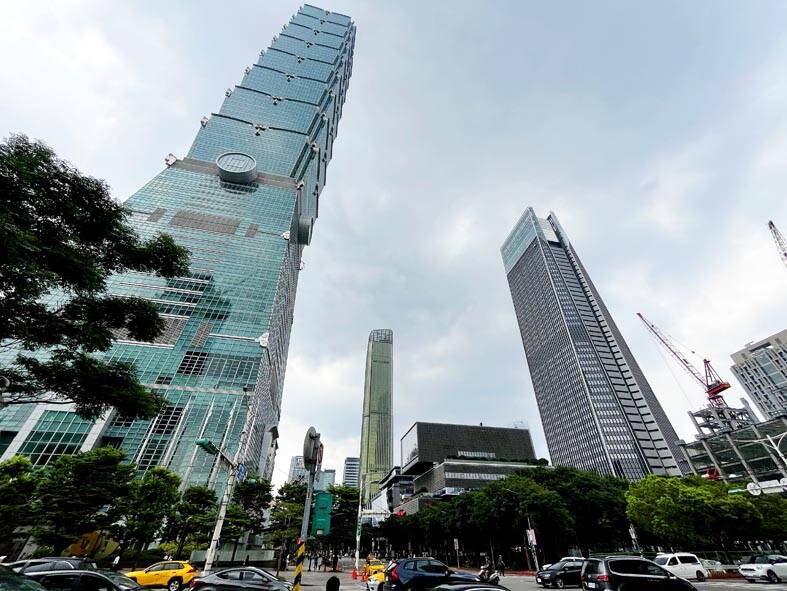
Photo: Hsu Yi-ping, Taipei Times
Transactions in Taipei’s business areas reached 25,737 ping, the highest level in nearly eight years, putting the full-year total on track to challenge the record, it said.
Second-quarter leasing activity alone totaled 13,797 ping, with 91 percent concentrated in core business districts, JLL said.
Taipei’s western areas and the Songjiang-Nanjing area recorded the strongest performance, together accounting for about half of total leasing volume, driven by continued absorption of newly completed projects, it said.
Technology companies were the biggest source of demand, fueled by expansion among artificial intelligence and semiconductor-related firms, JLL said.
The sector accounted for 55 percent of second-quarter leasing transactions, up from 38 percent in the previous quarter, it said.
Tenancy demand pushed vacancy rates lower for a fourth consecutive quarter, with the average vacancy rate falling to 5.1 percent, down 1.3 percentage points from three months earlier and the lowest in two years, it said.
Average rents in core business districts climbed 0.37 percent from the previous quarter to NT$3,283 (NT$101.99) per ping per month, it said.
However, rental growth slowed as the market entered a consolidation phase following recent gains, JLL said.
Looking ahead, about 47,000 ping of new office space, including owner-occupied projects, is expected to be completed in Taipei’s core business districts, which could place upward pressure on vacancy rates, it said.
Still, JLL said it expects demand for upgraded office environments, particularly from technology firms and companies pursuing workplace transformation, to support leasing activity and help maintain rental stability in the second half.
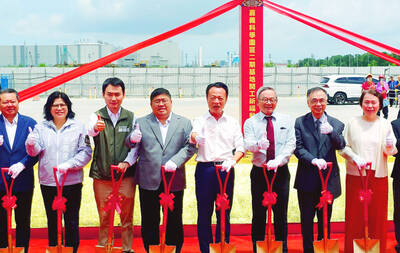
TECH CORRIDOR: The new Phase II site is expected to work with other facilities in the region and nation as TSMC looks to shape the future with its manufacturing Taiwan Semiconductor Manufacturing Co (TSMC, 台積電) would build three additional advanced packaging facilities in Phase II of the Chiayi Science Park (嘉義科學園區), National Science and Technology Council (NSTC) Minister Wu Cheng-wen (吳誠文) said yesterday. Speaking at the groundbreaking ceremony for the Phase II, Wu said the roughly 90-hectare site would be developed into an advanced packaging industry cluster led by TSMC. Two advanced packaging facilities at Phase I began mass production last month. Wu said that the Phase II development of the Chiayi Science Park would strengthen the resilience of the regional economy and help transform Chiayi County into a global production

Chinese authorities have held meetings with top tech firms over the past month about potentially restricting overseas access to China’s most advanced AI models, including those yet to be released, three people familiar with the discussions said. The talks follow a number of steps by Beijing to keep homegrown AI technology in the country and underscore how China, like the US, is now treating cutting-edge artificial intelligence as a critical national asset that needs controls. Companies present at the talks included tech giants Alibaba Group Holding Ltd (阿里巴巴) and ByteDance Ltd (字節跳動), as well as start-up Z.ai, formerly known as Zhipu AI
MOMENTUM: Second-quarter revenue reached NT$1.27 trillion as the June turnover surged, while TSMC’s 2nm process spending and US expansion remain focus points Taiwan Semiconductor Manufacturing Co (TSMC, 台積電) yesterday reported its highest quarterly sales amid strong global demand for artificial intelligence (AI) applications. The world’s largest contract chipmaker posted NT$1.27 trillion (US$39.5 billion) in consolidated revenue for the second quarter of this year, up 36 percent year-on-year and nearly 12 percent from a quarter earlier. The quarterly figure was bolstered by a very strong performance last month, when TSMC’s revenue was up 67.9 percent from a year earlier and rose 6.2 percent from a month earlier to NT$442.68 billion, a new monthly high, TSMC said in a statement. At its earnings conference in April, TSMC
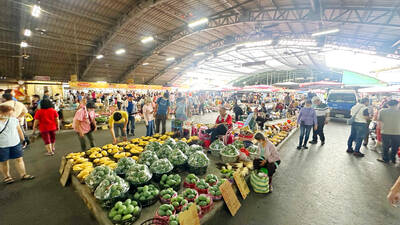
People buy mangoes at a wholesale market in Tainan’s Yujing District yesterday after Typhoon Bavi moved away from Taiwan. With the Irwin mango harvest season nearing its end, reduced output and strong demand has led the average mango price to climb to NT$67.4 per kg from about NT$35 at the beginning of this month, the Tainan Agriculture Bureau said.


 RSS
RSS