

ASML Holding NV lifted its annual sales forecast for the second time this year and laid out plans to increase production as a surge in artificial intelligence (AI) spending drives demand for the Dutch company’s chipmaking machines.
Net sales would grow to between 43 billion euros and 45 billion euros (US$49.11 billion and US$51.39 billion) this year, the company said in a statement yesterday.
That is well above the average estimate of 39.3 billion euros among analysts compiled by Bloomberg as well as the company’s prior guidance for annual sales of 36 billion euros to 40 billion euros.
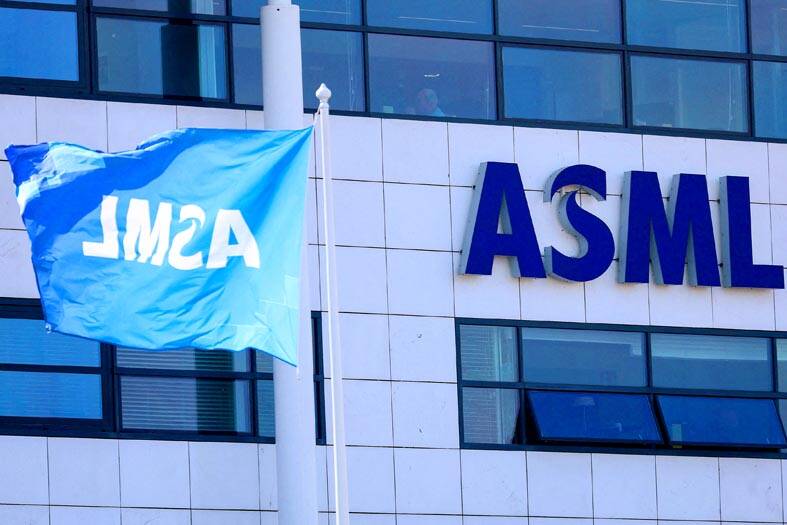
Photo: Reuters
ASML chief executive officer Christophe Fouquet’s challenge is keeping up with demand for the company’s intricate machines, which are used by the world’s largest chipmakers to produce semiconductors that train and run AI models, as well as the data centers that host them.
Fouquet announced plans to increase manufacturing capacity for its extreme ultraviolet (EUV) lithography machines to meet a large number of orders lined up for 2028.
Demand has motivated ASML’s customers to not only increase their capital spending, “but also accelerate all their plans,” Fouquet said in a video transcript accompanying the statement.
“This really creates a need for more systems basically starting this year,” he said.
The Veldhoven, Netherlands-based company is targeting capacity of about 65 units for its second-most advanced tool — known as the low numerical aperture EUV — this year, higher than prior projections.
It also outlined plans to increase that by 30 percent for next year, and said ASML is “investigating” to increase capacity with another 30 percent the following year.
Intel Corp has begun to use its most advanced machine for chip production, ASML said.
The new equipment — known as high numerical aperture EUV lithography — provides more precise patterning to make advanced chips.
The move was “proof of the maturity of the tool,” Fouquet said.
The announcement comes after Taiwan Semiconductor Manufacturing Co (台積電) said it would hold off on adopting the high numerical aperture EUV lithography tool through 2029, saying it was very expensive.
Net sales for the second quarter came in at 9.33 billion euros, ASML said.
Analysts had anticipated revenue of 8.85 billion euros in the period.
Net income was 2.9 billion euros in the second quarter, compared with 2.6 billion euros expected by analysts.
Gross margin for the year would grow to as much as 56 percent, up from the company’s previous forecast of as much as 53 percent, ASML said.
South Korea followed by Taiwan were ASML’s largest markets in the second quarter.
China’s contribution to the company’s net system sales fell to 14 percent from 19 percent in the first quarter, it said.
The machines ASML ships to China are eight generations behind the most sophisticated model, a fallout of the US administration’s curbs designed to hinder the progress of the Asian nation’s semiconductor industry.
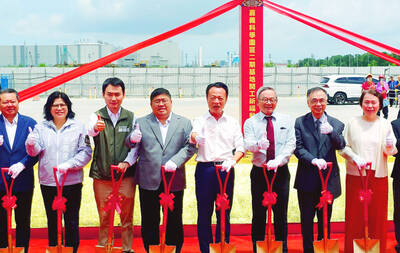
TECH CORRIDOR: The new Phase II site is expected to work with other facilities in the region and nation as TSMC looks to shape the future with its manufacturing Taiwan Semiconductor Manufacturing Co (TSMC, 台積電) would build three additional advanced packaging facilities in Phase II of the Chiayi Science Park (嘉義科學園區), National Science and Technology Council (NSTC) Minister Wu Cheng-wen (吳誠文) said yesterday. Speaking at the groundbreaking ceremony for the Phase II, Wu said the roughly 90-hectare site would be developed into an advanced packaging industry cluster led by TSMC. Two advanced packaging facilities at Phase I began mass production last month. Wu said that the Phase II development of the Chiayi Science Park would strengthen the resilience of the regional economy and help transform Chiayi County into a global production

Chinese authorities have held meetings with top tech firms over the past month about potentially restricting overseas access to China’s most advanced AI models, including those yet to be released, three people familiar with the discussions said. The talks follow a number of steps by Beijing to keep homegrown AI technology in the country and underscore how China, like the US, is now treating cutting-edge artificial intelligence as a critical national asset that needs controls. Companies present at the talks included tech giants Alibaba Group Holding Ltd (阿里巴巴) and ByteDance Ltd (字節跳動), as well as start-up Z.ai, formerly known as Zhipu AI
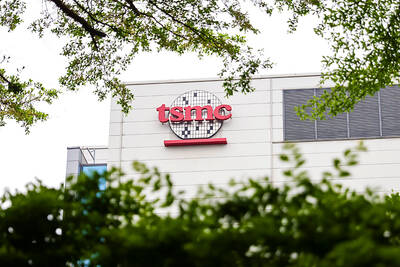
MOMENTUM: Second-quarter revenue reached NT$1.27 trillion as the June turnover surged, while TSMC’s 2nm process spending and US expansion remain focus points Taiwan Semiconductor Manufacturing Co (TSMC, 台積電) yesterday reported its highest quarterly sales amid strong global demand for artificial intelligence (AI) applications. The world’s largest contract chipmaker posted NT$1.27 trillion (US$39.5 billion) in consolidated revenue for the second quarter of this year, up 36 percent year-on-year and nearly 12 percent from a quarter earlier. The quarterly figure was bolstered by a very strong performance last month, when TSMC’s revenue was up 67.9 percent from a year earlier and rose 6.2 percent from a month earlier to NT$442.68 billion, a new monthly high, TSMC said in a statement. At its earnings conference in April, TSMC

People buy mangoes at a wholesale market in Tainan’s Yujing District yesterday after Typhoon Bavi moved away from Taiwan. With the Irwin mango harvest season nearing its end, reduced output and strong demand has led the average mango price to climb to NT$67.4 per kg from about NT$35 at the beginning of this month, the Tainan Agriculture Bureau said.


 RSS
RSS