


A tepid June jobs report offers relief for US equities just as investors had begun to worry that excessive labor market strength might force the Federal Reserve to turn more hawkish in its fight against inflation, hobbling high-flying tech stocks that have driven this year’s rally.
US job growth slowed more than expected in June and payroll gains for the prior two months were revised lower, the Labor Department said on Thursday, pointing to a cooling but still stable labor market that prompted financial markets to dial back expectations for a near-term Federal Reserve rate hike.
That could buy the stock market more time, just as soaring valuations, dramatic swings in the value of trillion-dollar companies, and periodic sharp selloffs have fueled concerns that pockets might be in a bubble.

Photo: Reuters
US stocks initially edged up before giving up gains, and the dollar slipped as traders pared expectations for a rate hike as early as September.
“This jobs report lets anyone concerned about an imminent Fed hike to breathe a sigh of relief,” said Adam Sarhan, chief executive of 50 Park Investments in New York.
“It doesn’t mean the fear of inflation is over. It just takes the pressure off the Fed to raise rates in the short term,” Sarhan said.
Last month, investors got a taste of how quickly this year’s 10 percent stock market rally could unravel after the Fed left rates unchanged at its June meeting, but projected a hike in borrowing costs later this year amid growing concerns about rising prices. That move stoked investor angst about debt-fueled corporate spending on AI and prompted stocks to pull back, particularly in big tech names that have come to dominate the market. Thursday’s jobs report, a break from the run of strong employment gains in prior months, should reassure Fed policymakers that the labor market is not fueling inflation, said investors.
Fed fund futures late on Thursday suggested roughly even odds that the central bank would raise rates by its September meeting, according to LSEG data.
While many warned against reading too much into a single report, especially given the volatility in the data in recent months, they said it gives the Fed more time, and should be a tailwind for stocks — at least in the short term.
“A consistent pattern of moderating labor market conditions and easing inflation would reinforce the case for a more accommodative Fed and support the current market outlook,” Savvy Wealth chief investment officer Anshul Sharma said.
The prospect of lower interest rates is generally supportive for equity valuations, but particularly in sectors such as technology which are focused on long-term growth, he added.
Despite the modest pullback in market expectations for a rate hike this year, there is still a gap between that pricing and the view of many economists who believe the Fed will not hike rates this year. That suggests there is room for further re-pricing.
To be sure, momentum and earnings expectations still appear to be bigger drivers for the stock market than economic data. After a strong first-quarter earnings season for S&P 500 companies, investors will be looking to see if second-quarter results in the coming weeks can continue to support lofty valuations.

The US Federal Communications Commission (FCC) on Friday said it would ban the import of more equipment from a group of Chinese manufacturers, the latest move by Washington to crack down on Chinese-made electronic gear. The move expands an FCC ban imposed in 2022 on new models of telecommunications and video surveillance equipment made by Huawei Technologies Co (華為), ZTE Corp (中興通訊), Hytera Communications Corp (海能達通信), Hikvision Digital Technology Co (海康威視) and Dahua Technology Co (大華科技), citing national security risks. The expanded ban includes old models, not just those designed starting in late 2022, of equipment used for “public safety, security of
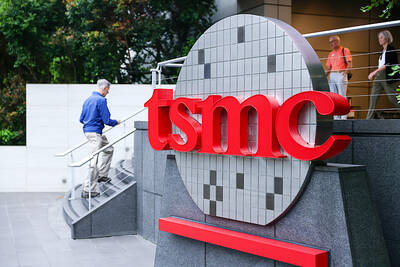
ARIZONA INVESTMENT: The Taiwanese semiconductor firm has gained approval for a US$20 billion capital injection into its its wholly owned US subsidiary The US is unlikely to match Taiwan Semiconductor Manufacturing Co’s (TSMC, 台積電) production capacity in Taiwan despite the chipmaker’s expansion in Arizona, Minister of Economic Affairs Kung Ming-hsin (龔明鑫) said yesterday. TSMC has already announced plans for a total of 16 fabrication plants and advanced chip-on-wafer-on-substrate packaging facilities in Taiwan, Kung said before a ministry meeting yesterday afternoon. “No matter how many fabs the US builds in the future, it won’t be that many,” Kung said. His remarks came after US President Donald Trump reportedly said on Wednesday that Taiwan was doubling the size of the chip plants under construction in Arizona and
UNSURPRISING LEADER: TSMC led in both net profit and revenue this year, followed by other big names in the Taiwanese sphere of tech as well as finance Taiwan’s 5,000 largest companies posted a record high in aggregate net profit last year, up more than 11 percent from a year earlier, with contract chipmaker Taiwan Semiconductor Manufacturing Co (TSMC, 台積電) holding on as the country’s most profitable company amid the artificial intelligence (AI) boom, credit information agency CRIF Taiwan (中華徵信所) said on Wednesday. Strong global demand for AI applications continued to benefit Taiwan’s top 5,000 enterprises last year, CRIF said in a report. Their combined net profit totaled NT$5.77 trillion (US$181.1 billion), up 11.01 percent from a year earlier, while aggregate revenue hit a record high of NT$48.50 trillion,
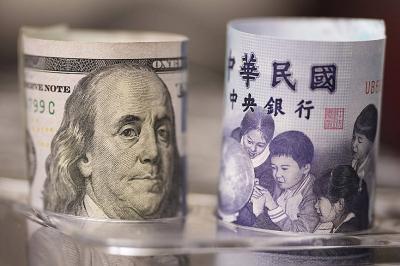
The New Taiwan dollar, which is on track for its first quarterly gain in a year, may face renewed pressure as the US currency strengthens and local companies boost dividend payouts to a record. Domestic firms are set to pay out more than NT$2.5 trillion (US$78.5 billion) in cash dividends this year, according to data from the Taiwan Stock Exchange, the largest amount ever in Bloomberg-compiled data going back to 1990. Foreign-exchange conversions by overseas investors repatriating the funds are expected to add to near-term volatility in the local currency. “The Taiwan dollar could hit a rough patch in the coming weeks,


 RSS
RSS