


Residential developers sharply cut new project launches in northern Taiwan in the first half of this year, as tight credit conditions, little policy support and a strong stock market weighed on housing demand.
The combined value of new housing projects — including presale and newly completed homes — totaled NT$461.6 billion (US$14.46 billion) in northern Taiwan in the first six months, down 36 percent from a year earlier, according to My Housing Monthly (住展雜誌).
Taipei and New Taipei City recorded the steepest declines. New project launches in Taipei plunged 50.2 percent from a year earlier to NT$77.07 billion, while New Taipei City fell 48.5 percent to NT$148.32 billion, it said.
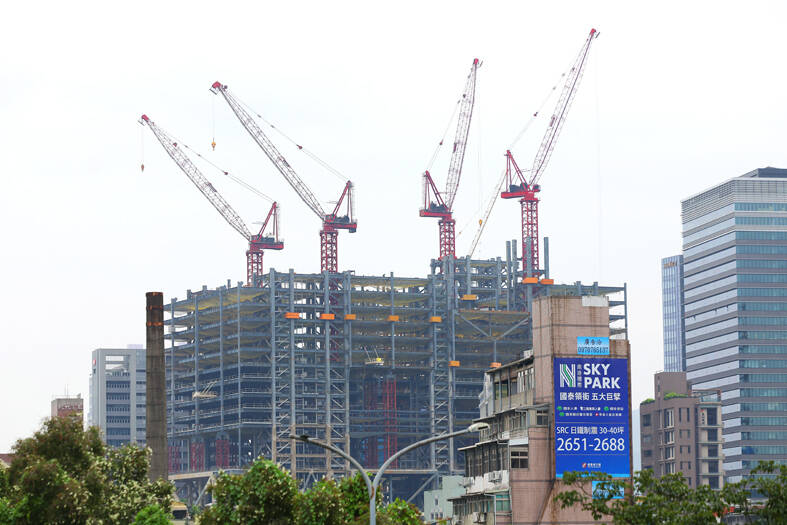
Photo: CNA
My Housing Monthly research office director and spokesman Chen Ping-chen (陳炳辰) attributed the slowdown to restrictive housing policies and shifting investment preferences.
“The market has yet to see a meaningful catalyst this year,” Chen said. “While policymakers have signaled no further tightening, they have also not eased existing credit controls.”
Meanwhile, strong stock-market gains have continued to divert funds away from real estate, prompting developers to remain cautious, he said.
In Taipei, the decline was amplified by the absence of large-scale projects. In the first half of last year, two projects exceeded NT$10 billion each, while no projects of that scale were launched this year.
Only four projects worth NT$5 billion to NT$10 billion were introduced this year, half as many as a year earlier. Developers have prioritized clearing existing inventory over launching new projects, particularly in the high-priced Taipei market where sales cycles are longer.
New Taipei City saw similar weakness. Although four projects worth more than NT$10 billion were launched, this was still half the number seen a year earlier. The overall number of projects also fell by about half.
Taoyuan, another key market, saw launch values drop 36.3 percent to NT$129.2 billion. While three projects exceeded NT$10 billion, nearly two-thirds of new projects were valued at less than NT$1 billion, highlighting a shift toward smaller, lower-risk projects, it said.
The Hsinchu area was the exception, with launch values surging 53.7 percent from a year earlier to NT$81.3 billion. Two projects worth more than NT$10 billion drove the increase, reversing last year’s slowdown.
Looking ahead, Chen said several major developments are expected in the second half of the year in Taipei’s Nangang District (南港), Taoyuan’s Guishan District (龜山), Hsinchu County’s Baoshan Township (寶山鄉) and some New Taipei City districts.
However, some projects may remain delayed. Without policy easing that would redirect capital into property, the market is likely to stay weak through year-end, Chen said. Annual launch values could fall below NT$1 trillion for the first time since 2018.


The US Federal Communications Commission (FCC) on Friday said it would ban the import of more equipment from a group of Chinese manufacturers, the latest move by Washington to crack down on Chinese-made electronic gear. The move expands an FCC ban imposed in 2022 on new models of telecommunications and video surveillance equipment made by Huawei Technologies Co (華為), ZTE Corp (中興通訊), Hytera Communications Corp (海能達通信), Hikvision Digital Technology Co (海康威視) and Dahua Technology Co (大華科技), citing national security risks. The expanded ban includes old models, not just those designed starting in late 2022, of equipment used for “public safety, security of
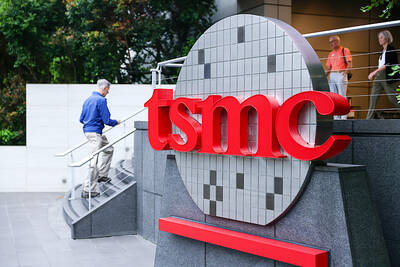
ARIZONA INVESTMENT: The Taiwanese semiconductor firm has gained approval for a US$20 billion capital injection into its its wholly owned US subsidiary The US is unlikely to match Taiwan Semiconductor Manufacturing Co’s (TSMC, 台積電) production capacity in Taiwan despite the chipmaker’s expansion in Arizona, Minister of Economic Affairs Kung Ming-hsin (龔明鑫) said yesterday. TSMC has already announced plans for a total of 16 fabrication plants and advanced chip-on-wafer-on-substrate packaging facilities in Taiwan, Kung said before a ministry meeting yesterday afternoon. “No matter how many fabs the US builds in the future, it won’t be that many,” Kung said. His remarks came after US President Donald Trump reportedly said on Wednesday that Taiwan was doubling the size of the chip plants under construction in Arizona and
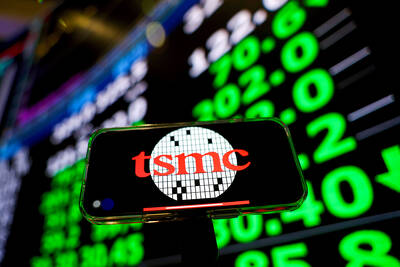
UNSURPRISING LEADER: TSMC led in both net profit and revenue this year, followed by other big names in the Taiwanese sphere of tech as well as finance Taiwan’s 5,000 largest companies posted a record high in aggregate net profit last year, up more than 11 percent from a year earlier, with contract chipmaker Taiwan Semiconductor Manufacturing Co (TSMC, 台積電) holding on as the country’s most profitable company amid the artificial intelligence (AI) boom, credit information agency CRIF Taiwan (中華徵信所) said on Wednesday. Strong global demand for AI applications continued to benefit Taiwan’s top 5,000 enterprises last year, CRIF said in a report. Their combined net profit totaled NT$5.77 trillion (US$181.1 billion), up 11.01 percent from a year earlier, while aggregate revenue hit a record high of NT$48.50 trillion,
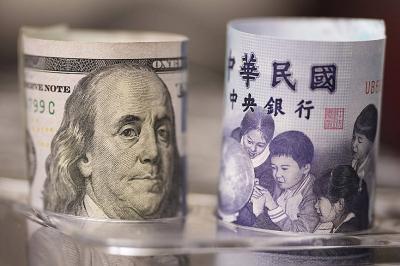
The New Taiwan dollar, which is on track for its first quarterly gain in a year, may face renewed pressure as the US currency strengthens and local companies boost dividend payouts to a record. Domestic firms are set to pay out more than NT$2.5 trillion (US$78.5 billion) in cash dividends this year, according to data from the Taiwan Stock Exchange, the largest amount ever in Bloomberg-compiled data going back to 1990. Foreign-exchange conversions by overseas investors repatriating the funds are expected to add to near-term volatility in the local currency. “The Taiwan dollar could hit a rough patch in the coming weeks,


 RSS
RSS