

Taiwanese consumers grew more optimistic about the economic outlook and more willing to spend and invest this month, as confidence indicators surged alongside a strengthening stock market and sustained artificial intelligence (AI) driven export momentum, according to a survey released yesterday by Cathay Financial Holding Co (國泰金控).
The monthly survey, which tracks household sentiment and financial expectations, showed broad improvements across perceptions of the economy, income outlook and risk appetite.
The findings come as Taiwan’s official indicators continue to point to steady expansion, supported by resilient external demand and easing geopolitical tensions.
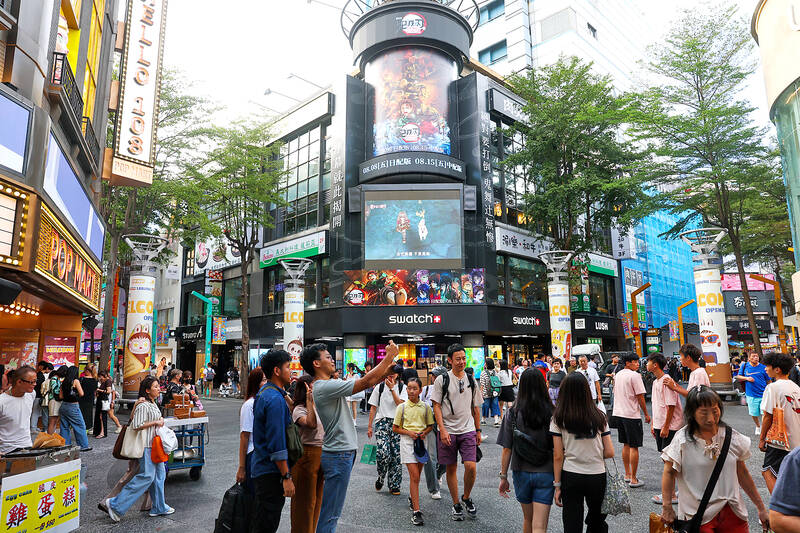
Photo: CNA
Sentiment toward current and future economic conditions improved. The index measuring perceptions of current conditions rose to 32, while the forward-looking outlook index climbed to 25.5, reflecting stronger confidence in near-term economic stability. Income-related sentiment strengthened, with the wage assessment index reaching 18.8 — its highest level on record.
Willingness to make large purchases rose to 21.6, another record high, suggesting households are increasingly prepared to commit to discretionary consumption. However, demand for durable goods — particularly real-estate — remained subdued, slipping by 0.8, indicating continued caution toward long-term household commitments.
Inflation and growth expectations were more nuanced. Many respondents, 59 percent, expect Taiwan’s economic growth in 2026 to exceed 7 percent, while 58 percent believe inflation would surpass the central bank’s 2 percent target.
By comparison, the government’s projections stand at 9.64 percent growth and 1.93 percent inflation, suggesting households are slightly more conservative on growth but more concerned about price pressures.
Equity market sentiment strengthened sharply. Optimism toward Taiwan’s stock market rose to 54.5, while risk appetite climbed to 40.6, setting new highs. The survey attributed the improvement to easing geopolitical tensions, including a ceasefire between the US and Iran and the start of negotiations, as well as continued AI-driven capital expenditure from major US cloud service providers, which has supported global technology demand and Taiwan’s equity performance.
Investor behavior is increasingly shifting toward exchange-traded funds (ETFs), the survey found, reflecting broader participation in equity markets.
About 26 percent of respondents said they invest solely in passive ETFs, while 24 percent hold active and passive products and 19 percent invest only in active ETFs, the survey said.
The majority — 54 percent — said their primary motivation is long-term wealth accumulation, followed by dividend income and portfolio diversification.
Looking ahead, half of respondents said they intend to hold Taiwan’s ETFs for more than one year, while 18 percent plan to maintain current positions and 13 percent expect to trade within a year.
AI remains the dominant perceived driver of market performance, with 54 percent of respondents identifying AI industry development as the most important factor influencing ETF returns over the next year. Corporate earnings, macroeconomic conditions, global equity trends and risk sentiment were cited as key influences.
READJUSTMENT? Despite the rumors, a senior Google official said that the company plans to expand its AI research center in Taipei’s Shilin District Google Taiwan is reducing its workforce as the company continues to adjust operations to improve efficiency and focus resources on core goals, the Chinese-language Liberty Times (sister paper of the Taipei Times) reported yesterday. The Alphabet Inc unit said the organizational adjustments have begun and would continue, even though it did not put a figure on the number of potential job cuts or specify the affected departments in its Taiwan operations. The company’s response came after rumors circulated on social media about major job cuts at Google Taiwan. Some posts said the downsizing would target the company’s consumer electronics-related departments

Taiwanese aircraft maker Aerospace Industrial Development Corp (AIDC, 漢翔航空) yesterday announced that it has secured a 20-year partnership agreement with Canada-based Bombardier Inc. The two companies held a ceremony in Taipei yesterday to exchange signed copies of the agreement, launching the 20-year partnership under which AIDC would supply cockpit and forward fuselage structural components for Bombardier’s super-midsize Challenger 3500 business jets, the Taiwanese company said. The agreement represents a new milestone in cooperation between the two companies, which dates back to 1999, with the Taiwanese supplier having provided rear fuselage structural components for more than 1,000 Challenger 3500 aircraft, it
FOUNDRY DATA: Demand pushed production on some TSMC lines to full utilization, while Samsung’s market share of 5.9 percent dropped, TrendForce said Taiwan Semiconductor Manufacturing Co’s (TSMC, 台積電) foundry market share edged up to 72.5 percent in the second quarter from 72.3 percent in the previous quarter, propelled by robust artificial intelligence (AI) and smartphone chip revenue, data compiled by market researcher TrendForce Corp (集邦科技) showed yesterday. TSMC’s revenue last quarter grew 12 percent sequentially to US$40.2 billion, outpacing the 11.5 percent average growth among the world’s top 10 foundry companies, the researcher said. Combined revenue of the top 10 is expected to grow further this quarter from US$53.49 billion last quarter, supported by strong demand and price hikes, it said. The increased demand has

Global notebook computer shipments are expected to fall 8 percent year-on-year to 167.9 million units this year, dragged by weak demand, high component prices and supply constraints, the Market Intelligence and Consulting Institute (MIC) said on Tuesday. Next year, shipments are expected to decline by a further 4.7 percent to 160 million units as higher retail prices weigh on consumption, MIC deputy director-general Edward Lin (林柏齊) told a news conference in Taipei. The downtrend is expected to extend into 2028, with replacement demand unlikely to recover before supplies of key components rebound and costs decline, Lin said. Surging demand for artificial intelligence (AI)


 RSS
RSS