


Taiwan Semiconductor Manufacturing Co (TSMC, 台積電) yesterday said an explosive demand for artificial intelligence (AI) chips has led to pervasive supply constraints and it is accelerating capacity expansions to avert bottlenecks.
“We are trying not to become the bottleneck. Supply is a little bit tight as customer demand has outstripped what we can supply,” TSMC chairman and chief executive officer C.C. Wei (魏哲家) told a news conference after the company’s annual general meeting in Hsinchu City.
“Customers have shown incredibly strong demand in recent years. The growth is insane this year, in particular,” Wei said.
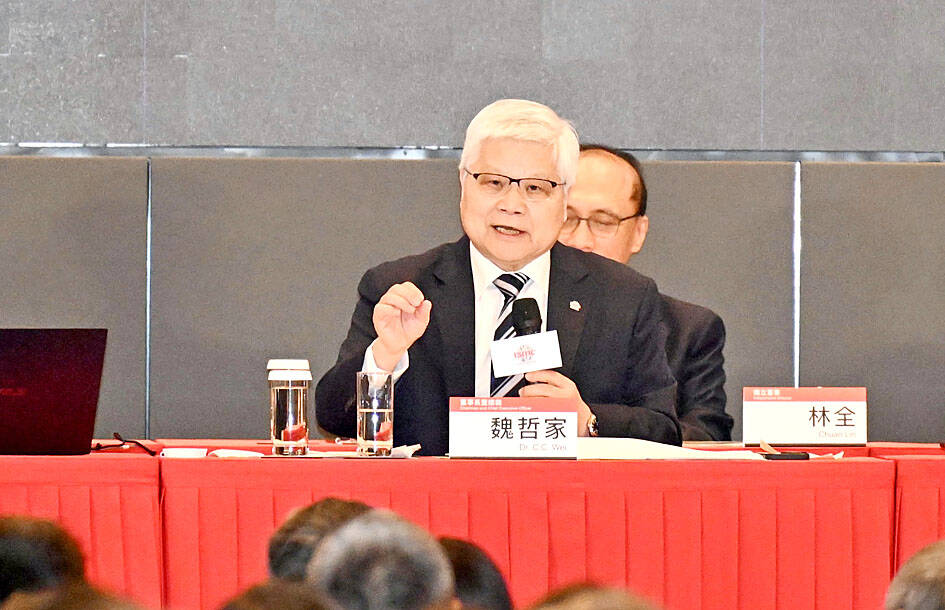
Photo: Peter Lo, Taipei Times
TSMC is also facing short supply of chip manufacturing equipment for advanced chips, he said.
Equipment manufacturers attribute the problem to component shortages from their suppliers, he said.
The growth of the AI industry requires the full support of a variety of components from logic chips, memory chips, packaging, testing and cooling systems, in addition to power supply, Wei said.
“The explosive growth of the AI industry has left the entire supply and ecosystem unprepared and unable to cope,” he said. Supply “restrictions are everywhere.”
Even so, the industry would navigate such constraints, as PC vendors might reduce use of memory chips and downgrade hardware specifications to cope with memory shortages, Wei said.
Eventually, supply and demand would reach parity, he said.
“From my perspective, the supply chain will find ways to reach a balance. They do not want to suffer the pain for a third consecutive year,” he said.
Wei also said he has confidence in Taiwan’s AI supply chain to fend off foreign competition, dismissing concerns that it could lose its competitive edge to South Korea, given Seoul’s strong ambition to build an AI ecosystem by duplicating Taiwan’s experience.
“There are a bunch of Taiwanese companies behind the [AI] ecosystem in Taiwan,” Wei said, citing Hon Hai Precision Industry Co (鴻海), Asustek Computer Inc (華碩) and Wistron Corp (緯創).
“That is not something South Korea can easily replicate [overnight],” he said. “Taiwan has huge competitive advantages in the AI industry and it will maintain those advantages for the foreseeable future. It is not easy for any country to catch up in the short term.”
TSMC’s South Korean competitor has said in recent years that it aims to catch up with TSMC within 10 years, but that was the same objective it missed 20 years ago, Wei said.
In 2019, Samsung Electronics Co again set a goal to beat TSMC by 2030.
“I’ll say that is totally a pipe dream,” he added.
When asked about growing competition from Intel Corp in the US market, Wei said Intel has been one of the company’s top 10 customers. TSMC intends to keep generating revenue from this partnership.
He also said TSMC has "never had a shortage of competitors over the past 30, 40 years. And we have always won. The future will be no different.”
Wei told shareholders that TSMC delivered a record year last year, with its stock more than doubling from NT$950 per share at the same meeting on June 3 last year to NT$2,425 on Wednesday, with the cash dividend rising more than 30 percent to at least NT$24 per share this year from NT$18 a year earlier.
Wei said he remains confident about TSMC’s growth trajectory in the years ahead.
On capital expenditure, Wei said this year's spending is now expected to come in near the upper end of TSMC's projected US$52 billion to US$56 billion range. Asked when spending might plateau, he said simply: "Honestly, I don't know," adding that he sees no indicators warranting a slowdown.
“If shareholders want to buy more shares, please continue,” he said.
Additional reporting by CNA
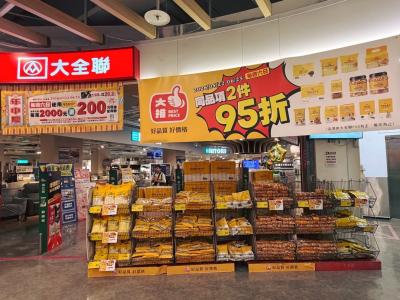
The Mega PX Mart Zhonglun (中崙) store in Taipei’s Zhongshan District (中山) would close on Sept. 13 after 22 years of business, Ruentex Development Co (潤泰創新) said today. More than 160 employees at the store would be assisted in finding new positions, with job openings to be made available in the coming days, Reuntex spokesman Chen Po-yu (陳柏宇) said. The Zhonglun store, previously an RT-Mart, opened in December 2004 as Taiwan’s first urban hypermarket in central Taipei. Due to high rents in the city center, the store never turned a profit in its 22 years of operation, Chen said. Even

Google DeepMind vice president John Jumper, who won the 2024 Nobel Prize in chemistry for his work on artificial intelligence (AI), is leaving the company to join Anthropic PBC. Jumper has been a key member of Google’s AI coding development team and his departure strains the tech giant’s efforts to beat Anthropic, OpenAI and SpaceX in the race to build the most powerful AI models. Google has struggled to sell AI coding tools to businesses, according to former employees. Employees and executives at DeepMind have raised concerns in the past few months that the company does not have a clear solution for

RESTRICTION BREACH: ASML said that it denies ‘unfounded rumors regarding non-compliance with export controls concerning China,’ and enforces controls strictly US Secretary of Commerce Howard Lutnick in a series of recent meetings outlined concerns to Dutch chip-equipment giant ASML Holding NV’s senior leaders that one of its top-of-the-line machines might have made its way into China, in violation of US-led export restrictions. In the meetings, Lutnick expressed concern to ASML executives over the company’s extreme ultraviolet lithography (EUV) machines, people familiar with the talks said. EUV systems are used by firms such as Taiwan Semiconductor Manufacturing Co (台積電) to manufacture processors for the likes of Nvidia Corp and Apple Inc. ASML has never been allowed to ship them to China because of curbs

PROMISING SIGNS: The indications of a peace deal, or at least a ceasefire, between the US and Iran have global prices easing down slightly after months of shooting State-owned oil supplier CPC Corp, Taiwan (CPC, 台灣中油) announced on Saturday that it would cut domestic gasoline and diesel prices by NT$1.0 (US$0.03) and NT$0.7 per liter respectively this week, reflecting reduced upward pressure on international energy prices. The announcement marked an end to the company’s 11-week streak of leaving its retail fuel prices unchanged amid military conflicts in the Middle East. CPC said in a statement that international crude prices fell last week after the US and Iran announced plans to sign a memorandum of understanding to extend their ceasefire for 60 days and open the Strait of Hormuz, the choke


 RSS
RSS