


Taiwan’s manufacturing activity last month accelerated to its fastest pace in nearly five years, driven by sustained demand for artificial intelligence (AI)-related products, although economists warned that rising inventories in some sectors might signal emerging imbalances beneath the economy’s robust expansion, the Chung-Hua Institution for Economic Research (CIER, 中華經濟研究院) said yesterday.
The manufacturing purchasing managers’ index (PMI) rose 1.1 points to 61.4 from 60.3 in April, marking the eighth consecutive month of expansion above 50 and the highest reading since September 2021.
“The latest PMI data indicate that Taiwan’s economy remains in a strong expansion phase,” CIER president Lien Hsien-ming (連賢明) told a news conference in Taipei.
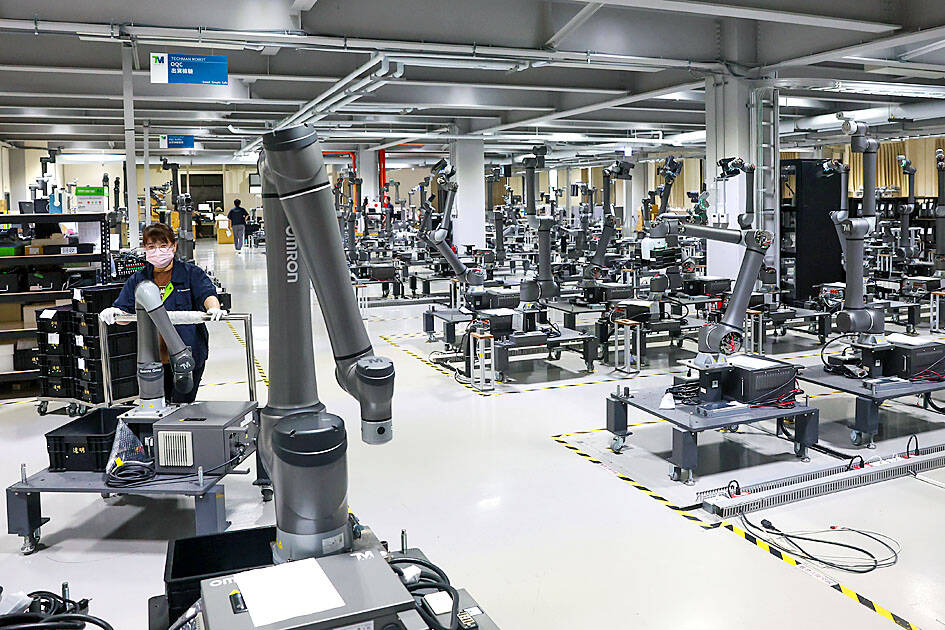
Photo: CNA
Demand for electronics and components linked to AI applications remains solid, supporting exports and sustaining growth momentum, he said.
Export demand is likely to stay firm through the year, Lien added.
Still, overbooking in some sectors amid record-high inventory levels could be concerning, he said.
The manufacturing inventories index rose 5.3 points to 65.7, a new high, suggesting firms are aggressively building stock ahead of expected demand, he said.
While rising inventories can reflect confidence in business conditions, elevated customer inventories have historically served as an early warning signal.
During the COVID-19 pandemic, some customers doubled their orders amid supply-chain disruptions, only to cancel them later and trigger a prolonged inventory correction cycle, Lien said.
“The shift toward excessively high customer inventories is something worth monitoring,” Supply Management Institute, Taiwan (中華採購與供應協會) adviser Jerry Pai (白宗城) said.
However, it is still too early to conclude that demand is turning, he added.
The inventory picture also varies significantly across industries, CIER researcher Chen Shin-hui (陳馨蕙) said.
Chemical manufacturers are already undergoing inventory adjustments after earlier front-loaded orders driven by higher oil prices and supply concerns, she said.
By contrast, orders in the electronics and optical products sector continue to expand steadily, Chen said.
Manufacturers remain broadly optimistic, as the six-month outlook index rose 2.9 points to 66.8, its strongest level since June 2021, with confidence particularly high among electronics and machinery producers, the institute said.
The rise of AI is reshaping Taiwan’s industrial structure beyond the technology sector, with traditional seasonal patterns in electronics manufacturing weakening, as AI-driven investment sustains demand across supply chains, CIER said.
The shift is creating opportunities not only for chipmakers but also for a wider range of traditional industries linked to the AI ecosystem, it said.
While geopolitical tensions and higher energy prices threaten the stability of the global economy, Taiwan’s manufacturing sector continues to benefit from one of the strongest technology investment cycles in decades, it said.
Taiwan’s non-manufacturing index was 58.2 last month, little changed from 58.3 in April, indicating continued expansion in the non-manufacturing sector, the institute said.
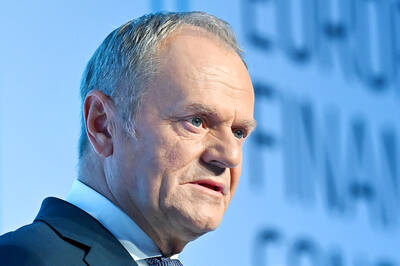
Poland is betting on a flood of investments and technology transfers from Taiwanese companies to reengineer its US$1 trillion economy. Polish Prime Minister Donald Tusk said yesterday that Poland will no longer be “just an assembly hub” as it pursues further investments from the likes of Foxconn Technology Group (富士康). The firm, whose full name is Hon Hai Precision Industry Co (鴻海精密), last month agreed to build electric vehicles (EVs) in the European Union nation and now could be a partner in a semiconductor venture, he said. The government’s aim is to boost manufacturing and the country’s high-tech chops in an era
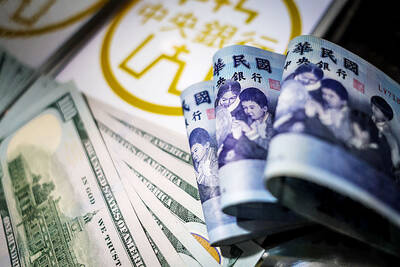
Taiwan remained the sixth-largest net creditor nation in the world last year, despite a fall of more than 10 percent in its net international investment position (NIIP) over the year, the central bank said yesterday. The NIIP is the difference between a country’s external financial assets and its external financial liabilities. Taiwan’s external financial assets hit US$3.27 trillion at the end of last year, up US$275.75 billion or 9.2 percent from a year earlier, the central bank said in its annual NIIP report. The growth largely reflected an increase in holdings of overseas marketable securities by residents in Taiwan, as well as a
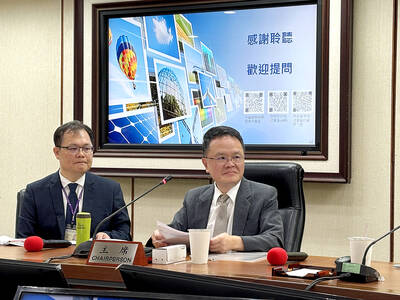
BAD FAITH LITIGATION? The two companies, owned by a California-based private equity firm, could be seeking licensing fees or a settlement payout with the suit Taiwan Intellectual Property Office (TIPO) Director-General Liao Cheng-wei (廖承威) said yesterday he suspected that two firms suing contract chipmaker Taiwan Semiconductor Manufacturing Co (TSMC, 台積電) for patent infringement are “patent trolls.” A patent troll refers to a company that buys patents not for manufacturing products, but to sue other companies for compensation, accusing them of using its patents. Patent trolls, formally called Non-Practicing Entities or Patent Assertion Entities, were responsible for more than 50 percent of lawsuits in the US last year, costing targeted businesses tens of billions of US dollars a year, according to the US-based LegalCharity Web site. Asked whether

RESTRICTION BREACH: ASML said that it denies ‘unfounded rumors regarding non-compliance with export controls concerning China,’ and enforces controls strictly US Secretary of Commerce Howard Lutnick in a series of recent meetings outlined concerns to Dutch chip-equipment giant ASML Holding NV’s senior leaders that one of its top-of-the-line machines might have made its way into China, in violation of US-led export restrictions. In the meetings, Lutnick expressed concern to ASML executives over the company’s extreme ultraviolet lithography (EUV) machines, people familiar with the talks said. EUV systems are used by firms such as Taiwan Semiconductor Manufacturing Co (台積電) to manufacture processors for the likes of Nvidia Corp and Apple Inc. ASML has never been allowed to ship them to China because of curbs


 RSS
RSS