


The hunt is on for companies that could benefit from the tailwinds of an unprecedented wave of initial public offerings (IPOs) in the US, and investors are increasingly honing in on the Asian supply chain.
Their thesis is that the billions of dollars that Space Exploration Technologies Corp (SpaceX), Anthropic PBC and OpenAI are set to raise would prompt a fresh round of technology spending — with a good chunk of that finding its way to the makers of server parts, specialized materials, cooling components and power equipment. For stock markets in Asia, that could be the catalyst for the next leg of a historic rally.
Hardware firms in the region are among the biggest winners of the data-center buildout, which has propelled chipmakers Taiwan Semiconductor Manufacturing Co (台積電), Samsung Electronics Co and SK Hynix Inc into the trillion-dollar club.
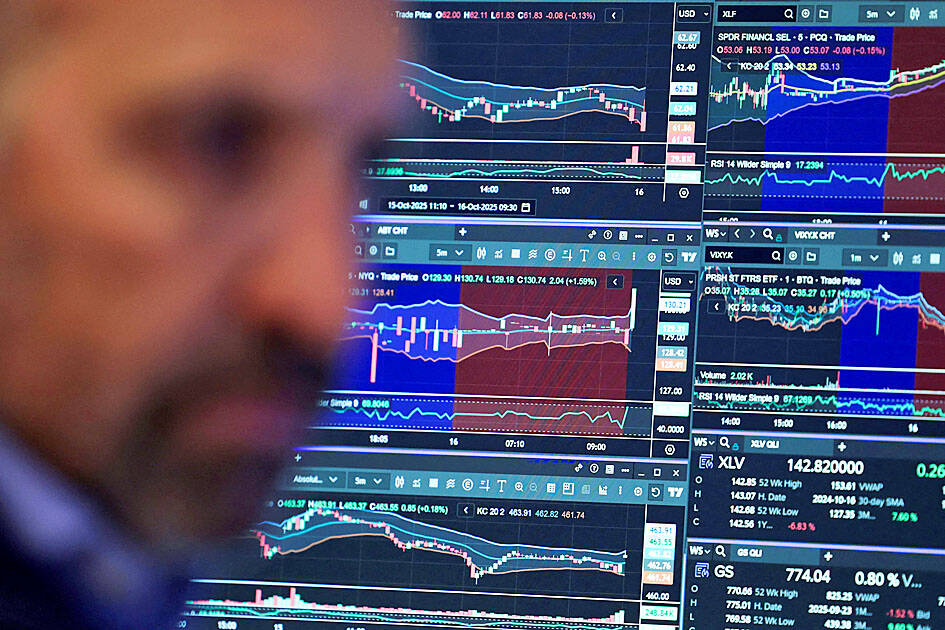
Photo: Reuters
However, after their breakneck gains, some investors have become uneasy about those lofty valuations and are now betting that the next phase would create a new class of champions.
“AI IPOs could further fuel the capex boom at a time when Asian chip stocks look stretched,” Eastspring Investments Hong Kong Ltd equity portfolio specialist Ken Wong (黃嘉權) said. “We’re currently underweighting semiconductors in our Asia technology strategy and focusing more on the electronic component makers.”
The battle for artificial intelligence (AI) leadership has driven massive expenditures on computing networks by the likes of Meta Platforms Inc and Amazon.com Inc. The listings of SpaceX, OpenAI and Anthropic might mean a total of US$70 billion in AI spending on top of the more than US$750 billion already committed by those biggest hyperscalers, IG International analyst Fabien Yip (葉蔚文) said.
“The flow-through to Asia is prominently visible” in the latest chipmaker earnings reports, she said. “As the AI rally matures, the broadening beyond pure-play names is underway.”
Some of the region’s hottest stock trades have been makers of electronic components used in servers as well as providers of materials and techniques used in making semiconductors. South Korea’s Samsung Electro-Mechanics Co and Japan’s Ibiden Co are among the top performers on MSCI Inc’s broadest Asia equity index this year. Among more far-flung plays, Yip highlights Japanese toilet maker Toto Ltd, which supplies ceramic materials for chipmaking equipment.
Supply crunches at Asian chipmakers are now starting to appear further down the supply chain, and the trend might deepen with the continued inflow of capex funding. Given concentration risks and limits on how much funds can invest in single stocks, money managers are looking at where earnings are only beginning to reflect the scale of AI infrastructure spending.
Jupiter Asset Management Ltd portfolio manager Sam Konrad sees opportunities in Taiwan’s Hon Hai Precision Industry Co (鴻海) and Quanta Computer Inc (廣達), which assemble servers, as well as chip designer MediaTek Inc (聯發科).
“The AI capex cycle is going to last multiple years,” he said. “Investors are likely to look for companies that are direct beneficiaries, but that are still trading at low valuation multiples.”
BNP Paribas Asset Management Asia Ltd’s Song Zhe (宋哲) said the next leg of the rally “should be stock-specific, not a blanket semiconductor trade.” His team is focused on advanced packaging, substrates, testing, optical connectivity, power, cooling and server-related companies across Taiwan and China “where earnings upgrades can still justify valuations.”
Swiss-Asia Financial Services Pte Ltd portfolio manager Brian Ooi (黃順豫) sees the SpaceX, OpenAI and Anthropic capital raisings as a positive signal to remain invested in AI stocks. He also likes power, with particular interest in transformers, fuel cells, cables, gas turbines and other equipment.
The three big AI-related IPOs “will provide them more liquidity to further invest in capital expenditure, and they have significant spending plans in place,” he said. “Asian suppliers will benefit.”
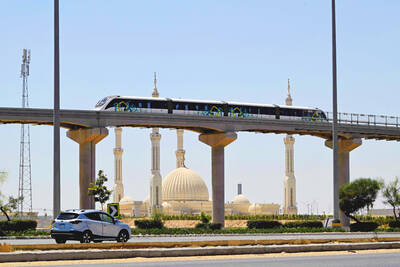
Cairo’s new monorail slices across the city skyline, running above the familiar chaos of blaring horns and aging buses’ exhaust fumes that mark rush hour below. The US$4.5 billion monorail, opened this month, is among Egypt’s most prominent new transport projects, part of a debt-funded infrastructure drive criticized for sapping state finances while bringing limited benefits to most of the country’s 109 million people. “It feels like you’re in a different country,” said Ramy Sayed, a restaurant manager, aboard a driverless Innovia 300 train. “No noise, no traffic, we’re not used to this.” The eastern line runs 56km from the bustling middle-class
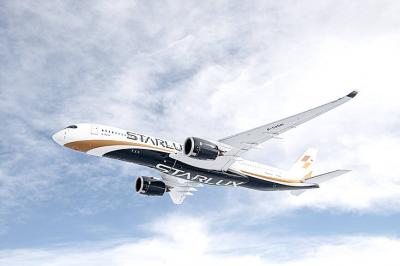
Starlux Airlines Co (星宇航空) today unveiled a long-haul network expansion plan at a shareholders’ meeting in Taipei, including direct flights to Barcelona, Spain, and Zurich, Switzerland, as well as a service connecting Taipei, Sydney and New Zealand. Starlux is to become the first Taiwanese carrier to offer non-stop services to the two European cities, while the inaugural oceanic route is expected to expand transit opportunities within the Australia-New Zealand market, Starlux said. Flight services to Chicago, Dallas, Washington and New York are under evaluation, the airline added. Prior to the shareholders’ meeting, the airline earlier this year announced that it would be

Netherlands-based semiconductor equipment supplier ASML Holding NV yesterday said that it is planning to hire an additional 1,000 people in Taiwan this year in response to growing demand from clients. ASML had previously planned to recruit 600 people this year, but that the plan has been adjusted upward, ASML vice president and ASML Taiwan general manager Grace Wang (汪佳慧) told reporters. ASML has a workforce of more than 4,500 in Taiwan, accounting for about 10 percent of its global total, Wang said. This year’s recruitment campaign would focus on adding people in the customer support, manufacturing and supply chain domains to assist ASML
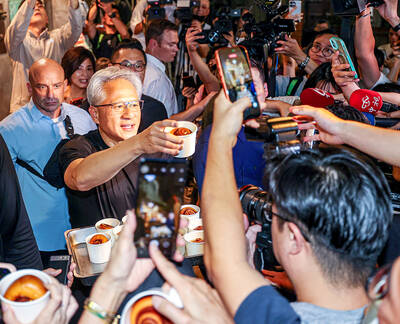
Nvidia Corp yesterday announced that CEO Jensen Huang (黃仁勳) would attend an employee meeting in Taipei tomorrow to celebrate the launch of the company’s Taiwan headquarters project. Huang would attend a gathering at the site of Nvidia’s planned headquarters in Beitou Shilin Technology Park (北投士林科技園區), the company said in a statement. After arriving in Taiwan on Saturday last week, Huang told reporters that he plans to meet with Quanta Computer Inc (廣達) chairman Barry Lam (林百里) and Taiwan Semiconductor Manufacturing Co (TSMC, 台積電) chairman C.C. Wei (魏哲家), and would attend the groundbreaking ceremony for Nvidia’s Taiwan headquarters tomorrow. Nvidia has not yet applied


 RSS
RSS