


China’s export growth gathered pace last month as factories raced to meet a wave of orders from artificial intelligence (AI)-related industries and other buyers seeking to stockpile components amid fears the Iran war could push global input costs even higher.
That export strength, which has seen China’s trade surplus with the US widen to US$87.7 billion so far this year, should be in focus next week as US President Donald Trump travels to Beijing for a leaders’ summit expected to extend last year’s trade truce.
While Chinese exporters have so far weathered the fallout from the Middle East conflict, economists warn that the longer the war drags on and energy prices rise, the greater the risk that external demand fades away — leaving sluggish domestic consumption unable to plug the gap.
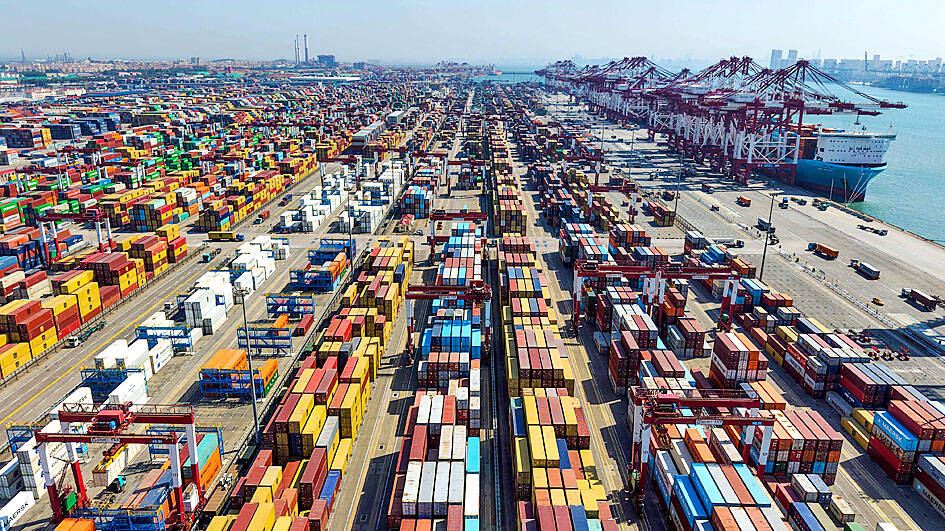
Photo: AFP
Economists are watching the pace of the AI manufacturing boom and whether shipments of related equipment can keep the Chinese export engine purring.
“The conflict in the Middle East pushed up demand for global manufacturing inventory replenishment and under the upward cycle of semiconductors, imports and exports maintained a boom,” Australia & New Zealand Banking Group senior China strategist Xing Zhaopeng (邢兆鵬) said.
“There is still room for expansion in this round of manufacturing cycle driven by AI and it is expected that the annual export growth rate will be about 10 percent,” Xing said.
Exports expanded 14.1 percent from a year earlier in US dollar value terms, customs data showed, outpacing the 2.5 percent gain in March and a 7.9 percent rise tipped by economists.
Imports notched another strong month, climbing 25.3 percent versus 27.8 percent in March. Economists had forecasted growth of 15.2 percent.
That boosted China’s trade surplus last month to US$84.8 billion, from US$51.13 billion in March.
Broader momentum in the Chinese economy was solid in the first quarter, with GDP growth hitting 5 percent year-on-year, the top of the government’s full-year target range.
However, factory data published last month showed input prices remained elevated, particularly for refined goods and petroleum, coal and chemicals. Unemployment rates also edged higher and retail sales — a gauge of consumption — continued to underperform industrial output.
Trump is scheduled to meet Chinese President Xi Jinping (習近平) during his visit this week to Beijing, as both countries seek to stabilize a relationship strained by tensions over trade, Taiwan and the Iran war.
Trump should be keen for trade concessions from Beijing ahead of November’s US midterm elections, although corporate executives and analysts are not expecting big breakthroughs.
Faced with US levies that briefly rose to the triple digits, Chinese exporters last year chased new markets such as South America by offering lower prices. China ended last year with a record trade surplus of US$1.2 trillion.
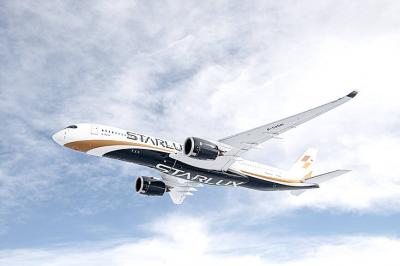
Starlux Airlines Co (星宇航空) today unveiled a long-haul network expansion plan at a shareholders’ meeting in Taipei, including direct flights to Barcelona, Spain, and Zurich, Switzerland, as well as a service connecting Taipei, Sydney and New Zealand. Starlux is to become the first Taiwanese carrier to offer non-stop services to the two European cities, while the inaugural oceanic route is expected to expand transit opportunities within the Australia-New Zealand market, Starlux said. Flight services to Chicago, Dallas, Washington and New York are under evaluation, the airline added. Prior to the shareholders’ meeting, the airline earlier this year announced that it would be
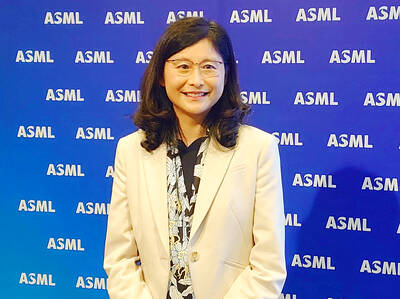
Netherlands-based semiconductor equipment supplier ASML Holding NV yesterday said that it is planning to hire an additional 1,000 people in Taiwan this year in response to growing demand from clients. ASML had previously planned to recruit 600 people this year, but that the plan has been adjusted upward, ASML vice president and ASML Taiwan general manager Grace Wang (汪佳慧) told reporters. ASML has a workforce of more than 4,500 in Taiwan, accounting for about 10 percent of its global total, Wang said. This year’s recruitment campaign would focus on adding people in the customer support, manufacturing and supply chain domains to assist ASML

UNDER MICROSCOPE: Taiwan detained three people who allegedly conspired to buy servers in Taiwan and export them using fraudulent documentation, prosecutors said Nvidia Corp chief executive officer Jensen Huang (黃仁勳) on Saturday urged Super Micro Computer Inc to tighten up on compliance after Taiwan detained three people this week for allegedly making fraudulent declarations about artificial intelligence (AI) servers made by its US partner. The development marked the nation’s first crackdown on semiconductor smuggling, which grew after the US slapped restrictions on exports of high-end chips such as Nvidia AI accelerators to China. Nvidia is “rigorous” in explaining regulations to all of its partners, Huang told reporters after arriving in Taipei. “Ultimately Super Micro has to run their own company,” he said in response to
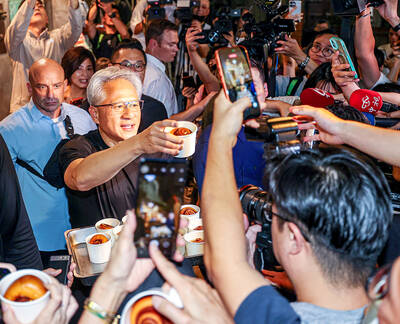
Nvidia Corp yesterday announced that CEO Jensen Huang (黃仁勳) would attend an employee meeting in Taipei tomorrow to celebrate the launch of the company’s Taiwan headquarters project. Huang would attend a gathering at the site of Nvidia’s planned headquarters in Beitou Shilin Technology Park (北投士林科技園區), the company said in a statement. After arriving in Taiwan on Saturday last week, Huang told reporters that he plans to meet with Quanta Computer Inc (廣達) chairman Barry Lam (林百里) and Taiwan Semiconductor Manufacturing Co (TSMC, 台積電) chairman C.C. Wei (魏哲家), and would attend the groundbreaking ceremony for Nvidia’s Taiwan headquarters tomorrow. Nvidia has not yet applied


 RSS
RSS