

The Financial Supervisory Commission (FSC) is weighing plans to ease lending restrictions on securities firms, as a shortage of funding for margin-style loans fuels industry calls for greater flexibility — but any relaxation is likely to come with stricter capital conditions.
The FSC is considering raising the cap on nonrestricted purpose lending — loans brokers extend to investors for general use — from four times net worth to as much as five or six times, people familiar with the matter said.
A framework could be finalized later this month.

Photo: Kelson Wang, Taipei Times
The move would not be a straightforward loosening. Brokers seeking higher lending limits would need to commit to capital injections within a specified timeframe and meet minimum capital adequacy requirements, a key measure of financial strength that assesses whether firms hold sufficient buffers to absorb potential losses.
Based on the industry’s net worth of about NT$757 billion (US$23.92 billion) at the end of last year, the proposed adjustment could unlock an additional NT$757 billion to NT$1.51 trillion in lending capacity, potentially providing fresh liquidity to investors — assuming firms participate fully and meet regulatory thresholds.
The discussions follow meetings between the Taiwan Stock Exchange, the Securities Firms Association and the FSC’s Securities and Futures Bureau, where broader adjustments to leverage rules were also explored.
The potential policy shift aligns with the FSC’s broader ambition to develop Taiwan into a regional asset management hub by expanding the capacity of domestic financial institutions, but regulators remain cautious about loosening constraints without safeguards.
Despite a strong equity market rally last month that pushed the benchmark TAIEX above the 40,000 points, the industry’s net worth has increased only modestly. Officials have noted that much of the sector’s earnings have been distributed as cash dividends rather than retained to strengthen balance sheets.
That trend has drawn scrutiny from the FSC, which is increasingly tying any relaxation of lending limits to commitments from major shareholders to inject new capital.
Industry conditions are also uneven. While some larger brokers maintain strong balance sheets, smaller firms have expanded nonrestricted lending aggressively, despite limited capital bases, raising concerns over risk management and credit quality.
Regulators have internally said that expanding loan volumes should not come at the expense of asset quality. Instead, brokers are being encouraged to allocate capital more selectively, focusing on borrowers with stronger repayment capacity to reduce the risk of bad debts in the event of a market downturn.
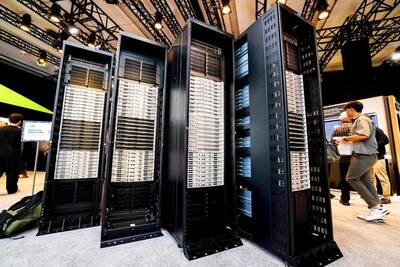
AM Intelligence, an Indian artificial intelligence (AI) infrastructure company, has ordered 9,000 Nvidia Corp Vera Rubin systems, seeking to become one of the first adopters of the advanced computing platform in Asia. Servers equipped with the rack-scale systems are slated to come online next year in southern India, the Hyderabad-based company said in a statement yesterday. Customers include major cloud service providers, AI labs and organizations aiming to develop homegrown Indian AI models, it said. Supplies of high-end Nvidia compute clusters remain tight. Demand from data centers and companies such as Microsoft Corp, Alphabet Inc’s Google and Amazon.com Inc to train AI models

In China’s hilly Guizhou Province, a cluster of European-style buildings complete with clock tower and multi-arched bridge emits a low, permanent hum — a clue to its unexpected identity as tech giant Huawei’s largest data center. The town-like complex is unique in design, but not in its placement. Dozens of data centers have been constructed in the southwestern province in the past few years. They are part of a government strategy that has seen much of the digital infrastructure for breakneck artificial intelligence (AI) development across China’s eastern seaboard established in the country’s less populated, rural west. The build-out is ongoing. China

Xiaomi Corp (小米) has launched a mobile processor for its marquee devices, putting pressure on Qualcomm Inc and MediaTek Inc (聯發科), which for years supplied the key component to the Chinese company. The Xring O3 system-on-a-chip advances Xiaomi’s in-house semiconductor design efforts with more power-efficient image processing and better artificial intelligence capabilities, the Beijing-based company said in a post on Sina Weibo yesterday. The company’s new silicon is made using a 3-nanometer fabrication process, Xiaomi founder Lei Jun (雷軍) said in a WeChat post . That is closer to the node used for Apple Inc’s most recent A19 Pro chips and well ahead
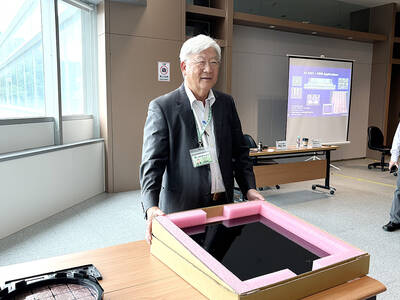
STRATEGIC GAMBLE: After developing FOPLP for six years, the chip packager has secured a 100 percent utilization rate for the new technology, its chairman said Chip packaging service provider Powertech Technology Inc (力成科技) yesterday said that its advanced fan-out panel-level packaging (FOPLP) production line has secured a 100 percent utilization rate through 2030 ahead of its scheduled volume production next year. Powertech made the remarks during the first public unveiling of its FOPLP production capabilities. The company expressed strong confidence in its long-term order pipeline, saying that robust market traction has mitigated any client acquisition concerns. “Our capacity has been fully booked by two major customers. Customers are not an issue through 2030,” Powertech chairman Tsai Du-kung (蔡篤恭) told reporters at the company’s plant in the Hsinchu


 RSS
RSS