


A constellation of artificial-intelligence (AI) stocks dropped after OpenAI reportedly failed to meet its sales and user targets, rekindling doubts that the hundreds of billions of dollars that big companies are plowing into the technology will deliver sufficient profits anytime soon.
The report dragged down the stocks of companies that have cut investment and business deals with OpenAI, which helped unleash the stock market’s AI boom after the release of ChatGPT more than three years ago.
Shares of Oracle Corp and CoreWeave Inc, which have cloud-computing pacts with OpenAI, closed 4.1 percent and 5.8 percent lower, respectively. Chipmaker Advanced Micro Devices Inc shares fell 3.4 percent and Nvidia Corp stock fell 1.6 percent in its worst day in about a month. Both companies also have ties to OpenAI.
Photo: Reuters
The reported miss by OpenAI revived worries that have shadowed the stock market periodically for months as technology giants like Microsoft Corp, Meta Platforms Inc, Amazon.com Inc and Alphabet Inc invest heavily in AI and stocks have rallied on the back of it.
Those investments — as they boosted the revenues of semiconductor, power and data-center companies — have sown fears that tech stocks could come tumbling back down if the spending halts or windfall profits don’t appear.
“What we’ve seen in this market is like the maximum reaction,” Zacks Investment Management chief market strategist Brian Mulberry said. “We automatically price in the worst-case scenario or the best-case scenario.”
OpenAI chief financial officer Sarah Friar has told leaders internally that she is worried the firm might not be able to pay for future computing contracts if revenue doesn’t grow fast enough, the Wall Street Journal reported, citing people familiar with the matter. An OpenAI spokesperson said the company is “firing on all cylinders” and seeing strong growth in demand from enterprise customers and for its nascent advertising business.
The stock price moves yesterday weren’t outsized by recent standards. But the report comes ahead of earnings reports from big tech companies like Alphabet, Microsoft, Meta and Amazon.com, all of which will provide an update on AI rollouts.
“There’s still a fair bit of nervousness around the exposure of the entire chip and data center and software supply chain to the big players,” Advisors Capital Management LLC portfolio manager JoAnne Feeney said. “Any bit of news that comes out is going to make people pause and reassess and wonder at the risks they may not have been considering.”
While OpenAI had an early advantage in the AI business, competition has been fierce, with upstart rivals like Anthropic PBC making major headway and the big companies mounting their own major pushes into it as well. That has aided companies like CoreWeave that aren’t tied just to OpenAI.
OpenAI is “not our only” partner, a CoreWeave spokesperson said in an email, adding that the company’s business is supported by other customers like Meta, Anthropic, Microsoft, Google and Perplexity AI.
An Oracle spokesperson said that the company is “incredibly excited” about its partnership with OpenAI and is focused on “building and delivering the capacity they need to support rapidly growing demand.”
OpenAI, once at the forefront of the AI frenzy, fell short of several monthly sales targets this year after rival Anthropic gained ground in the coding and enterprise markets, the Journal reported on Monday, citing unidentified people familiar with the matter.
Perceptions about OpenAI’s leadership shifted last fall after Alphabet’s Gemini AI model and Anthropic’s Claude received broad acclaim. These updates from consumer and business-focused rivals have sparked repeated selloffs in companies considered proxies for OpenAI.
“Google for a while was being perceived as a bit of a loser, because their models were maybe not as good as what we were seeing coming out of OpenAI and Anthropic,” Columbia Threadneedle Investments senior portfolio manager Tiffany Wade said in an interview with Bloomberg Television. “That changed last year when they released some of their newer Gemini models and were seen as more of a winner.”
Wade added that while the investor reaction to the OpenAI news makes sense, especially given tech and semiconductor stock gains this month. She said expectations about the longer-term demand for AI-related infrastructure remains intact.
“There is so much demand and it’s not just from Anthropic and OpenAI,” she said. “It’s really across the economy that we’re seeing demand for more processing power, so I expect the spending is going to continue.”
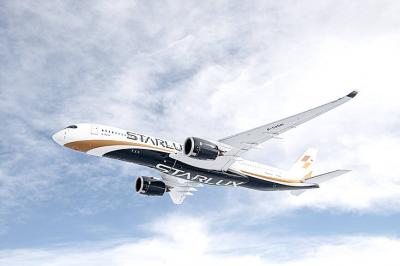
Starlux Airlines Co (星宇航空) today unveiled a long-haul network expansion plan at a shareholders’ meeting in Taipei, including direct flights to Barcelona, Spain, and Zurich, Switzerland, as well as a service connecting Taipei, Sydney and New Zealand. Starlux is to become the first Taiwanese carrier to offer non-stop services to the two European cities, while the inaugural oceanic route is expected to expand transit opportunities within the Australia-New Zealand market, Starlux said. Flight services to Chicago, Dallas, Washington and New York are under evaluation, the airline added. Prior to the shareholders’ meeting, the airline earlier this year announced that it would be

Netherlands-based semiconductor equipment supplier ASML Holding NV yesterday said that it is planning to hire an additional 1,000 people in Taiwan this year in response to growing demand from clients. ASML had previously planned to recruit 600 people this year, but that the plan has been adjusted upward, ASML vice president and ASML Taiwan general manager Grace Wang (汪佳慧) told reporters. ASML has a workforce of more than 4,500 in Taiwan, accounting for about 10 percent of its global total, Wang said. This year’s recruitment campaign would focus on adding people in the customer support, manufacturing and supply chain domains to assist ASML

UNDER MICROSCOPE: Taiwan detained three people who allegedly conspired to buy servers in Taiwan and export them using fraudulent documentation, prosecutors said Nvidia Corp chief executive officer Jensen Huang (黃仁勳) on Saturday urged Super Micro Computer Inc to tighten up on compliance after Taiwan detained three people this week for allegedly making fraudulent declarations about artificial intelligence (AI) servers made by its US partner. The development marked the nation’s first crackdown on semiconductor smuggling, which grew after the US slapped restrictions on exports of high-end chips such as Nvidia AI accelerators to China. Nvidia is “rigorous” in explaining regulations to all of its partners, Huang told reporters after arriving in Taipei. “Ultimately Super Micro has to run their own company,” he said in response to

Nvidia Corp yesterday announced that CEO Jensen Huang (黃仁勳) would attend an employee meeting in Taipei tomorrow to celebrate the launch of the company’s Taiwan headquarters project. Huang would attend a gathering at the site of Nvidia’s planned headquarters in Beitou Shilin Technology Park (北投士林科技園區), the company said in a statement. After arriving in Taiwan on Saturday last week, Huang told reporters that he plans to meet with Quanta Computer Inc (廣達) chairman Barry Lam (林百里) and Taiwan Semiconductor Manufacturing Co (TSMC, 台積電) chairman C.C. Wei (魏哲家), and would attend the groundbreaking ceremony for Nvidia’s Taiwan headquarters tomorrow. Nvidia has not yet applied


 RSS
RSS