


As he threaded his way through the scrub in Serbia’s southern hills, Slobodan Velickovic stopped to inspect the small indigo berries that have made the Balkans a key part of the global gin industry.
Although still months from the autumn harvest, the 34-year-old picker — who has collected juniper in the area since childhood — expertly plucks an almost ripe berry from the bush.
“Strong aroma, beautiful taste,” he told reporters as he chewed the fruit.
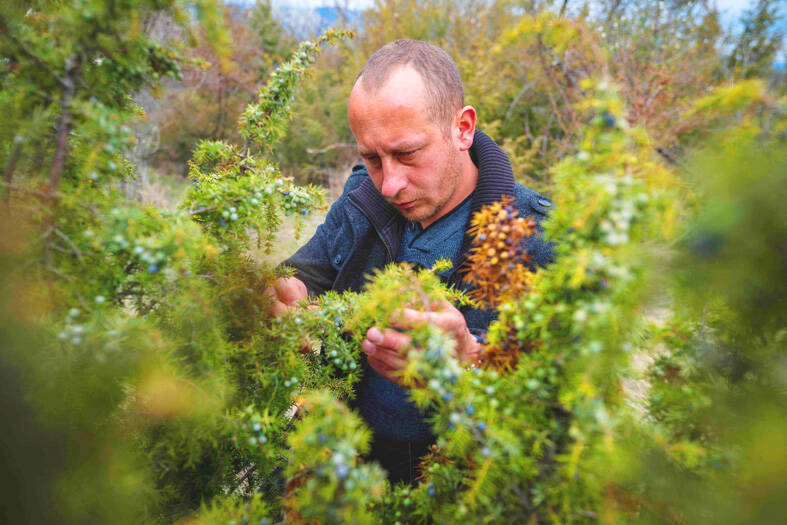
Photo: AFP
In Serbia, juniper is not farmed, but gathered from wild bushes by hand.
Growing over a wide range of the northern hemisphere, the hardy plant thrives on rocky slopes and in harsh conditions where few others can survive.
Despite that resilience, the presence of juniper has declined in parts of Europe in the past few decades — particularly in lowland areas where it once grew, under pressure from climate change, overgrazing and habitat loss.
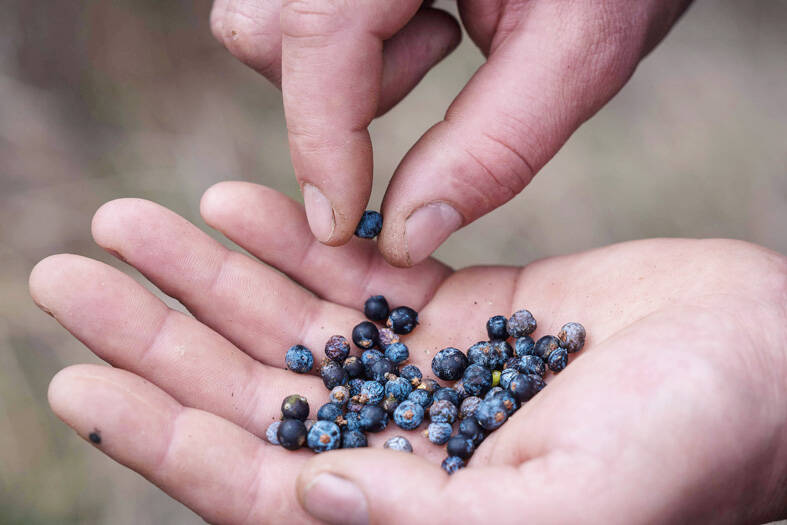
Photo: AFP
For pickers like Velickovic, the increasing variability of weather extremes also affects the harvest in his region.
“It depends on the year — whether it’s dry or rainy. Those conditions affect quality,” he said — a shift that can affect flavor during distillation.
However, for Balkan producers, pressures elsewhere also offer opportunity.
“In conditions of reduced yields in parts of western Europe, the Balkans are increasingly positioning themselves as an alternative source of supply,” the Chamber of Commerce and Industry of Serbia said.
Serbia, with a long tradition of juniper picking, exports about 1,000 tonnes of juniper annually, the chamber said.
“The quality in the Balkans is exceptional,” said Tommy Haughton of Beacon Commodities, a global juniper wholesaler.
Haughton said the region offers larger volumes at lower prices than other sources, including Italy, with long-standing supply networks built over generations.
However, hotter summers and fewer very cold winters could affect harvests, while forest fires can restrict access to picking areas and taint berries with smoke, he said.
A rainy harvest can also pose a challenge for ginmakers trying to maintain flavor.
“As gin distillers, our entire business is built around you having a product that’s the same yesterday as it was today,” said Matthew Pauley, a researcher at the International Centre for Brewing and Distilling at Heriot-Watt University in Edinburgh.
Rain during harvest can force berries to be mechanically dried with hot air, a process that can alter the volatile compounds in the berries, affecting what is extracted during distillation and, in turn, the flavor, Pauley’s research showed.
As a result, distillers might need to source juniper from other regions or, in extreme cases, modify a recipe.
“If we’re doing our job properly, there should be no difference,” Pauley said.
Protecting the taste in the glass falls to distillers such as Ivan Lakatos, who runs a craft gin producer in the Serbian village of Belegis.
“The quality of juniper doesn’t depend on the size of the berry itself, but on the intensity of its flavor, where it was picked,” Lakatos said, as vapors rise from a copper still in the basement behind him.
To compete with the region’s dominant spirit, rakija — a brandy most often made with plums — it is vitally important to maintain quality in every one of the about 2,000 bottles of his Little Fat Gin he sells per year.
“We’re proud of that, but we’d like that number to grow,” he said.
For him, local sourcing remains key, with noticeable differences in taste between Serbian juniper and juniper from other parts of Europe.
As climate change continues to shift where crops can be grown, Pauley said juniper sourcing was likely to evolve as well.
“That shift isn’t going to stop anytime soon. In fact, it’s going to accelerate,” he said. “One way or another, we’re going to be forced to explore other regions that previously, maybe we haven’t used.”
However, distillers are well versed in adapting to changes in their ingredients, he said.
“Gin distillers have been rolling with the punches since the 16th century,” he added.

Starlux Airlines Co (星宇航空) today unveiled a long-haul network expansion plan at a shareholders’ meeting in Taipei, including direct flights to Barcelona, Spain, and Zurich, Switzerland, as well as a service connecting Taipei, Sydney and New Zealand. Starlux is to become the first Taiwanese carrier to offer non-stop services to the two European cities, while the inaugural oceanic route is expected to expand transit opportunities within the Australia-New Zealand market, Starlux said. Flight services to Chicago, Dallas, Washington and New York are under evaluation, the airline added. Prior to the shareholders’ meeting, the airline earlier this year announced that it would be

Netherlands-based semiconductor equipment supplier ASML Holding NV yesterday said that it is planning to hire an additional 1,000 people in Taiwan this year in response to growing demand from clients. ASML had previously planned to recruit 600 people this year, but that the plan has been adjusted upward, ASML vice president and ASML Taiwan general manager Grace Wang (汪佳慧) told reporters. ASML has a workforce of more than 4,500 in Taiwan, accounting for about 10 percent of its global total, Wang said. This year’s recruitment campaign would focus on adding people in the customer support, manufacturing and supply chain domains to assist ASML

UNDER MICROSCOPE: Taiwan detained three people who allegedly conspired to buy servers in Taiwan and export them using fraudulent documentation, prosecutors said Nvidia Corp chief executive officer Jensen Huang (黃仁勳) on Saturday urged Super Micro Computer Inc to tighten up on compliance after Taiwan detained three people this week for allegedly making fraudulent declarations about artificial intelligence (AI) servers made by its US partner. The development marked the nation’s first crackdown on semiconductor smuggling, which grew after the US slapped restrictions on exports of high-end chips such as Nvidia AI accelerators to China. Nvidia is “rigorous” in explaining regulations to all of its partners, Huang told reporters after arriving in Taipei. “Ultimately Super Micro has to run their own company,” he said in response to

Nvidia Corp yesterday announced that CEO Jensen Huang (黃仁勳) would attend an employee meeting in Taipei tomorrow to celebrate the launch of the company’s Taiwan headquarters project. Huang would attend a gathering at the site of Nvidia’s planned headquarters in Beitou Shilin Technology Park (北投士林科技園區), the company said in a statement. After arriving in Taiwan on Saturday last week, Huang told reporters that he plans to meet with Quanta Computer Inc (廣達) chairman Barry Lam (林百里) and Taiwan Semiconductor Manufacturing Co (TSMC, 台積電) chairman C.C. Wei (魏哲家), and would attend the groundbreaking ceremony for Nvidia’s Taiwan headquarters tomorrow. Nvidia has not yet applied


 RSS
RSS