


Saudi Arabia has raised the price of its main oil grade to Asia to a record high premium, as a widening conflict in the Middle East — and Iran’s near-closure of the Strait of Hormuz — convulse energy markets.
State-run Saudi Arabian Oil Co (Saudi Aramco) would increase flagship Arab Light crude prices for next month’s sales to a premium of US$19.50 over regional benchmarks for refiners in Asia, according to a price list seen by Bloomberg.
Aramco has reached the maximum capacity of 7 million barrels a day on its pipeline running to the Red Sea coast, from where it is exporting close to 5 million barrels of crude a day, or about 70 percent of its prewar shipments.
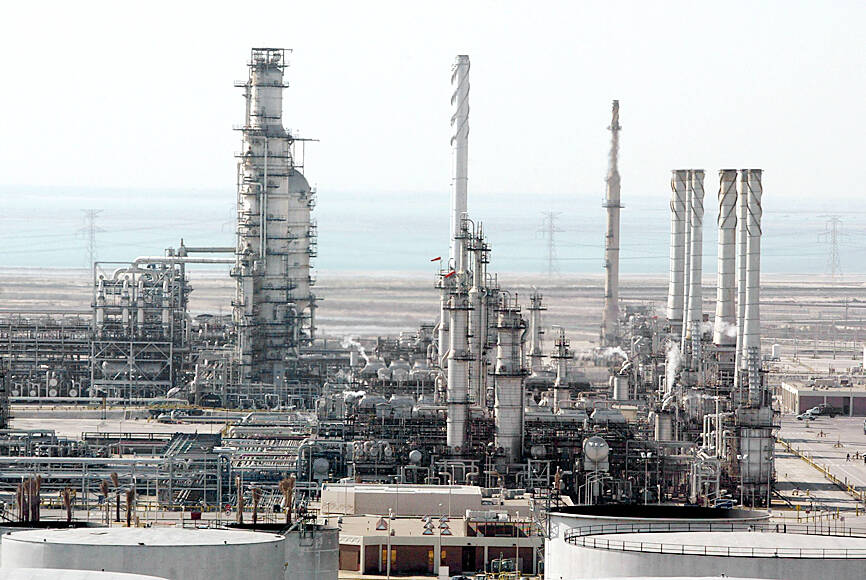
Photo: AFP
US and Israeli strikes against Iran have upended global energy trade, with the Islamic republic effectively shutting the vital Strait of Hormuz and choking off its neighbors’ supplies out of the Persian Gulf. Saudi Arabia and the United Arab Emirates are the only two Gulf producers with significant export alternatives that circumvent the chokepoint.
OPEC+ warned after a weekend meeting that damage to energy assets would have a prolonged impact on oil supply even after hostilities end. Members of the producers’ group approved an increase in output quotas — a signal of intent given that flows from the Persian Gulf remain throttled.
Oil prices fluctuated yesterday as traders tracked record Saudi Arabian crude pricing, a reported push for a ceasefire in the Middle East and a fresh ultimatum from US President Donald Trump on Iran if the Strait of Hormuz were not reopened. Global benchmark Brent traded below US$110 a barrel, while West Texas Intermediate was near US$112.
Control of the Strait of Hormuz — which connects the Persian Gulf to wider markets, especially across Asia — remains central to the conflict. Tehran has imposed its authority over the waterway, permitting just a small number of vessels to pass through, including, in recent days, a French container ship and a Japanese-owned tanker, as well as vessels from Malaysia and Pakistan.
However, Iraq has told traders and refiners they can collect crude cargoes as vessels carrying the nation’s oil are now able to transit the Strait of Hormuz thanks to an Iranian exemption, testing buyers’ confidence in the security guarantee.
In a notice sent on Sunday, the Iraqi State Organization for Marketing of Oil said shipments were now “exempt from any potential restrictions.” It asked buyers to submit schedules, including vessel details and volumes requested, adding that all loading terminals, including Basrah, are “fully operational.”
Customers were given 24 hours to respond.
Iran at the weekend said that its neighbor was now free from shipping restrictions around the vital waterway. Tanker Ocean Thunder, carrying 1 million barrels of Iraqi crude, crossed the narrow waterway after the announcement.
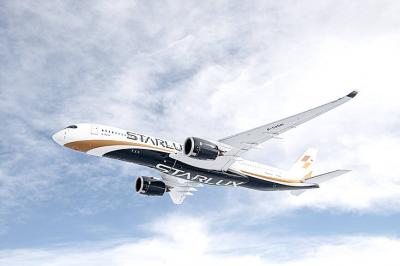
Starlux Airlines Co (星宇航空) today unveiled a long-haul network expansion plan at a shareholders’ meeting in Taipei, including direct flights to Barcelona, Spain, and Zurich, Switzerland, as well as a service connecting Taipei, Sydney and New Zealand. Starlux is to become the first Taiwanese carrier to offer non-stop services to the two European cities, while the inaugural oceanic route is expected to expand transit opportunities within the Australia-New Zealand market, Starlux said. Flight services to Chicago, Dallas, Washington and New York are under evaluation, the airline added. Prior to the shareholders’ meeting, the airline earlier this year announced that it would be

Netherlands-based semiconductor equipment supplier ASML Holding NV yesterday said that it is planning to hire an additional 1,000 people in Taiwan this year in response to growing demand from clients. ASML had previously planned to recruit 600 people this year, but that the plan has been adjusted upward, ASML vice president and ASML Taiwan general manager Grace Wang (汪佳慧) told reporters. ASML has a workforce of more than 4,500 in Taiwan, accounting for about 10 percent of its global total, Wang said. This year’s recruitment campaign would focus on adding people in the customer support, manufacturing and supply chain domains to assist ASML

UNDER MICROSCOPE: Taiwan detained three people who allegedly conspired to buy servers in Taiwan and export them using fraudulent documentation, prosecutors said Nvidia Corp chief executive officer Jensen Huang (黃仁勳) on Saturday urged Super Micro Computer Inc to tighten up on compliance after Taiwan detained three people this week for allegedly making fraudulent declarations about artificial intelligence (AI) servers made by its US partner. The development marked the nation’s first crackdown on semiconductor smuggling, which grew after the US slapped restrictions on exports of high-end chips such as Nvidia AI accelerators to China. Nvidia is “rigorous” in explaining regulations to all of its partners, Huang told reporters after arriving in Taipei. “Ultimately Super Micro has to run their own company,” he said in response to

Nvidia Corp yesterday announced that CEO Jensen Huang (黃仁勳) would attend an employee meeting in Taipei tomorrow to celebrate the launch of the company’s Taiwan headquarters project. Huang would attend a gathering at the site of Nvidia’s planned headquarters in Beitou Shilin Technology Park (北投士林科技園區), the company said in a statement. After arriving in Taiwan on Saturday last week, Huang told reporters that he plans to meet with Quanta Computer Inc (廣達) chairman Barry Lam (林百里) and Taiwan Semiconductor Manufacturing Co (TSMC, 台積電) chairman C.C. Wei (魏哲家), and would attend the groundbreaking ceremony for Nvidia’s Taiwan headquarters tomorrow. Nvidia has not yet applied


 RSS
RSS