


Continental Holdings Corp (CHC, 欣陸投控) yesterday said it expects stable growth in the coming years, supported by a strong project backlog across its construction, property development and environmental engineering businesses.
The Taipei-based conglomerate said combined backlog across its three main segments reached NT$227.9 billion (US$7.16 billion) as of the end of last year, providing solid revenue visibility.
The company’s consolidated revenue rose 12 percent to NT$34.38 billion last year, while net profit increased 26.1 percent to NT$1.48 billion. Earnings per share reached NT$1.8, compared with NT$1.43 a year earlier. The board also approved a cash dividend of NT$1.05 per share.
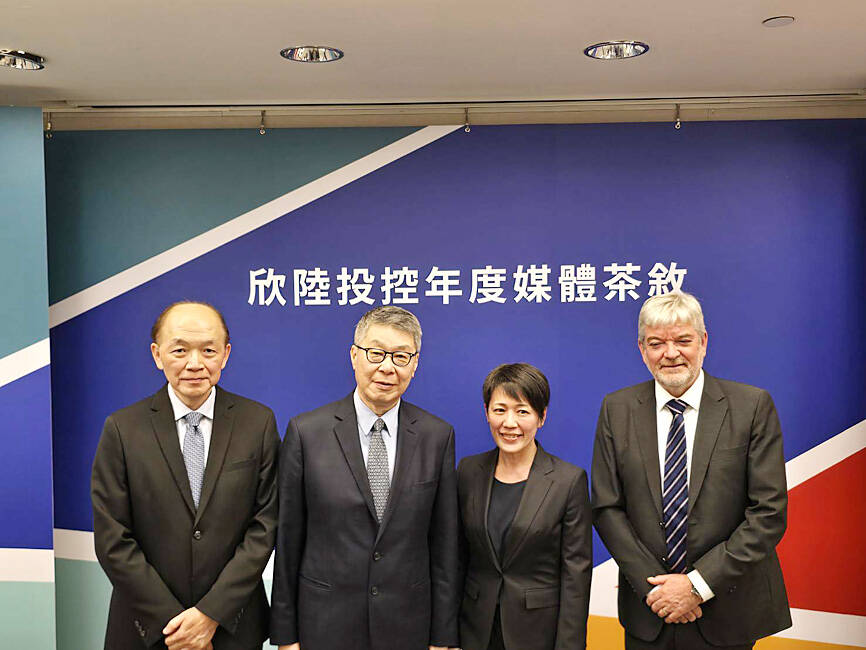
Photo: Chen Yung-chi, Taipei Times
The construction arm, Continental Engineering Corp (大陸工程), delivered stable performance last year, while the group’s other two major subsidiaries — Continental Development Corp (大陸建設) and HDEC Corp (欣達環工) — continued to post solid growth, CHC chief executive officer Cindy Chang (張方欣) said at a briefing in Taipei.
The construction unit, which marked its 80th anniversary last year, secured additional contracts, bringing its backlog to NT$114.7 billion — about 4.9 times its annual revenue.
To improve efficiency and reduce reliance on labor, the firm has been advancing digital transformation by adopting design-for-manufacture-and-assembly methods and expanding off-site prefabrication.
The company has also strengthened the use of building information modeling tools for construction simulation, clash detection and carbon reduction, improving coordination among construction teams, designers and project owners, Chang said.
The group’s property development arm recorded a notable increase in revenue after completing two residential projects. Its backlog stood at NT$25.8 billion, equivalent to about 3.6 times annual revenue, she said.
The company plans to launch four residential projects this year in Taipei, Hsinchu and Taichung, with a combined sales value of NT$28.94 billion.
Units smaller than 50 ping (165m2) would account for about 83 percent of the offerings, reflecting prevailing housing demand for small apartments, the company said.
Urban renewal and redevelopment of unsafe and old buildings would remain its main land development strategy.
In addition to its existing presence in Taipei, New Taipei City, Taichung and Kaohsiung, the company is also closely monitoring areas around high-speed rail and metro stations in Hsinchu and Taoyuan for potential opportunities, Chang said.
The environmental engineering business reported a record backlog of NT$87.4 billion, driven mainly by water treatment projects for private companies in the Hsinchu Science Park (新竹科學園區), she said.
Several projects — including a water reclamation plant in Kaohsiung and a waste-to-energy facility in Tainan — are scheduled to begin operations this year, with nine projects expected to generate stable revenue and profit through 2030, Chang said.
Long-term prospects for the group remain favorable, she said, supported by Taiwan’s expansion and upgrading of rail infrastructure, rising demand for urban renewal driven by aging housing stock, and the growing trend toward a circular economy.
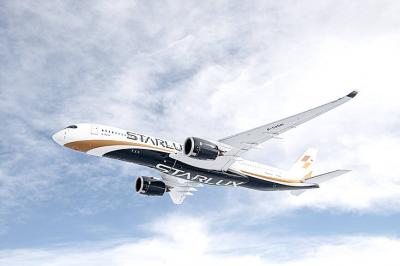
Starlux Airlines Co (星宇航空) today unveiled a long-haul network expansion plan at a shareholders’ meeting in Taipei, including direct flights to Barcelona, Spain, and Zurich, Switzerland, as well as a service connecting Taipei, Sydney and New Zealand. Starlux is to become the first Taiwanese carrier to offer non-stop services to the two European cities, while the inaugural oceanic route is expected to expand transit opportunities within the Australia-New Zealand market, Starlux said. Flight services to Chicago, Dallas, Washington and New York are under evaluation, the airline added. Prior to the shareholders’ meeting, the airline earlier this year announced that it would be
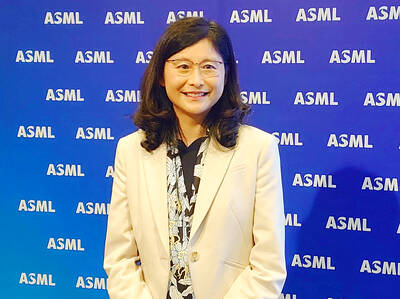
Netherlands-based semiconductor equipment supplier ASML Holding NV yesterday said that it is planning to hire an additional 1,000 people in Taiwan this year in response to growing demand from clients. ASML had previously planned to recruit 600 people this year, but that the plan has been adjusted upward, ASML vice president and ASML Taiwan general manager Grace Wang (汪佳慧) told reporters. ASML has a workforce of more than 4,500 in Taiwan, accounting for about 10 percent of its global total, Wang said. This year’s recruitment campaign would focus on adding people in the customer support, manufacturing and supply chain domains to assist ASML

UNDER MICROSCOPE: Taiwan detained three people who allegedly conspired to buy servers in Taiwan and export them using fraudulent documentation, prosecutors said Nvidia Corp chief executive officer Jensen Huang (黃仁勳) on Saturday urged Super Micro Computer Inc to tighten up on compliance after Taiwan detained three people this week for allegedly making fraudulent declarations about artificial intelligence (AI) servers made by its US partner. The development marked the nation’s first crackdown on semiconductor smuggling, which grew after the US slapped restrictions on exports of high-end chips such as Nvidia AI accelerators to China. Nvidia is “rigorous” in explaining regulations to all of its partners, Huang told reporters after arriving in Taipei. “Ultimately Super Micro has to run their own company,” he said in response to

Nvidia Corp yesterday announced that CEO Jensen Huang (黃仁勳) would attend an employee meeting in Taipei tomorrow to celebrate the launch of the company’s Taiwan headquarters project. Huang would attend a gathering at the site of Nvidia’s planned headquarters in Beitou Shilin Technology Park (北投士林科技園區), the company said in a statement. After arriving in Taiwan on Saturday last week, Huang told reporters that he plans to meet with Quanta Computer Inc (廣達) chairman Barry Lam (林百里) and Taiwan Semiconductor Manufacturing Co (TSMC, 台積電) chairman C.C. Wei (魏哲家), and would attend the groundbreaking ceremony for Nvidia’s Taiwan headquarters tomorrow. Nvidia has not yet applied


 RSS
RSS