


Airoha Technology Corp (達發科技), a supplier of network and communications chips, yesterday said that revenue would grow moderately this year, driven by rising demand for optical fiber chips used in artificial intelligence (AI) data centers and Ethernet chips for ground stations of low Earth orbit satellites.
Airoha, 66.41 percent owned by the world’s largest smartphone chip designer, MediaTek Inc (聯發科), reported record-high revenue last year of NT$20.93 billion (US$669.7 million), up 9.4 percent from NT$19.12 billion in 2024.
“We expect optical fiber and Ethernet chips to deliver the strongest growth. The two product lines are likely to account for about 20 percent of the company’s total revenue this year,” Airoha executive vice president M.H. Shieh (謝孟翰) told an earnings conference yesterday.
Photo courtesy of Airoha Technology Corp
Airoha expects its optical fiber chips to enjoy high-speed growth this year and over the next few years as optical fiber transceiver modules remain the top choice for AI data center operators, Shieh said.
The company plans to start volume production of a new high-speed single-lane digital signal processor (DSP) supporting 100 gigabit transmission in the middle of this year, he said.
The 100-gigabit-per-second SerDes DSP is critical for data center interconnects, enabling high-speed data transmission over a single optical lane using PAM4 technology, Shieh said.
Marvell Technology Inc and Broadcom Inc are the leading suppliers of high-speed DSPs.
Airoha expects high-speed DSPs supporting transmission speed of 400 gigabits, 800 gigabits or 1.6 terabits per second to remain the mainstream technology for optical fiber modules in the next five years, while copackaged optics (CPO) technology would support much higher-speed transmission up to 3.2 terabits per second for the main AI chips, he said.
Nvidia Corp is expected to adopt CPO technology for new AI chips to address power consumption issues.
In addition, Airoha expects rapid deployment of low Earth orbit satellites this year to fuel demand for the company’s ethernet chips used in ground stations and receivers, Shieh said.
Strong customer demand and higher average selling prices are expected to boost the revenue contribution of networking chips — fixed broadband chips, ethernet chips and optical fiber chips — from 45 percent of the total last year and 35 percent in 2024, he said.
Bluetooth chips accounted for 50 percent of the company’s revenue last year, he added.
Airoha counts major cloud service providers and optical fiber transceiver module makers among its customers.
This quarter’s revenue is expected to grow sequentially and annually, bucking the traditional downtrend in the first quarter of the year, Shieh said.
Airoha reported net profit of NT$533 million for the fourth quarter of last year, down 8.6 percent year-on-year and 35.4 percent quarter-on-quarter.
Last year’s net profit grew 8.2 percent to NT$2.83 billion from NT$2.61 billion in 2024, with earnings per share rising to NT$17.32 from NT$16.1.
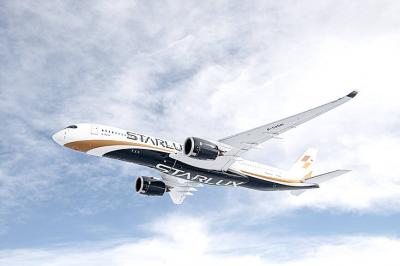
Starlux Airlines Co (星宇航空) today unveiled a long-haul network expansion plan at a shareholders’ meeting in Taipei, including direct flights to Barcelona, Spain, and Zurich, Switzerland, as well as a service connecting Taipei, Sydney and New Zealand. Starlux is to become the first Taiwanese carrier to offer non-stop services to the two European cities, while the inaugural oceanic route is expected to expand transit opportunities within the Australia-New Zealand market, Starlux said. Flight services to Chicago, Dallas, Washington and New York are under evaluation, the airline added. Prior to the shareholders’ meeting, the airline earlier this year announced that it would be

Netherlands-based semiconductor equipment supplier ASML Holding NV yesterday said that it is planning to hire an additional 1,000 people in Taiwan this year in response to growing demand from clients. ASML had previously planned to recruit 600 people this year, but that the plan has been adjusted upward, ASML vice president and ASML Taiwan general manager Grace Wang (汪佳慧) told reporters. ASML has a workforce of more than 4,500 in Taiwan, accounting for about 10 percent of its global total, Wang said. This year’s recruitment campaign would focus on adding people in the customer support, manufacturing and supply chain domains to assist ASML
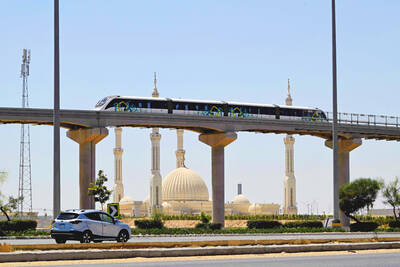
Cairo’s new monorail slices across the city skyline, running above the familiar chaos of blaring horns and aging buses’ exhaust fumes that mark rush hour below. The US$4.5 billion monorail, opened this month, is among Egypt’s most prominent new transport projects, part of a debt-funded infrastructure drive criticized for sapping state finances while bringing limited benefits to most of the country’s 109 million people. “It feels like you’re in a different country,” said Ramy Sayed, a restaurant manager, aboard a driverless Innovia 300 train. “No noise, no traffic, we’re not used to this.” The eastern line runs 56km from the bustling middle-class

UNDER MICROSCOPE: Taiwan detained three people who allegedly conspired to buy servers in Taiwan and export them using fraudulent documentation, prosecutors said Nvidia Corp chief executive officer Jensen Huang (黃仁勳) on Saturday urged Super Micro Computer Inc to tighten up on compliance after Taiwan detained three people this week for allegedly making fraudulent declarations about artificial intelligence (AI) servers made by its US partner. The development marked the nation’s first crackdown on semiconductor smuggling, which grew after the US slapped restrictions on exports of high-end chips such as Nvidia AI accelerators to China. Nvidia is “rigorous” in explaining regulations to all of its partners, Huang told reporters after arriving in Taipei. “Ultimately Super Micro has to run their own company,” he said in response to


 RSS
RSS