


King Liu (劉金標), founder of Taiwanese bicycle maker Giant Group (巨大集團) and a self-described "missionary" for cycling culture, died yesterday at the age of 92, the company said.
Liu started Giant in 1972 in his hometown of Taichung, a manufacturing hub in central Taiwan, making bikes for overseas brands before the company got its own label in 1981.
Giant is now one of the biggest bicycle makers in the world, pulling in more than US$2 billion in sales a year and selling millions of bikes annually.
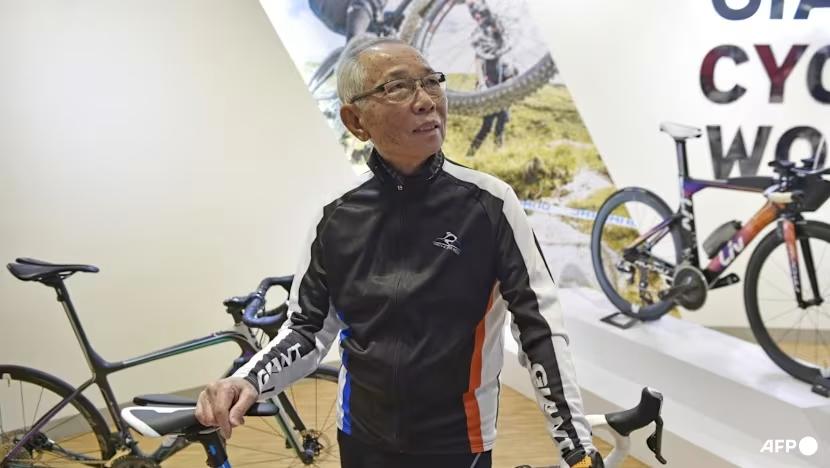
Photo: Sam Yeh, AFP
Liu "passed away peacefully" early yesterday, Giant Group said in a statement, describing him as a "lifelong advocate" for pedal power.
"Throughout his life, Mr Liu devoted himself to bicycles, believing they represented not merely a business, but a meaningful way of life," Giant said.
Born into a well-off family in central Taiwan on July 2, 1934, Liu worked briefly in his father’s trading and food manufacturing company but was soon itching to branch out on his own.
He dabbled in a range of businesses, including trucking cargo, importing fish feed and even farming eels.
His venture into cycling came at a friend’s suggestion during a brainstorming session to tap into the US market.
To better understand the product, Liu biked to work during Giant’s first few years, but the habit fell by the wayside as the company grew.
Giant formed its own brand at a time when the label "Made in Taiwan" bore the stigma of cheap, low-quality goods and cycling was still seen locally as a poor man’s mode of transport.
It shifted over the years to higher-end production and now promotes cycling as a leisure sport.
Liu told AFP in 2016 he got into cycling seriously at the age of 73 after years out of the saddle. "I was an old man contemplating retirement, but funnily enough, I instead discovered a brand-new me," he said of his first major ride, more than 900 kilometers (560 miles) around the island’s rugged coastline.
"It boosted my self-confidence, my health, and I became more willing to learn new things, to take on new challenges."
Liu said he saw himself as a "missionary" spreading cycle culture.
Several members of Liu’s family, including his children, have occupied senior management roles in Giant, although his eldest daughter Vicky Liu (劉麗珠) once told the Chinese-language China Times that working with him was "painful."
"There will be one day when I can’t pedal my bike anymore," King Liu told AFP in 2016. "I hope that day will keep getting pushed back again and again."

SECOND-RATE: Models distilled from US products do not perform the same as the original and undo measures that ensure the systems are neutral, the US’ cable said The US Department of State has ordered a global push to bring attention to what it said are widespread efforts by Chinese companies, including artificial intelligence (AI) start-up DeepSeek (深度求索), to steal intellectual property from US AI labs, according to a diplomatic cable. The cable, dated Friday and sent to diplomatic and consular posts around the world, instructs diplomatic staff to speak to their foreign counterparts about “concerns over adversaries’ extraction and distillation of US AI models.” Distillation is the process of training smaller AI models using output from larger, more expensive ones to lower the costs of training a powerful new
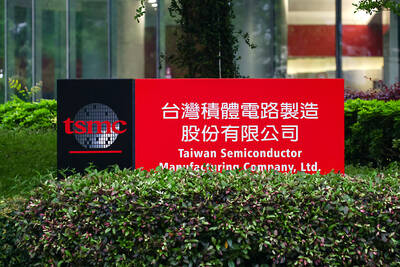
Shares of Taiwan Semiconductor Manufacturing Co (TSMC, 台積電) have repeatedly hit new highs, but an equity analyst said the stock’s valuation remains within a reasonable range and any pullback would likely be technical. The contract chipmaker’s historical price-to-earnings (P/E) ratio has ranged between 20 and 30, Cathay Futures Consultant Co (國泰證期) analyst Tsai Ming-han (蔡明翰) told Central News Agency. With market consensus projecting that TSMC would post earnings per share of about NT$100 (US$3.17) this year, supported by strong global demand for artificial intelligence (AI) applications, and the stock currently trading at a P/E ratio of below 25, Tsai said the valuation
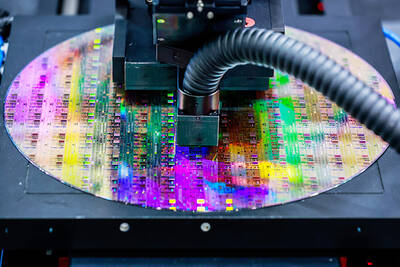
The artificial intelligence (AI) boom has triggered a seismic reshuffling of global equity markets, with Taiwan and South Korea muscling past European nations one by one. With its stock market now valued at nearly US$4.3 trillion, Taiwan surpassed the UK, Europe’s biggest market, earlier this month, data compiled by Bloomberg showed. South Korea is about US$140 billion away from doing the same. The tech-heavy Asian markets have shot past Germany and France in the past seven months. The shift is largely down to massive gains in shares of three companies that provide essential hardware for AI: Taiwan Semiconductor Manufacturing Co (TSMC, 台積電),
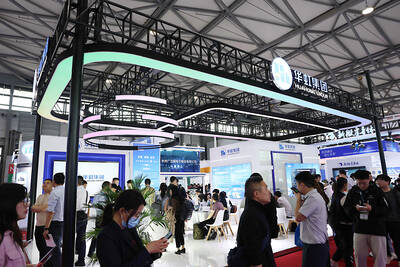
The US Department of Commerce last week ordered multiple chip equipment companies to halt shipments of certain tools to China’s second-largest chipmaker, Hua Hong Semiconductor Ltd (華虹半導體), its latest action to slow the country’s development of advanced chips, two people familiar with the matter said. The department sent letters to at least a handful of companies informing them of restrictions on tools and other materials destined for two Hua Hong facilities US officials believe make China’s most sophisticated chips, the people said. Top US chip equipment companies Lam Research Corp, Applied Materials Inc and KLA Corp, each of which has significant


 RSS
RSS