


Vietnam has granted a license to Starlink to operate its satellite Internet services in the country, a government agency said.
The radio frequency regulator said local unit Starlink Services Vietnam Co can initially deploy four gateway stations and a maximum of 600,000 terminal devices in Vietnam.
The licensing requires Starlink to ensure “no interference with existing radio communication networks,” the Authority of Radio Frequency Management announced on Saturday.
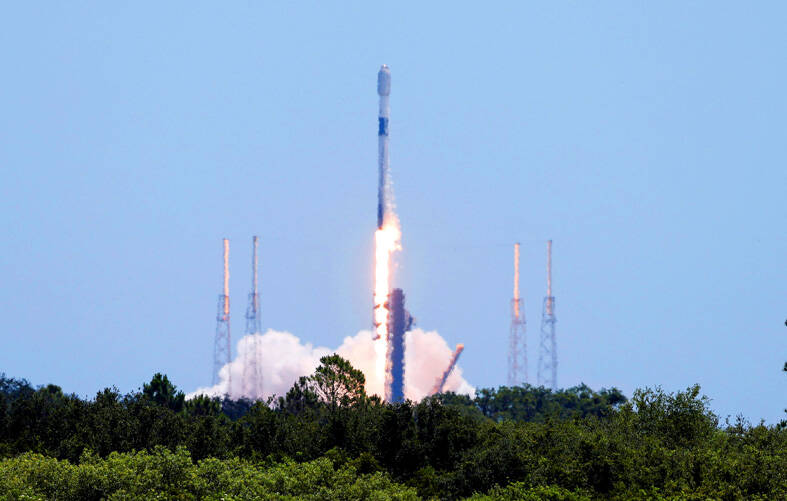
Photo: Reuters
The Starlink system would contribute to “expanding satellite internet connectivity,” it added.
Starlink provides high-speed Internet access to remote locations across the world via thousands of low Earth orbit satellites.
Nearly 80 percent of Vietnam’s approximately 100 million people are Internet users, according to the Vietnam Internet Network Information Center.
But gaps in access to Internet service remain in rural and mountainous areas.
Parent company Space Exploration Technologies Corp (SpaceX) did not immediately reply to a request for comment from AFP.
US-based Starlink says its services in Vietnam are “coming soon,” according to an availability map on its Web site.
Vietnam and the US are negotiating a trade deal after Washington imposed 20 percent tariffs on Vietnamese goods last year.
The two countries held a sixth round of talks this month, but have not reached a final agreement.
Vietnamese President To Lam travels to the US this week for a meeting of US President Donald Trump’s “Board of Peace,” two sources briefed on the visit told AFP last week.
The board, of which Trump is the chairman, was originally intended to oversee the Gaza Strip after two years of war, but its charter appears to extend beyond the Palestinian territory.
The first meeting is scheduled to take place on Thursday in Washington.
It was not clear if Lam, general secretary of the Vietnamese Communist Party, would hold trade talks with Trump.
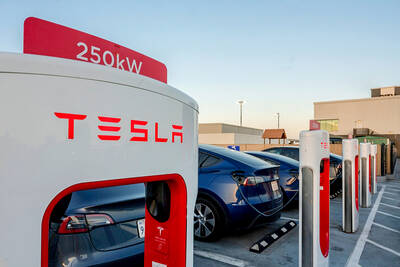
NEW IMPORTS: Car dealer PG Union Corp said it would consider introducing US-made models such as the Jeep Grand Cherokee and Stellantis’ RAM 1500 to Taiwan Tesla Taiwan yesterday said that it does not plan to cut its car prices in the wake of Washington and Taipei signing the Agreement on Reciprocal Trade on Thursday to eliminate tariffs on US-made cars. On the other hand, Mercedes-Benz Taiwan said it is planning to lower the price of its five models imported from the US after the zero tariff comes into effect. Tesla in a statement said it has no plan to adjust the prices of the US-made Model 3, Model S and Model X as tariffs are not the only factor the automaker uses to determine pricing policies. Tesla said
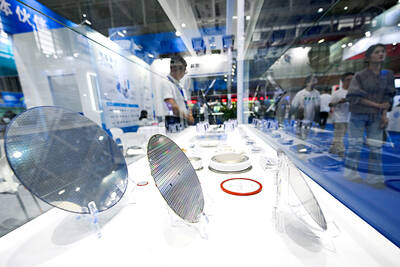
China’s top chipmaker has warned that breakaway spending on artificial intelligence (AI) chips is bringing forward years of future demand, raising the risk that some data centers could sit idle. “Companies would love to build 10 years’ worth of data center capacity within one or two years,” Semiconductor Manufacturing International Corp (SMIC, 中芯) cochief executive officer Zhao Haijun (趙海軍) said yesterday on a call with analysts. “As for what exactly these data centers will do, that hasn’t been fully thought through.” Moody’s Ratings projects that AI-related infrastructure investment would exceed US$3 trillion over the next five years, as developers pour eye-watering sums

OpenAI has warned US lawmakers that its Chinese rival DeepSeek (深度求索) is using unfair and increasingly sophisticated methods to extract results from leading US artificial intelligence (AI) models to train the next generation of its breakthrough R1 chatbot, a memo reviewed by Bloomberg News showed. In the memo, sent on Thursday to the US House of Representatives Select Committee on China, OpenAI said that DeepSeek had used so-called distillation techniques as part of “ongoing efforts to free-ride on the capabilities developed by OpenAI and other US frontier labs.” The company said it had detected “new, obfuscated methods” designed to evade OpenAI’s defenses
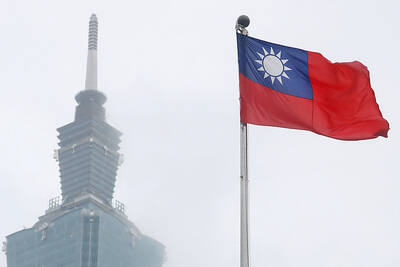
Bank of America Corp nearly doubled its forecast for the nation’s economic growth this year, adding to a slew of upgrades even after a rip-roaring last year propelled by demand for artificial intelligence (AI). The firm lifted its projection to 8 percent from 4.5 percent on “relentless global demand” for the hardware that Taiwanese companies make, according to a note dated yesterday by analysts including Xiaoqing Pi (皮曉青). Taiwan’s GDP expanded 8.63 percent last year, the fastest pace since 2010. The increase “reflects our sustained optimism over Taiwan’s technology driven expansion and is reinforced by several recent developments,” including a more stable currency,


 RSS
RSS