


The union at TaiDoc Technology Corp (泰博科技) yesterday protested outside the Ministry of Labor, accusing the medical device maker of undermining its operations, a claim the company rejected, blaming the dispute on the involvement of an "outsider."
After "illegally dismissing" the Taidoc Technology Labor Union chair, a Filipina worker named Elizabeth Basas, TaiDoc posted notices around the workplace targeting her, said Lennon Wang (汪英達), director of the Department of Policies on Migrant Workers at the labor rights non-governmental organization Serve the People Association.
Wang, who also serves as the union's secretary-general, said at the protest that the notices accused Basas of "colluding with outsiders," "forging documents" and "damaging the company's image."
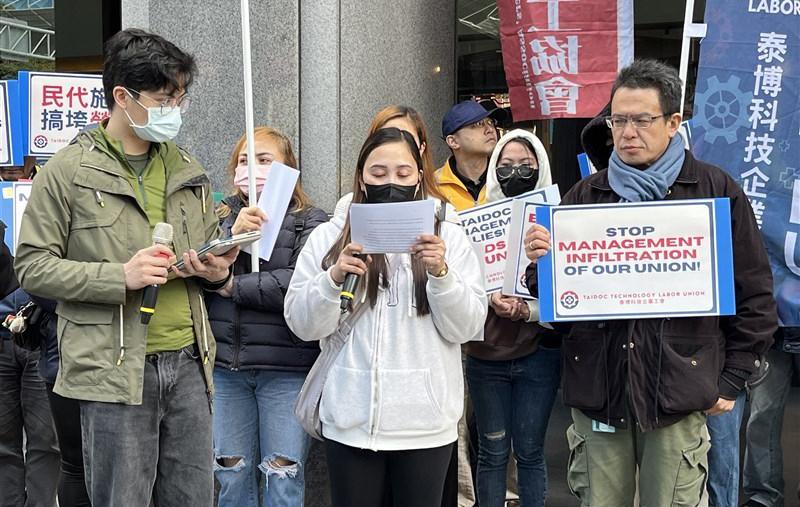
Photo: CNA
"It's meant to humiliate the chair and the union, and to intimidate other workers by signaling that joining the union comes with consequences," Wang said, adding that Basas' employment contract was not due to expire until September next year.
The union now has about 30 Filipino members and has already registered with the New Taipei City government's Labor Affairs Department, Wang said.
The union was formed about six months ago to address issues including what it described as overly strict rules on migrant workers — such as dormitory management practices it alleged amounted to forced labor — but has faced continued pressure from management since its formation, Wang said.
TaiDoc on Wednesday last week also held a meeting during work hours to "force" employees to join the union, Wang said, calling the move "problematic" and an attempt to control the union.
The company unilaterally announced that more than 100 employees had become union members that day, he said, adding that new membership applications must be reviewed by the union and it had not yet held a meeting to do so.
TaiDoc's response
Responding to the union's accusations, TaiDoc chairman Chen Chao-wang (陳朝旺) held a news conference in the afternoon, attended by some Taiwanese employees who the company said had recently joined the union.
Wang is not a company employee, but an "outsider" trying to influence others' actions, which is illegal under the Labor Union Act (工會法), Chen said.
"An external secretary-general is actually blocking TaiDoc's rank-and-file employees from joining the union," Chen said, criticizing Wang for "disrupting Taiwan's industrial order."
However, Article 12 of the act does not explicitly prohibit a union from appointing or hiring a non-employee as its secretary-general.
Chen also questioned the union's decision to launch a strike vote, saying the union claimed it had passed the vote, citing union figures of 38 members, 25 ballots cast and a 23-2 vote in favor.
He disputed the legitimacy of the move given the company's headcount of nearly 1,000 employees, calling it "absurd" and saying that the voting process was fraudulent and undermined Taiwan's democratic system.
The ministry said in a statement that it received a submission from the union on Monday last week requesting an investigation into allegations that TaiDoc management had sought to interfere in union affairs.
The ministry would conduct a lawful investigation at upcoming meetings, it said.
Employers should respect the independent operations of unions and "refrain from any improper obstruction or influence," the ministry said.
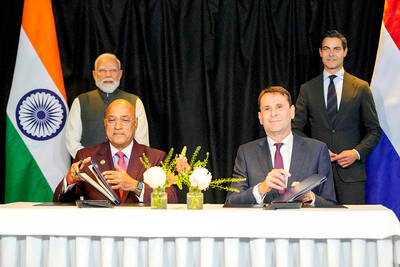
NEW MARKET: The partnership opens up India to the Dutch company, which already has a strong hold in the semiconductor market of South Korea, Taiwan and China ASML Holding NV entered into a partnership agreement with Tata Electronics Pvt Ltd aimed at ramping up India’s goal to develop domestic chip-manufacturing capabilities. The Dutch company’s technology would help power Tata Electronics’ planned 300 millimeter (mm) semiconductor foundry in Gujarat, according to a joint statement from the two companies on Saturday. The signing of a memorandum of understanding coincides with a visit by Indian Prime Minister Narendra Modi to the Netherlands, which is looking to deepen bilateral relations with New Delhi. ASML, whose top customers include Taiwan Semiconductor Manufacturing Co (台積電) and Samsung Electronics Co, makes lithography machines that can print
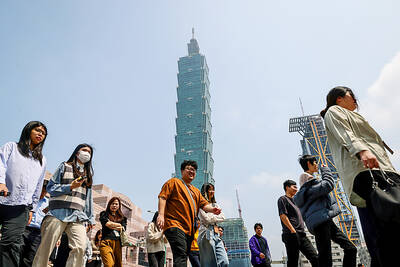
TECH RELIANCE: Growth is increasingly reflecting an unequal K-shaped distribution, where technology sectors outperform and other industries struggle, an expert said Standard Chartered Bank has significantly raised its forecast for Taiwan’s economic growth to 9.5 percent this year, up from 7.6 percent previously, citing surging artificial intelligence (AI) demand driving exports, semiconductor production and investment. The upgrade reflects a sustained AI supercycle that continues to fuel demand for advanced chips and technology infrastructure, which form the backbone of Taiwan’s exports, the bank said in a report this week. “We raise our 2026 growth forecast to reflect a much stronger-than-expected first-quarter GDP figure,” Standard Chartered senior economist for greater China and Asia Tommy Wu (胡東安) said in the report. Driven largely by a 35.3 percent
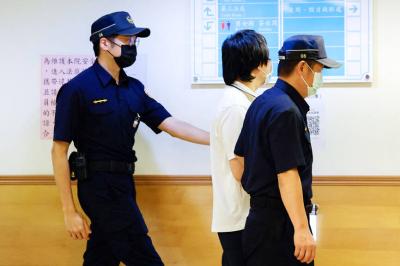
Tokyo Electron's Taiwan unit today said in a written response that it respects the judicial process, takes the court ruling seriously and would not appeal in the Taiwan Semiconductor Manufacturing Co (TSMC, 台積電) trade secrets case. Last month, a court fined the Taiwan unit of Japan's Tokyo Electron NT$150 million (US$4.74 million) in a case involving trade secrets related to TSMC's sensitive chip technology.

Two of Taiwan’s international carriers, Starlux Airlines Co (星宇航空) and EVA Airways Corp (長榮航空), have retained the five-star airline rating awarded by international airline review organization Skytrax. Starlux was awarded the distinction for a second consecutive year, while EVA Air received it for the 11th straight year, Skytrax said in statements released yesterday and on Thursday last week, respectively. The five-star rating is considered one of the airline industry's highest honors and is awarded following professional audits of airline product and frontline service standards, Skytrax said. The ratings are based on in-depth assessments using unified global quality standards rather than customer review scores


 RSS
RSS