


Communication with the US Department of the Treasury remains smooth after Washington released its latest foreign exchange report, which kept Taiwan on its monitoring list, but stopped short of labeling any major trading partner a currency manipulator, the central bank said yesterday.
Taiwan met only two of the three criteria in the Report to Congress on Macroeconomic and Foreign Exchange Policies of Major Trading Partners, which is used by the US to assess currency practices, citing a large bilateral trade surplus and a high current account surplus, while its foreign exchange intervention did not breach the Treasury’s threshold, the central bank said.
The bank reported net purchases of foreign exchange of US$5.9 billion for the four quarters ending in June last year, or about 0.7 percent of GDP, it said, quoting the report.
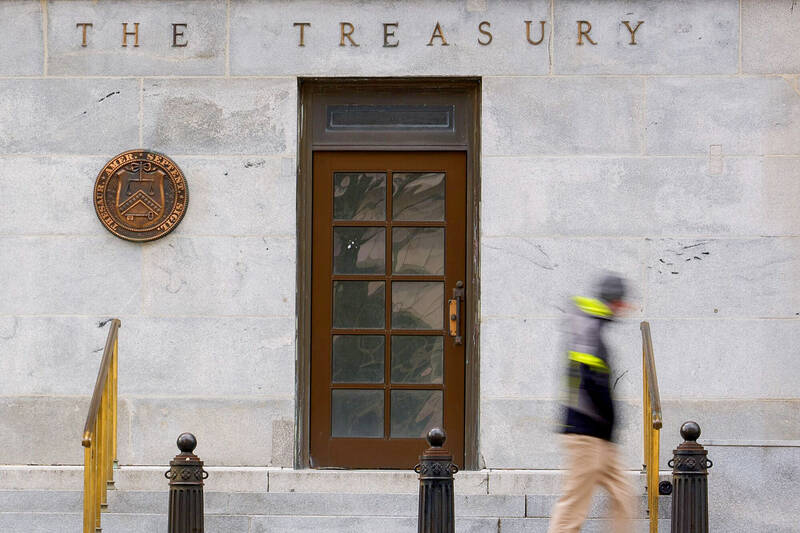
Photo: Bloomberg
Taiwan’s persistently high current account surplus reflects structural factors, including a high savings rate linked to an aging population and relatively strict fiscal discipline, rather than exchange rate misalignment, the bank said.
The sharp rise in Taiwan’s trade surplus with the US in the past few years has been driven by robust demand for Taiwanese-made technology products, it said.
Addressing US concerns over market intervention, the bank said its foreign exchange operations have become increasingly symmetric since 2021, aimed at smoothing excessive volatility in either direction rather than influencing the currency’s long-term trend.
It has also enhanced transparency, with semi-annual disclosures of intervention data starting in 2020 and having committed in a joint statement with the Treasury in November last year to release the data at least quarterly, it said.
The central bank said that measures — including restrictions on foreign investors’ use of fixed-income products, stock instruments and inverse exchange-traded funds, as well as requirements that inward remittances be used for domestic securities investment — helped curb speculative activity in the New Taiwan dollar.
It said it would continue to engage constructively with the Treasury on macroeconomic and exchange rate issues, while maintaining a market-determined exchange rate and safeguarding financial stability.
The central bank’s remarks came after the Treasury said on Thursday that it was boosting scrutiny of the foreign exchange practices of major trading partners, including their interventions to resist depreciation and appreciation against the US dollar, but it did not accuse any major trading partner of currency manipulation.
In its latest semi-annual currency report, the Treasury said no major trading partner met all three criteria for enhanced analysis of currency practices during the second half of 2024 and the first six months of last year.
The Treasury added Thailand to its “monitoring list” of countries warranting close attention due to the growth of the Asian country’s global current account surplus and its trade surplus with the US.
The addition took the monitoring list to 10 economies, with China, Japan, South Korea, Taiwan, Singapore, Vietnam, Germany, Ireland and Switzerland also on the list.
The report has traditionally focused on whether countries are engaging in one-sided currency intervention or other manipulation to resist appreciation against the US dollar to keep their exports cheaper.
The Treasury said it “is now monitoring more broadly the extent to which economies that choose to smooth exchange rate movements do so to resist depreciation pressure in the same manner as they do to resist appreciation pressure.”
Sweeping policy changes under US Secretary of Health and Human Services Robert F. Kennedy Jr are having a chilling effect on vaccine makers as anti-vaccine rhetoric has turned into concrete changes in inoculation schedules and recommendations, investors and executives said. The administration of US President Donald Trump has in the past year upended vaccine recommendations, with the country last month ending its longstanding guidance that all children receive inoculations against flu, hepatitis A and other diseases. The unprecedented changes have led to diminished vaccine usage, hurt the investment case for some biotechs, and created a drag that would likely dent revenues and

Macronix International Co (旺宏), the world’s biggest NOR flash memory supplier, yesterday said it would spend NT$22 billion (US$699.1 million) on capacity expansion this year to increase its production of mid-to-low-density memory chips as the world’s major memorychip suppliers are phasing out the market. The company said its planned capital expenditures are about 11 times higher than the NT$1.8 billion it spent on new facilities and equipment last year. A majority of this year’s outlay would be allocated to step up capacity of multi-level cell (MLC) NAND flash memory chips, which are used in embedded multimedia cards (eMMC), a managed

CULPRITS: Factors that affected the slip included falling global crude oil prices, wait-and-see consumer attitudes due to US tariffs and a different Lunar New Year holiday schedule Taiwan’s retail sales ended a nine-year growth streak last year, slipping 0.2 percent from a year earlier as uncertainty over US tariff policies affected demand for durable goods, data released on Friday by the Ministry of Economic Affairs showed. Last year’s retail sales totaled NT$4.84 trillion (US$153.27 billion), down about NT$9.5 billion, or 0.2 percent, from 2024. Despite the decline, the figure was still the second-highest annual sales total on record. Ministry statistics department deputy head Chen Yu-fang (陳玉芳) said sales of cars, motorcycles and related products, which accounted for 17.4 percent of total retail rales last year, fell NT$68.1 billion, or

In the wake of strong global demand for AI applications, Taiwan’s export-oriented economy accelerated with the composite index of economic indicators flashing the first “red” light in December for one year, indicating the economy is in booming mode, the National Development Council (NDC) said yesterday. Moreover, the index of leading indicators, which gauges the potential state of the economy over the next six months, also moved higher in December amid growing optimism over the outlook, the NDC said. In December, the index of economic indicators rose one point from a month earlier to 38, at the lower end of the “red” light.


 RSS
RSS