


Taiwan’s financial regulator is exploring tax incentives for family offices and expanding private banking services as part of its efforts to build up its wealth and asset management industry.
The Financial Supervisory Commission (FSC) yesterday said it would look at potential tax incentives to enhance Taiwan’s competitiveness and meet with financial institutions to help banks establish institutional family office services. The commission is considering rolling out some of the most popular private banking operations piloted in Kaohsiung such as Lombard lending to other parts of the country, it said.
“In developing family offices, we are mindful of regional competition and potential tax issues,” FSC Banking Bureau Director-General Phil Tong (童政彰) said at a news conference in New Taipei City. “We will explore possible tax incentives through workshops with the industry.”
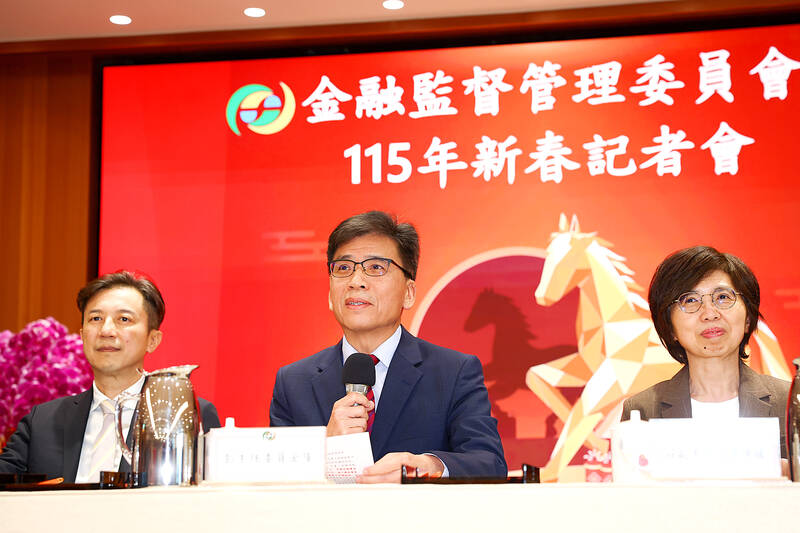
Photo: CNA
Taiwanese regulators have pledged to strengthen the local finance sector on top of its dominance in advanced semiconductor production to build buffers amid rising pressure from China.
“Whenever people talk about Taiwan, they often mention geopolitical risk,” FSC Chairman Peng Jin-lung (彭金隆) said. “As our financial market becomes increasingly connected with the international community, our resilience will continue to grow.”
Since 2024, total assets under management in Taiwan’s financial industry have grown by NT$4.95 trillion (US$158 billion), the company said in a statement yesterday.
The FSC is steering the country’s US$1 trillion life insurance sector through a critical period of change, as the industry adopts a new accounting framework this year that imposes stricter capital requirements but eases hedging requirements.
The insurers have been battered by market headwinds in the past few years, including by the New Taiwan dollar’s sharp appreciation last year. The sector holds more than US$700 billion in foreign assets, raising the currency risk for companies as they pay out to policy holders primarily in NT dollars.
Regulators overhauled accounting rules to ease the requirement to immediately reflect currency fluctuations on financial statements, reducing the need for insurers to spend billions on hedging costs. The approach provides insurers with much-needed relief, but has sparked debate over the appropriateness of such a shift.
“Even the soundest policy will inevitably face questions and discussions, and skepticism tends to arise from a lack of information,” Peng said. “International observers might not easily access all the details on Taiwan, leading them to speculate or make inferences based on their expertise or standpoint.”
Local insurers have largely unwound their hedge positions in non-deliverable forwards and proxies, and are gradually cutting onshore hedges, FSC Insurance Bureau Director-General Wang Li-hui (王麗惠) said.
The unwinding activity in the offshore markets should not affect NT dollar’s spot rate, she said.
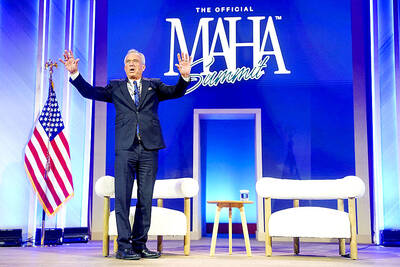
Sweeping policy changes under US Secretary of Health and Human Services Robert F. Kennedy Jr are having a chilling effect on vaccine makers as anti-vaccine rhetoric has turned into concrete changes in inoculation schedules and recommendations, investors and executives said. The administration of US President Donald Trump has in the past year upended vaccine recommendations, with the country last month ending its longstanding guidance that all children receive inoculations against flu, hepatitis A and other diseases. The unprecedented changes have led to diminished vaccine usage, hurt the investment case for some biotechs, and created a drag that would likely dent revenues and

Macronix International Co (旺宏), the world’s biggest NOR flash memory supplier, yesterday said it would spend NT$22 billion (US$699.1 million) on capacity expansion this year to increase its production of mid-to-low-density memory chips as the world’s major memorychip suppliers are phasing out the market. The company said its planned capital expenditures are about 11 times higher than the NT$1.8 billion it spent on new facilities and equipment last year. A majority of this year’s outlay would be allocated to step up capacity of multi-level cell (MLC) NAND flash memory chips, which are used in embedded multimedia cards (eMMC), a managed

CULPRITS: Factors that affected the slip included falling global crude oil prices, wait-and-see consumer attitudes due to US tariffs and a different Lunar New Year holiday schedule Taiwan’s retail sales ended a nine-year growth streak last year, slipping 0.2 percent from a year earlier as uncertainty over US tariff policies affected demand for durable goods, data released on Friday by the Ministry of Economic Affairs showed. Last year’s retail sales totaled NT$4.84 trillion (US$153.27 billion), down about NT$9.5 billion, or 0.2 percent, from 2024. Despite the decline, the figure was still the second-highest annual sales total on record. Ministry statistics department deputy head Chen Yu-fang (陳玉芳) said sales of cars, motorcycles and related products, which accounted for 17.4 percent of total retail rales last year, fell NT$68.1 billion, or

In the wake of strong global demand for AI applications, Taiwan’s export-oriented economy accelerated with the composite index of economic indicators flashing the first “red” light in December for one year, indicating the economy is in booming mode, the National Development Council (NDC) said yesterday. Moreover, the index of leading indicators, which gauges the potential state of the economy over the next six months, also moved higher in December amid growing optimism over the outlook, the NDC said. In December, the index of economic indicators rose one point from a month earlier to 38, at the lower end of the “red” light.


 RSS
RSS