


The US Federal Reserve on Wednesday held interest rates steady at its first policy gathering this year, citing robust economic growth, as the central bank resists US President Donald Trump’s mounting pressure for cuts.
Trump has sharply escalated his targeting of the Fed since returning to the White House in January last year, seeking to oust a key official among its leadership in what Fed Chairman Jerome Powell said could be the “most important legal case” in the institution’s long history.
However, on Wednesday, the Fed voted 10-2 to maintain rates at a range of 3.50 percent to 3.75 percent, an outcome that was widely expected as officials await more data on the world’s biggest economy.
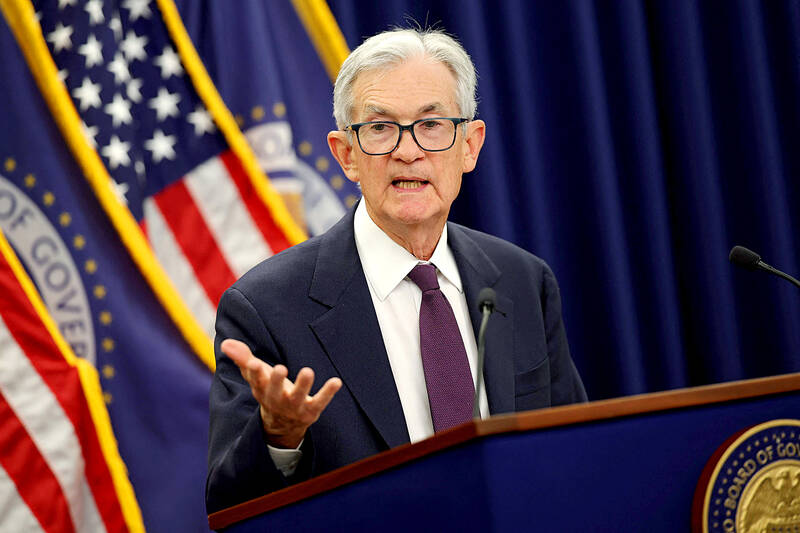
Photo: Getty
In a statement, policymakers flagged that economic activity was “expanding at a solid pace,” while the unemployment rate showed some “signs of stabilization.”
The rate-setting Federal Open Market Committee saw two dissents.
Fed governors Stephen Miran and Christopher Waller — the latter seen as a candidate to succeed Powell — backed a quarter-percentage-point rate cut instead.
The Fed has made quarter-point cuts at its last three policy meetings, as officials worried about the cooling jobs market. However, solid GDP growth, relatively steady unemployment and stubborn inflation have provided reasons to pause cuts, putting officials again at odds with Trump, who has repeatedly urged for lower interest rates.
Policymakers have warned that Trump’s actions could threaten the bank’s independence from politics.
However, Powell stressed at a press briefing on Wednesday that he did not believe the bank would lose its independence.
Trump has sought to oust Fed Governor Lisa Cook over mortgage fraud allegations, while his administration launched an investigation into Powell over the bank’s headquarters renovation.
In a rare rebuke earlier this month, Powell criticized the threat of criminal charges against him, saying this was about whether monetary policy would be “directed by political pressure or intimidation.”
He did not elaborate on Wednesday on the probe.
The Fed is “in no hurry to cut interest rates again,” Navy Federal Credit Union chief economist Heather Long said, adding that she saw policymakers “in a stalemate.”
“Leaders like Miran and Waller who were worried about the labor market don’t have as many supporters now, and similarly, Fed leaders who were concerned about inflation also seem to have backed off,” she added.
Long said she expects a “shake-up” to come as Powell’s term as Fed chairman ends in May, with Trump’s new appointee taking office.
Powell said the Fed would let economic data “light the way” on the future path of interest rates.
A weakening labor market could tip the balance in favor of a further rate reduction, while cooling inflation allows for lower levels.
He said inflation from tariffs could top out in the “middle quarters” of the year, but cautioned that this was hard to guess with precision.
While much of the price effects from Trump’s tariffs have already percolated through the economy, Powell said that “we need to keep our eye on inflation and not declare victory prematurely.”
Looking ahead, all eyes are on how Powell’s successor shapes Fed policy.
Asked about advice for the new chairman, Powell said: “Don’t get pulled into elected politics.”
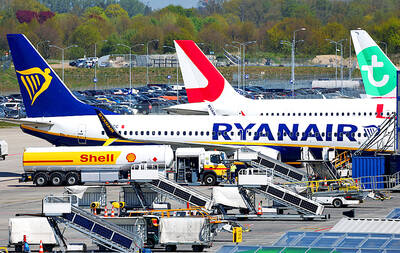
Ryanair, Transavia, Volotea and other low-cost airlines are feeling the financial pain from high jet fuel prices as a result of the Middle East war and are cutting flights. The closure of the Strait of Hormuz has taken a huge chunk of oil supplies off the market, sending the price of jet fuel soaring and triggering fears of shortages that could force airlines to cancel flights. Airlines are not waiting for a lack of supplies to react. “Travel alert: Airlines are cutting thousands of flights right now,” Travel Therapy host Karen Schaler said in an Instagram reel this past weekend.

MANAGING RISKS: Taiwan has secured LNG sufficient to cover 95 percent of electricity demand for next month, UBS said, describing the government’s approach as proactive UBS Group AG has raised its forecast for Taiwan’s economic growth this year to 8 percent, up from 6.9 percent previously, and said expansion could reach as high as 8.6 percent if external energy shocks are avoided. The upgrade reflects a stronger-than-expected first-quarter performance and sustained momentum in artificial intelligence (AI)-driven exports, which UBS said are providing a firm foundation for growth despite geopolitical and energy risks. Taiwan’s GDP expanded 13.69 percent year-on-year in the first quarter, the fastest growth since the second quarter of 1987, the Directorate-General of Budget, Accounting and Statistics (DGBAS) reported on Thursday. On a seasonally

The list of Asian stocks that benefit from business partnership with Nvidia Corp is getting longer, as the region further integrates into the artificial intelligence (AI) chip giant’s business ecosystem. Just in the past week, South Korea’s LG Electronics Inc, Taiwan’s Nanya Technology Corp (南亞科技), as well as China’s Huizhou Desay SV Automotive Co (德賽西威) and Pateo Connect Technology Shanghai Corp (博泰車聯) have become the latest to rally on news of tie-ups, supply-chain participation or product collaboration with the US chip designer. Asian suppliers account for about 90 percent of Nvidia’s production costs, up from about 65 percent last year, data compiled

The Fair Trade Commission’s (FTC) ongoing review of Grab Holdings Ltd’s US$600 million acquisition of Foodpanda Taiwan’s operations, announced on March 23, has taken on fresh urgency as industry experts warn that the transaction could embed significant Chinese cybersecurity vulnerabilities into Taiwan’s digital infrastructure through Grab’s deep ties to autonomous-driving firm WeRide (文遠知行). Less than 16 months after the FTC blocked Uber Eats’ direct attempt to acquire Foodpanda Taiwan — citing potential combined market shares of 80 to 90 percent — the emergence of Grab as the buyer has prompted questions about whether the same competitive harm is simply being rerouted


 RSS
RSS