


Advanced Micro Devices Inc (AMD) is to set up a research and development (R&D) center in Taiwan with research teams targeting several advanced technologies, including silicon photonics, artificial intelligence (AI) and heterogeneous integration, a Ministry of Economic Affairs official said on Saturday.
An AMD application for the ministry’s A+ global R&D and innovation partnership program was approved this month, granting a more than 30 percent subsidy, or NT$3.31 billion (US$100.82 million), of the company’s total NT$8.64 billion investment, the ministry’s Web site showed.
AMD, a US-based central processing unit (CPU) producer and AI chip giant, would invest NT$5.33 billion, while 50 percent of its R&D workforce would be foreign talent, the ministry said.

Photo: Annabelle Chih, Bloomberg
Department of Industrial Technology Director-General Chiou Chyou-huey (邱求慧) wrote about the details of negotiations with the tech giant over the past year on social media.
The department team visited AMD headquarters in Santa Clara, California, while attending an APEC meeting in Seattle last year, Chiou said.
“Just a month before our visit, AMD had a market value of US$170 billion, surpassing Intel Corp and becoming the world’s most valuable CPU company and second in terms of AI chips,” he wrote.
After nearly a year of discussions and reviews, the investment plan was confirmed following a meeting on June 5 during Computex Taipei between AMD CEO Lisa Su (蘇姿丰) and Minister of Economic Affairs J.W. Kuo (郭智輝), Chiou said.
AMD has promised to set up research teams focusing on silicon photonics, AI and heterogeneous integration in Taiwan, he said.
Silicon photonics and heterogenous integration are promising technologies for advancing IC efficiency, as traditional silicon chip technology has reached its physical limits.
Because the software AMD uses for its graphics processing units is open source, meaning it is freely available and can be modified, “we also negotiated for more local companies to have cooperation opportunities with AMD,” Chiou said.
As a result, 33 domestic companies would be included in the research program, “pushing the value of the investment up to NT$15 billion and cultivating more than 1,000 AI specialists in Taiwan every year” during the three-year program, he said.
Separately, the ministry last month approved four Taiwanese teams to receive free access to “Taipei-1,” a supercomputer built by US-based Nvidia Corp, to boost their R&D capabilities.
Taipei-1 was launched in Kaohsiung late last year and partly funded by the government to develop AI technologies and products.
The computer would help the teams — the first batch of applicants for the government campaign — with R&D on a wide range of topics from large language model training and chip design to smart healthcare and autonomous driving, the ministry said on June 25.
The teams, selected from nearly 30 companies, universities and research institutions in Taiwan, would each be able to use 25 percent of Taipei-1’s computing power for six weeks from July 1 to Sept. 30, it said.
This is the first time the government has secured AI computing power from a foreign company for Taiwan, Chiou said.
Such access is expected to last for two and a half years and is valued at approximately NT$400 million, he said.

‘NO SECURITY RISK’: The Railway Bureau reassured the public that the technicians’ activities were limited to technical guidance and did not involve sensitive systems The Railway Bureau yesterday said it had invited eight Chinese technicians to assist with an airport MRT construction project. The bureau issued the confirmation after an Internet user said Chinese nationals had entered the construction zone of Taiwan Taoyuan International Airport’s Terminal 3 project. They asked why “individuals from an enemy state” were allowed access to such a major national infrastructure project, which raised serious concerns over Taiwan’s industrial safety, sensitive systems and information security. The bureau’s Northern Region Engineering Branch Office said subcontractor Taiwan Handle Industrial Co (台灣手把工業) of the Taoyuan airport MRT’s “Contract No. CU05 Project A14 Station Civil, MEP &

A signaling system malfunction disrupted high-speed rail (HSR) services beginning at 8am today, with trains temporarily reduced to three northbound and three southbound trains per hour as authorities conduct inspections. The malfunction occurred on a section of track in Miaoli County during pre-operation checks early this morning, forcing northbound and southbound trains to use a single track, the HSR operator said. The regular schedule has been replaced with three hourly trains offering only nonreserved seating in each direction, stopping at every station, it said, adding that business class cars would still have reserved seating. Departures from terminal stations are scheduled at the top
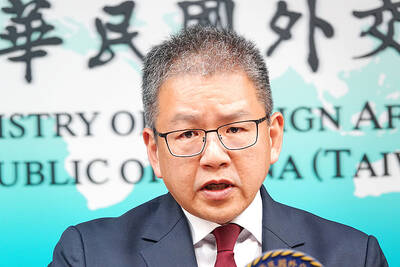
Taiwan is still in the process of assessing the possibility of recruiting workers from Eswatini, the Ministry of Foreign Affairs said yesterday, adding that its goal is to help Eswatini upgrade its vocational training centers. If there are plans to recruit workers from Eswatini, safeguarding national security, protecting public health and ensuring the employment rights of Taiwanese would be prerequisites, Department of West Asian and African Affairs Director-General Yen Chia-liang (顏嘉良) told a news conference. Key considerations would also include filling labor shortages in specific industries, and fostering bilateral professional and technical exchanges, he said. Yen was asked about the progress of labor

A US uncrewed surface vessel (USV) encountered multiple Chinese warships during an autonomous transit of the Taiwan Strait, US defense company Seasats said in a statement on Wednesday. Seasats announced that a Lightfish USV had completed the first autonomous transit of the Taiwan Strait. Over five days, the USV traversed the entire length of the Strait while constantly monitoring surface vessel traffic, the company said. The Lightfish encountered multiple Chinese warships, one of which was a Chinese People’s Liberation Army Navy (PLAN) Type 056 corvette, it said. The Chinese vessels were operating “well within Taiwan’s exclusive economic zone without transmitting their identity via the


 RSS
RSS