


Credit card spending continued to climb this year, underscoring resilient consumer demand driven by overseas travel, online shopping and the growing adoption of digital payment channels, even as broader economic uncertainties linger.
Cumulative credit card spending reached NT$4.14 trillion (US$131.7 billion) in the first 10 months of the year, marking a 6.65 percent increase from the same period last year, Financial Supervisory Commission data showed.
The growth momentum extended into last month and is expected to carry into next year with a double-digit expansion, the nation’s six largest card issuers said.
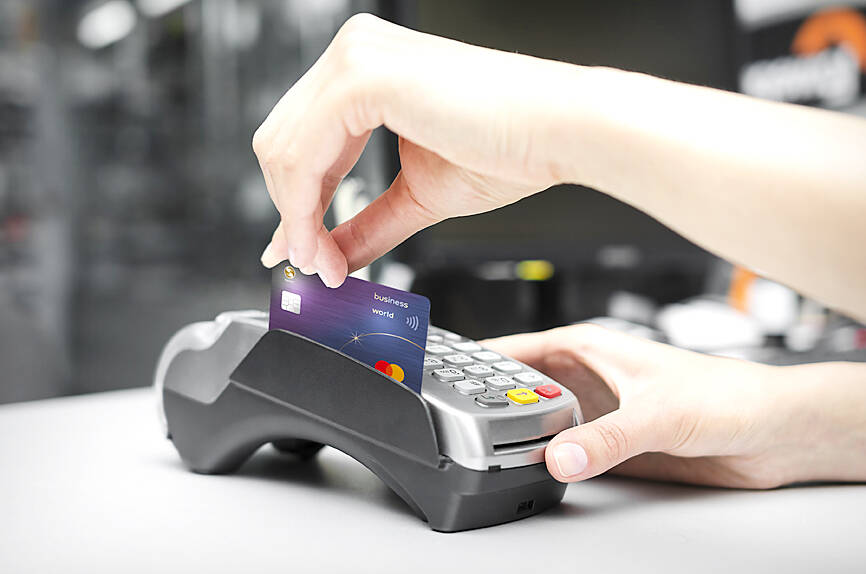
Photo: Lee Chin-hui, Taipei Times
Cathay United Bank Co (國泰世華銀行) reported double-digit growth in overseas spending and transactions via online travel agencies, while Taishin International Bank Co (台新銀行) saw overseas card spending surge 22 percent year-on-year. Taipei Fubon Commercial Bank Co (台北富邦銀行) said that overseas consumption continued to drive overall momentum, with online transactions accounting for an increasing share of spending. DBS Bank Taiwan Ltd (星展銀行) also highlighted double-digit annual growth in overseas travel-related transactions, identifying them as a key contributor to overall card usage growth.
Insurance premiums, overseas travel and online shopping ranked as the top three spending categories among cardholders. However, the fastest growth was observed in cross-border spending, e-commerce, and digital or mobile payment channels.
Both Cathay United Bank and E.Sun Commercial Bank Ltd (玉山銀行) recorded double-digit growth in online shopping, while Taipei Fubon Bank said its co-branded cards linked to major e-commerce platforms helped lift spending. E.Sun Bank said that app-based and small-value payment channels jumped more than 20 percent, reflecting the broader shift toward digital and mobile payments.
DBS highlighted that card-linked mobile payments were particularly popular for dining and small everyday purchases.
Demographically, consumers aged 30 to 49 accounted for more than half of total spending at Cathay United Bank, while Taipei Fubon Bank said its core spending cohort was aged 40 to 49.
Banks attribute this concentration to a combination of higher disposable income, frequency of overseas travel and comfort with digital payment technologies among these age groups.
Looking ahead, the banks expect credit card spending to post double-digit percentage growth next year, supported by sustained demand for overseas travel, experiential consumption and the continued expansion of digital payment ecosystems.
Cathay United Bank plans to deepen its partnerships with online platforms, while Taishin Bank plans to enhance cash rebates to retain and attract cardholders. Taipei Fubon Bank is targeting key retail channels operated by Costco President Taiwan Inc (台灣好市多) and Momo.com Inc (富邦媒體) to expand its market share.
These moves set the stage for an increasingly competitive credit card market, as issuers vie for consumers drawn to convenience, rewards and a seamless digital payment experience.

SECOND-RATE: Models distilled from US products do not perform the same as the original and undo measures that ensure the systems are neutral, the US’ cable said The US Department of State has ordered a global push to bring attention to what it said are widespread efforts by Chinese companies, including artificial intelligence (AI) start-up DeepSeek (深度求索), to steal intellectual property from US AI labs, according to a diplomatic cable. The cable, dated Friday and sent to diplomatic and consular posts around the world, instructs diplomatic staff to speak to their foreign counterparts about “concerns over adversaries’ extraction and distillation of US AI models.” Distillation is the process of training smaller AI models using output from larger, more expensive ones to lower the costs of training a powerful new

Micron Technology Inc is a driving force pushing the US Congress to pass legislation that would put new export restrictions on equipment its Chinese competitors use to make their chips, according to people familiar with the matter. A US House of Representatives panel yesterday was to vote on the “MATCH Act,” a bill designed to close gaps in restrictions on chipmaking equipment. It would also pressure foreign companies that sell equipment to Chinese chipmaking facilities to align with export curbs on US companies like Lam Research Corp and Applied Materials Inc. The bill targets facilities operated by China’s ChangXin Memory Technologies Inc

Singapore-based ride-hailing and delivery giant Grab Holdings’ planned acquisition of Foodpanda’s Taiwan operations has yet to enter the formal review stage, as regulators await supplementary documents, the Fair Trade Commission (FTC) said yesterday. Acting FTC Chairman Chen Chih-min (陳志民) told the legislature’s Economics Committee that although Grab submitted its application on March 27, the case has not been officially accepted because required materials remain incomplete. Once the filing is finalized, the FTC would launch a formal probe into the deal, focusing on issues such as cross-shareholding and potential restrictions on market competition, Chen told lawmakers. Grab last month announced that it would acquire
The artificial intelligence (AI) boom has triggered a seismic reshuffling of global equity markets, with Taiwan and South Korea muscling past European nations one by one. With its stock market now valued at nearly US$4.3 trillion, Taiwan surpassed the UK, Europe’s biggest market, earlier this month, data compiled by Bloomberg showed. South Korea is about US$140 billion away from doing the same. The tech-heavy Asian markets have shot past Germany and France in the past seven months. The shift is largely down to massive gains in shares of three companies that provide essential hardware for AI: Taiwan Semiconductor Manufacturing Co (TSMC, 台積電),


 RSS
RSS