


Taiwan’s housing market is set to consolidate next year, with transaction volumes expected to hold near this year’s levels as tight mortgage conditions continue to weigh on demand, Evertrust Rehouse Co (永慶房屋) said on Wednesday, citing a quarterly survey.
Between 251,000 and 264,000 home sales are forecast for next year, implying anything from a 3 percent decline to a mild 2 percent increase from this year’s estimated 260,000 units, the company said.
This year’s figures would represent a 27 percent slump, attributable to the central bank’s property loan curbs, Evertrust general manager Yeh Ling-chi (葉凌棋) told a news conference in Taipei.
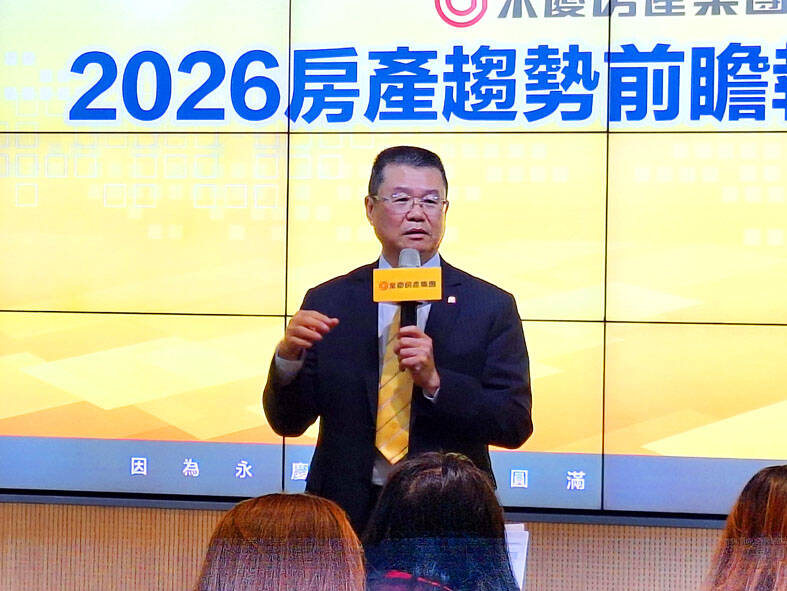
Photo: CNA
“The worst from policy tightening is likely over and conditions are unlikely to deteriorate, barring major economic or policy shocks,” Yeh said.
Speculative buyers have mostly exited the market, leaving transactions increasingly driven by owner-occupiers, he said, as long as Taiwan’s economy remains broadly stable.
Yeh flagged four major uncertainties shaping the outlook: the health of a global artificial intelligence boom, Washington’s trade policy under US President Donald Trump, domestic housing policy directions, cross-strait relations and the pace of new housing supply.
Borrowing costs remain a key headwind.
Mortgage rates have climbed to about 2.3 percent, the highest since the 2008–2009 global financial crisis, eroding affordability for first-time buyers, Yeh said.
For years, Taiwanese homebuyers had grown accustomed to mortgage rates below 2 percent despite elevated home prices, he said, adding that interest rates have become the single most critical variable for the market.
Affordability pressures are set to intensify when a government interest-subsidy program expires in July next year.
The scheme, which provides subsidized interest rates on loans of up to NT$10 million (US$317,662) along with a five-year grace period, helped cushion households from rising borrowing costs, Evertrust said.
Authorities plan to roll out additional support measures in July next year, although Yeh cautioned against disclosing details too soon.
Early signals could encourage would-be buyers to sit on the sidelines, risking a freeze in transactions during the first half of the year, he said.
Nevertheless, housing sentiment has improved modestly.
The share of respondents expecting home prices to fall in the first quarter of next year dropped to 39 percent from 50 percent in the prior quarter, while those anticipating price gains rose to 26 percent, the survey showed.
About 35 percent of respondents expect prices to hold steady, Evertrust research manager Daniel Chen (陳賜傑) said.
The shift followed policymakers’ decision to exempt first-time homebuyers from property loan restrictions, even as they maintain overall credit controls, Chen said.
Additional relief might be emerging after the central bank on Thursday last week eased loan-reduction requirements for banks and required lenders to submit mortgage data on a monthly basis.
The move could help speed up loan approvals that had previously delayed or derailed transactions, Chen added.
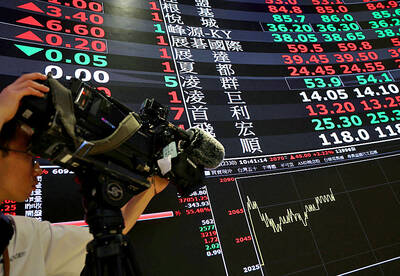
After several years flying high as Asia’s best Nvidia Corp proxy, Taiwan Semiconductor Manufacturing Co (TSMC, 台積電) is increasingly vying with other artificial intelligence (AI) stocks for investor attention. Stock traders are chasing a wider array of beneficiaries as mainstream usage of AI creates demand for hardware beyond the most-advanced chips TSMC makes for Nvidia. Subthemes from the deepening memory crunch to advances in robotics are also luring bids. At the same time, investment caps on single stocks are pushing funds to diversify, while retail investors long familiar with TSMC through its US depositary receipts are being offered a broader set of
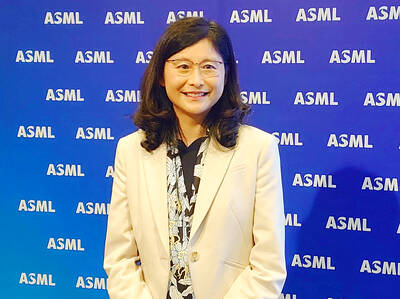
Netherlands-based semiconductor equipment supplier ASML Holding NV yesterday said that it is planning to hire an additional 1,000 people in Taiwan this year in response to growing demand from clients. ASML had previously planned to recruit 600 people this year, but that the plan has been adjusted upward, ASML vice president and ASML Taiwan general manager Grace Wang (汪佳慧) told reporters. ASML has a workforce of more than 4,500 in Taiwan, accounting for about 10 percent of its global total, Wang said. This year’s recruitment campaign would focus on adding people in the customer support, manufacturing and supply chain domains to assist ASML
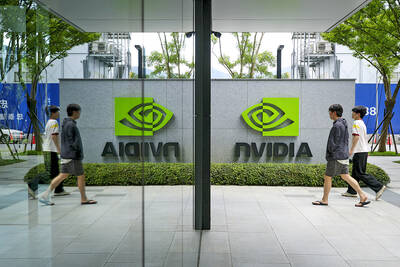
UNDER MICROSCOPE: Taiwan detained three people who allegedly conspired to buy servers in Taiwan and export them using fraudulent documentation, prosecutors said Nvidia Corp chief executive officer Jensen Huang (黃仁勳) on Saturday urged Super Micro Computer Inc to tighten up on compliance after Taiwan detained three people this week for allegedly making fraudulent declarations about artificial intelligence (AI) servers made by its US partner. The development marked the nation’s first crackdown on semiconductor smuggling, which grew after the US slapped restrictions on exports of high-end chips such as Nvidia AI accelerators to China. Nvidia is “rigorous” in explaining regulations to all of its partners, Huang told reporters after arriving in Taipei. “Ultimately Super Micro has to run their own company,” he said in response to

Nvidia Corp yesterday announced that CEO Jensen Huang (黃仁勳) would attend an employee meeting in Taipei tomorrow to celebrate the launch of the company’s Taiwan headquarters project. Huang would attend a gathering at the site of Nvidia’s planned headquarters in Beitou Shilin Technology Park (北投士林科技園區), the company said in a statement. After arriving in Taiwan on Saturday last week, Huang told reporters that he plans to meet with Quanta Computer Inc (廣達) chairman Barry Lam (林百里) and Taiwan Semiconductor Manufacturing Co (TSMC, 台積電) chairman C.C. Wei (魏哲家), and would attend the groundbreaking ceremony for Nvidia’s Taiwan headquarters tomorrow. Nvidia has not yet applied


 RSS
RSS