


Taiwan’s bid to become a leading Asian asset-management hub is gathering momentum, with assets under management climbing more than NT$4 trillion (US$127 billion), reaching a key two-year milestone ahead of schedule, Financial Supervisory Commission (FSC) Chairman Peng Jin-lung (彭金隆) said yesterday.
The progress marks the completion of the first phase of a six-year road map to transform Taiwan into a regional center for wealth and asset management, with further targets set for four and six years.
“Thirty years ago, we could only imagine it,” Peng said at a financial competitiveness forum in Taipei. “Now we have the capital, the industries and the talent to reach that goal.”
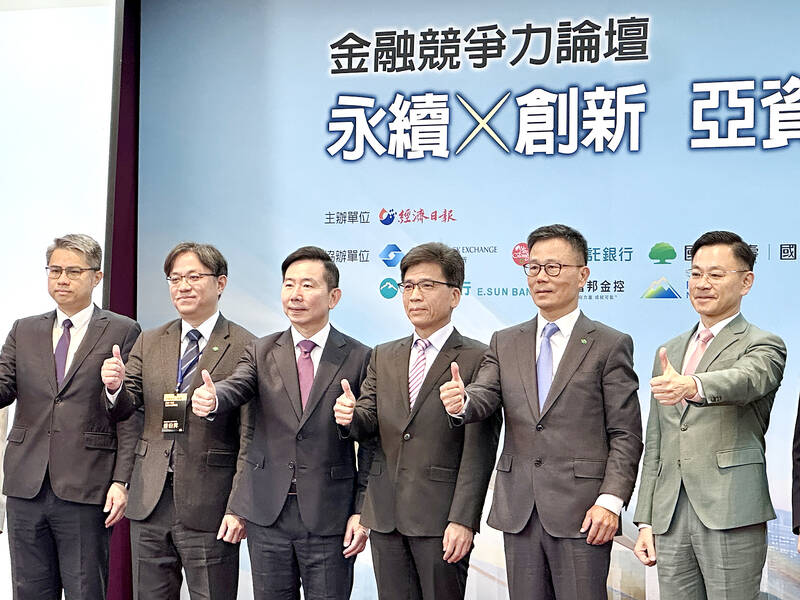
Photo: CNA
Earlier government efforts since the mid-1990s had limited impact, but structural conditions today are fundamentally different, with strong domestic capital, active investment demand and a maturing financial ecosystem creating a prime window for reform, he said.
While Taiwan still trails Singapore and Hong Kong in tax competitiveness, English-language proficiency and foreign-exchange flexibility, the FSC head highlighted the nation’s unique advantages, globally competitive technology and manufacturing industries, tightly integrated supply chains, substantial private wealth and a deep pool of financial professionals.
Rather than attempting to replicate or replace existing centers, Taiwan aims to carve a differentiated role aligned with its industrial strengths, Peng said.
Concrete policy initiatives are already reshaping the market. In July, the FSC launched a dedicated asset-management zone in Kaohsiung, permitting 38 types of financial services.
Forty institutions have been approved to operate in the zone, and all four major international accounting firms have established a presence, Peng said.
Banks in the zone have already attracted more than NT$2 trillion in assets under management.
Retail participation is growing as well. Taiwan introduced the Taiwan Individual Savings Account (TISA) mechanism in July to encourage long-term investment habits and support financial planning for Taiwanese amid an aging population.
So far, 22 fund houses offer 37 TISA-qualified funds, attracting more than 60,000 accounts in just three months, Peng said.
Cross-border market links are expanding. Taiwan debuted its first Japan-dual-listed exchange-traded fund in Tokyo in September, while seven major foreign asset managers have announced plans to establish or expand operations locally, signaling rising international interest.
The FSC bolstered Taiwan’s financial infrastructure by opening the Asian Asset Management Center Promotion Office in September and launching an Asian innovation financing platform in October to help turn Taiwan into a regional counterpart to NASDAQ — the exchange for major tech firms such as Apple Inc, Amazon.com Inc and Alphabet Inc.
“Building a regional hub is a long-term challenge,” Peng said. “It took decades for existing centers to reach their scale, but if we do not act now, the window will become increasingly narrow.”

Cairo’s new monorail slices across the city skyline, running above the familiar chaos of blaring horns and aging buses’ exhaust fumes that mark rush hour below. The US$4.5 billion monorail, opened this month, is among Egypt’s most prominent new transport projects, part of a debt-funded infrastructure drive criticized for sapping state finances while bringing limited benefits to most of the country’s 109 million people. “It feels like you’re in a different country,” said Ramy Sayed, a restaurant manager, aboard a driverless Innovia 300 train. “No noise, no traffic, we’re not used to this.” The eastern line runs 56km from the bustling middle-class

Taiwanese firms have increased investment in the Philippines in recent years as Manila’s ties with Washington deepen and global supply chains continue to shift away from China, an expert at the Chung-Hua Institution for Economic Research (CIER, 中華經濟研究院) said yesterday. The Philippines had not been among Taiwanese investors’ top choices in Southeast Asia, CIER Taiwan ASEAN Studies Center director Kristy Hsu (徐遵慈) said at a seminar in Taipei. However, Taiwan’s investment in the country has grown significantly since the COVID-19 pandemic, reaching US $257 million last year, a high in recent years, she said. Although Taiwan’s total investment in the Philippines still lags
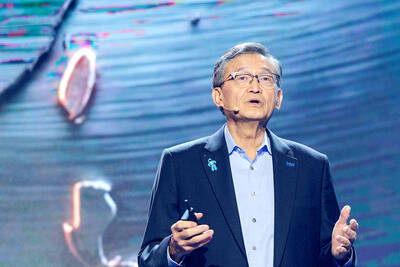
Intel Corp regards Taiwan Semiconductor Manufacturing Co (TSMC, 台積電) as a longstanding partner, as the US chipmaker would continue outsourcing production of advanced chips to TSMC, Intel chief executive officer Lip-Bu Tan (陳立武) said yesterday. “I don’t look at people as competitors. I look at the collaboration... Nvidia is also, you know, a good friend,” Tan told a news conference following his keynote speech at the Computex trade show in Taipei. “It’s a very trusted partnership for us... We are a big, top customer for them, and we’re going to continue doing that,” he said, referring to TSMC, the world’s largest foundry

Artificial intelligence (AI) agents would supplant smartphones as the center of people’s digital lives, fundamentally reshaping personal devices and driving a major computing upgrade cycle, Qualcomm Inc CEO Cristiano Amon said yesterday. In his keynote speech for this year’s Computex trade show in Taipei, Amon said that the rise of "agentic AI" — AI systems capable of reasoning, planning and carrying out tasks autonomously — would transform how people interact with technology across phones, PCs, vehicles and wearable devices. Describing the technology as the next major evolution in computing, Amon said that "2026 is the year of agents.” For decades, smartphones have sat


 RSS
RSS