


MetaX Integrated Circuits (Shanghai) Co (沐曦) yesterday soared in its first day of trading, the latest outsized debut by a Chinese chipmaker after similar gains by Moore Threads Technology Co (摩爾線程) earlier this month.
MetaX surged 693 percent in Shanghai after raising US$585.8 million in an initial public offering (IPO). The gains made it the top performing debut for IPOs between US$500 million and US$1 billion in China over the past decade.
Like Moore Threads, MetaX makes graphics processing units (GPUs) for artificial intelligence (AI) developers — a red-hot industry that is growing at a rapid clip as consumers and businesses adopt AI services. Its shares were 2,986 times oversubscribed on the retail portion, drawing even higher demand than Moore Threads, whose shares were oversubscribed by 2,750 times.
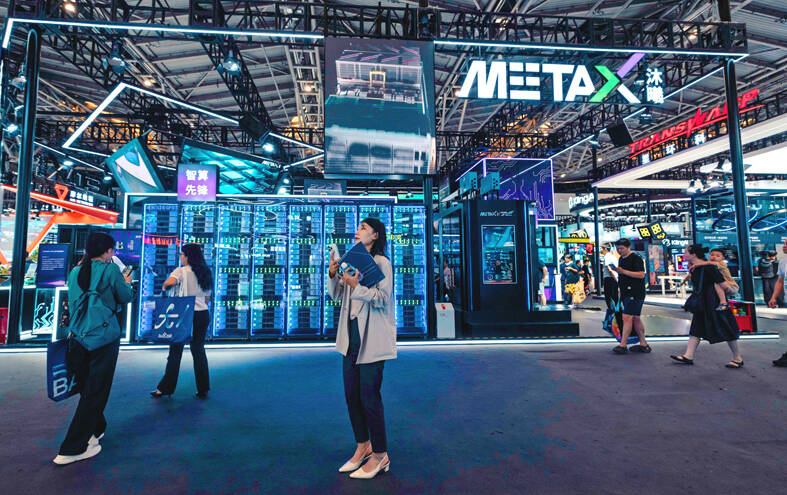
Photo: EPA
Priced at 104.66 yuan a share in its IPO, the jump took MetaX’s market capitalization to more than 332 billion yuan (US$47.13 billion). That compares with Moore Threads’ current market value of 336 billion yuan.
MetaX can trace its roots to Advanced Micro Devices Inc (AMD), with three key members of its founding team having previously worked for the US chipmaker. Those include chairman and chief executive officer Chen Weiliang (陳偉良), chief technology officers Peng Li (彭莉) — one of AMD’s first female Chinese scientists — and Yang Jian (楊健).
Chen, who studied at the University of Electronic Science and Technology of China and completed a master’s degree in engineering at Tsinghua University, also brought in a slate of former AMD colleagues who now occupy key management roles at MetaX. They include Chen Yang (陳陽), Zhou Jun (周俊) and Wang Ding (王定).
MetaX designs and sells GPUs that are used for AI workloads as well as graphics rendering in gaming and other visualization applications. Its AI-focused Xiyun C500 series, which the company claimed was comparable to Nvidia Corp’s A100, accounted for about 98 percent of revenue last year.
The newer C588 generation has significantly narrowed the performance gap with Nvidia’s H100, the company said.
Besides US chip giants such as Nvidia and AMD, MetaX faces a crowded field of domestic rivals. These include Moore Threads, Huawei Technologies Co (華為), Hygon Information Technology Co (海光) and Cambricon Technologies Corp (寒武紀).
In addition, MetaX is burning cash at a ferocious rate to close the gap in terms of system level performance and production with Nvidia. From 2022 through last year, MetaX spent more than 2.2 billion yuan on research and development alone. While revenue is skyrocketing — hitting 915 million yuan in the first half of this year, surpassing the entire previous year — profitability remains elusive.
The company posted a net loss of 1.41 billion yuan last year. MetaX projects it would break even by next year, a target that relies heavily on its flagship C500 chip maintaining its foothold against rivals such as Huawei’s Ascend series.
Another risk lies in manufacturing. MetaX operates as a “fabless” chipmaker — it designs the chips, but relies on third-party foundries to manufacture them. With the US tightening restrictions on China’s access to advanced lithography, MetaX’s supply chain remains a vulnerability.
“If our major suppliers experience capacity constraints or are subject to trade restrictions ... our ability to deliver products could be materially impaired.” MetaX said in its prospectus.
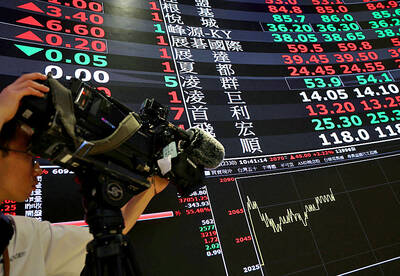
After several years flying high as Asia’s best Nvidia Corp proxy, Taiwan Semiconductor Manufacturing Co (TSMC, 台積電) is increasingly vying with other artificial intelligence (AI) stocks for investor attention. Stock traders are chasing a wider array of beneficiaries as mainstream usage of AI creates demand for hardware beyond the most-advanced chips TSMC makes for Nvidia. Subthemes from the deepening memory crunch to advances in robotics are also luring bids. At the same time, investment caps on single stocks are pushing funds to diversify, while retail investors long familiar with TSMC through its US depositary receipts are being offered a broader set of
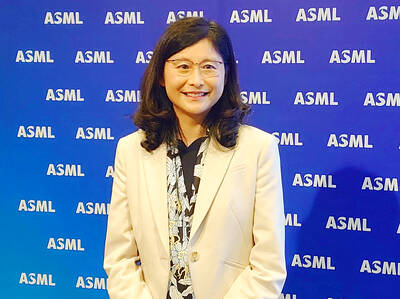
Netherlands-based semiconductor equipment supplier ASML Holding NV yesterday said that it is planning to hire an additional 1,000 people in Taiwan this year in response to growing demand from clients. ASML had previously planned to recruit 600 people this year, but that the plan has been adjusted upward, ASML vice president and ASML Taiwan general manager Grace Wang (汪佳慧) told reporters. ASML has a workforce of more than 4,500 in Taiwan, accounting for about 10 percent of its global total, Wang said. This year’s recruitment campaign would focus on adding people in the customer support, manufacturing and supply chain domains to assist ASML
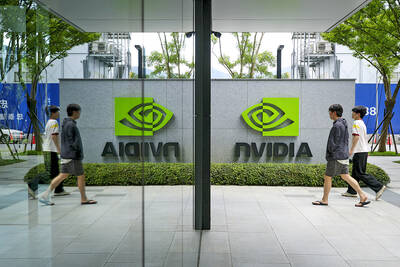
UNDER MICROSCOPE: Taiwan detained three people who allegedly conspired to buy servers in Taiwan and export them using fraudulent documentation, prosecutors said Nvidia Corp chief executive officer Jensen Huang (黃仁勳) on Saturday urged Super Micro Computer Inc to tighten up on compliance after Taiwan detained three people this week for allegedly making fraudulent declarations about artificial intelligence (AI) servers made by its US partner. The development marked the nation’s first crackdown on semiconductor smuggling, which grew after the US slapped restrictions on exports of high-end chips such as Nvidia AI accelerators to China. Nvidia is “rigorous” in explaining regulations to all of its partners, Huang told reporters after arriving in Taipei. “Ultimately Super Micro has to run their own company,” he said in response to

Nvidia Corp yesterday announced that CEO Jensen Huang (黃仁勳) would attend an employee meeting in Taipei tomorrow to celebrate the launch of the company’s Taiwan headquarters project. Huang would attend a gathering at the site of Nvidia’s planned headquarters in Beitou Shilin Technology Park (北投士林科技園區), the company said in a statement. After arriving in Taiwan on Saturday last week, Huang told reporters that he plans to meet with Quanta Computer Inc (廣達) chairman Barry Lam (林百里) and Taiwan Semiconductor Manufacturing Co (TSMC, 台積電) chairman C.C. Wei (魏哲家), and would attend the groundbreaking ceremony for Nvidia’s Taiwan headquarters tomorrow. Nvidia has not yet applied


 RSS
RSS