


US President Donald Trump on Monday granted Nvidia Corp permission to ship its H200 artificial intelligence (AI) chips to China in exchange for a 25 percent surcharge, a move that lets the world’s most valuable company potentially regain billions of dollars in lost business from a key global market.
The decision was announced by Trump in a post on his Truth Social network, capping weeks of deliberations with advisers about whether to allow H200 exports to China.
Trump said he informed Chinese President Xi Jinping (習近平) about the move and that Xi had responded favorably.
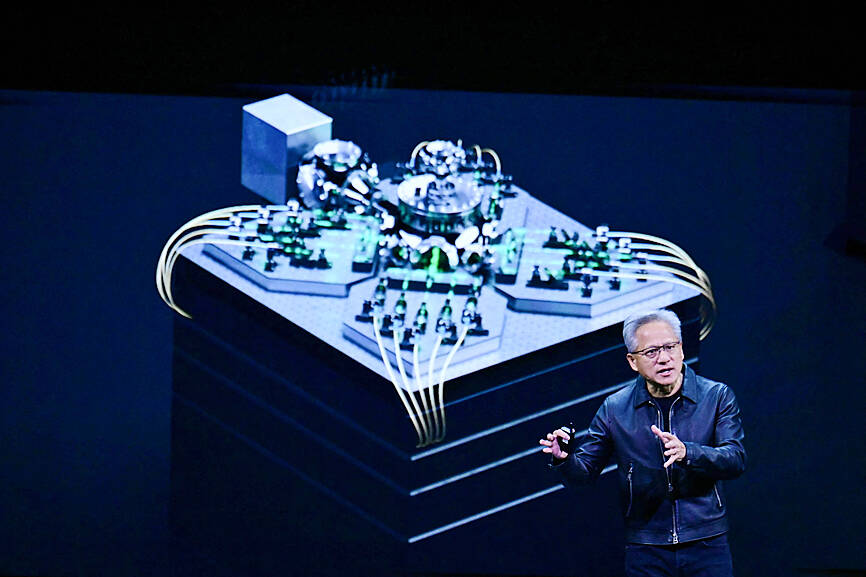
Photo: AFP
The US president added that shipments would only go to “approved customers,” and that chipmakers such as Intel Corp and Advanced Micro Devices Inc (AMD) would also be eligible.
Trump’s decision provoked an immediate backlash from Democratic US senators including Elizabeth Warren, who warned of a “colossal economic and national security failure” in providing Beijing the tools it needs to develop next-generation AI.
The H200 is, on paper at least, a generation ahead of anything offered by Chinese designers from Huawei Technologies Co (華為) to Cambricon Technologies Corp (寒武紀) and Moore Threads Technology Co (摩爾). China at present also requires more chips than local firms can supply.
“We will protect National Security, create American Jobs, and keep America’s lead in AI,” Trump said in his post.
“NVIDIA’s US Customers are already moving forward with their incredible, highly advanced Blackwell chips, and soon, Rubin, neither of which are part of this deal,” he said, referring to more advanced lines of Nvidia chips.
Nvidia chief executive officer Jensen Huang (黃仁勳) had met privately with Trump in Washington last week to discuss export controls, although neither the White House nor the company shared details on their conversation.
Payment to the US government would come as a 25 percent fee when the chips are shipped from manufacturing sites in Taiwan to the US for inspection by the US Department of Commerce’s Bureau of Industry and Security as part of a security review, a department official said, adding that the chips would then be shipped to customers in China.
In August, Nvidia won approval to sell its H20 chip to China while AMD was cleared for its MI308 processor — each designed to fall just below export restrictions. Under that arrangement, touted by Trump, the companies would have paid 15 percent of their China sales to the US government. The payments failed to materialize, because regulations that would make them legal were never enacted.
The H20 and H200 come from the same generation of Hopper processors, an aging lineup. Nvidia sells the more-advanced Blackwell generation in the US and is preparing to shift to an even speedier family of chips called Rubin.
Still, the H200 represents a significant step up from the H20.
The H200’s total processing performance is about 10 times the limit previously allowed for export to China, according to Georgetown University’s Center for Security and Emerging Technology.
Nvidia hailed the decision, saying it would “help to support high-paying jobs and manufacturing in America. Offering H200 to approved commercial customers, vetted by the Department of Commerce, strikes a thoughtful balance that is great for America.”
Nvidia and AMD shares both gained about 2 percent in late trading after Trump’s announcement. Intel, which is not expected to benefit from the changes in the near term, rose less than 1 percent.


Taiwanese firms have increased investment in the Philippines in recent years as Manila’s ties with Washington deepen and global supply chains continue to shift away from China, an expert at the Chung-Hua Institution for Economic Research (CIER, 中華經濟研究院) said yesterday. The Philippines had not been among Taiwanese investors’ top choices in Southeast Asia, CIER Taiwan ASEAN Studies Center director Kristy Hsu (徐遵慈) said at a seminar in Taipei. However, Taiwan’s investment in the country has grown significantly since the COVID-19 pandemic, reaching US $257 million last year, a high in recent years, she said. Although Taiwan’s total investment in the Philippines still lags
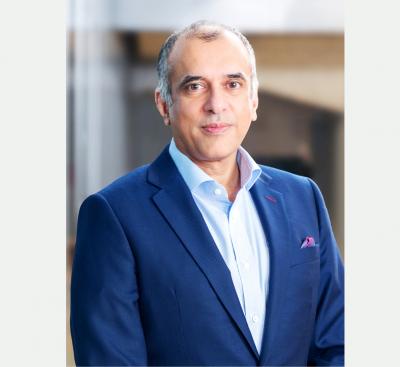
HSBC Holdings PLC is deepening its commitment to Taiwan as the economy emerges as one of the bank’s fastest-growing markets globally, driven by an artificial intelligence (AI) investment boom, expanding cross-border trade, and rising wealth creation. “The advantage that Taiwan has is a growth story linked to the semiconductor and broader AI industries, strong underlying corporate performance, and wealth creation,” said Surendra Rosha, HSBC’s co-chief executive for Asia and the Middle East, in an exclusive interview with the Taipei Times on June 2, during this year’s HSBC Taiwan Conference. That combination has helped HSBC cement its position as the most profitable international

Intel Corp regards Taiwan Semiconductor Manufacturing Co (TSMC, 台積電) as a longstanding partner, as the US chipmaker would continue outsourcing production of advanced chips to TSMC, Intel chief executive officer Lip-Bu Tan (陳立武) said yesterday. “I don’t look at people as competitors. I look at the collaboration... Nvidia is also, you know, a good friend,” Tan told a news conference following his keynote speech at the Computex trade show in Taipei. “It’s a very trusted partnership for us... We are a big, top customer for them, and we’re going to continue doing that,” he said, referring to TSMC, the world’s largest foundry

Hon Hai Precision Industry Co (鴻海精密) yesterday said it would work with US chipmaker Intel Corp to jointly develop and deploy next-generation artificial intelligence (AI) infrastructure and intelligent computing platforms in a move to capture booming demand for AI computing systems. Hon Hai, also known as Foxconn Technology Group (富士康), said in a statement that the partnership would combine its global manufacturing scale, system integration expertise and AI data center deployment capabilities with Intel’s strengths in processor architecture, silicon technologies and software ecosystem. The companies said they plan to work on equipment used in AI data centers, including server racks powered by


 RSS
RSS