


Taiwan’s benchmark TAIEX could approach 35,000 points next year, as it continues to ride a global artificial intelligence (AI) boom, five major advisory firms said.
President Capital Management Corp (統一投顧) offered the most optimistic outlook among the firms, saying the index would reach 34,988.
AI applications are expected to extend from servers to edge AI devices such as smart glasses, driving the continued growth of AI-related stocks and supporting a higher TAIEX next year, President Capital Management president Liao Wan-ting (廖婉婷) said.
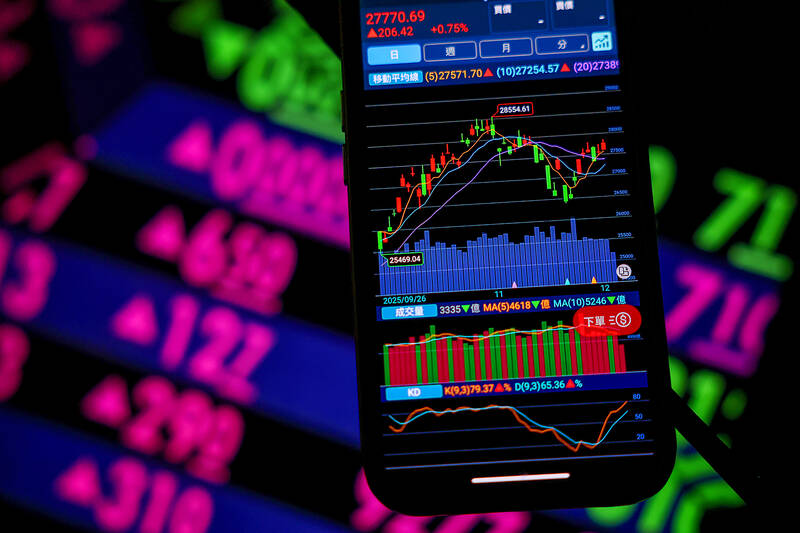
Photo: CNA
The TAIEX this year fell to a low of 17,391.76 on April 9, after US President Donald Trump threatened exorbitant tariffs on most of the US’ main trading partners, before rebounding strongly.
The index closed at 27,980.89 on Friday, up 21.47 percent so far this year and up 61 percent from the April 9 low on easing tariff concerns, AI enthusiasm and expectations of more US Federal Reserve interest rate cuts.
Taiwan Semiconductor Manufacturing Co (TSMC, 台積電), Hon Hai Precision Industry Co (鴻海), Delta Electronics Inc (台達電), MediaTek Inc (聯發科) and Quanta Computer Inc (廣達) — Taiwan’s top five tech companies by market value — have all benefited from AI momentum, Capital Investment Management Corp president Rico Fan (范振鴻) said.
Fan forecast that the TAIEX would challenge 34,000 points next year, and the five companies, which account for 52.8 percent of the market’s capitalization, would continue to dominate the broader market.
First Capital Management Inc (第一金投顧) chairman Barry Huang (黃詣庭) also expressed confidence that the global AI trend would be sustained and that Taiwan would remain a major beneficiary.
TSMC, which represents more than 40 percent of the TAIEX’s market cap alone, would post earnings per share of NT$75 next year and help the TAIEX move higher, Huang said.
The market has expected TSMC’s earnings per share to exceed NT$60 this year.
Huang predicted the TAIEX could reach 31,000 points next year, and possibly 33,000, if the economy improves further.
Fubon Securities Investment Services Co (富邦投顧) chairman Edward Chen (陳奕光) anticipated that the index would hit 32,000 points and go as high as 34,000 in a best-case scenario.
He said he expected ample market liquidity and the Fed’s anticipated rate cuts to contribute to the AI-driven momentum.
Hua Nan Securities Investment Management Co (華南投顧) chairman Jerry Lu (呂仁傑) said he did not expect the AI bubble to burst soon and forecast the TAIEX to climb as high as 32,000 next year.
Shares of contract chipmaker Taiwan Semiconductor Manufacturing Co (TSMC, 台積電) came under pressure yesterday after a report that Apple Inc is looking to shift some orders from the Taiwanese company to Intel Corp. TSMC shares fell NT$55, or 2.4 percent, to close at NT$2,235 on the local main board, Taiwan Stock Exchange data showed. Despite the losses, TSMC is expected to continue to benefit from sound fundamentals, as it maintains a lead over its peers in high-end process development, analysts said. “The selling was a knee-jerk reaction to an Intel-Apple report over the weekend,” Mega International Investment Services Corp (兆豐國際投顧) analyst Alex Huang
Taiwan Semiconductor Manufacturing Co (TSMC, 台積電) is expected to remain Apple Inc’s primary chip manufacturing partner despite reports that Apple could shift some orders to Intel Corp, industry experts said yesterday. The comments came after The Wall Street Journal reported on Friday that Apple and Intel had reached a preliminary agreement following more than a year of negotiations for Intel to manufacture some chips for Apple devices. Taiwan Institute of Economic Research (台灣經濟研究院) economist Arisa Liu (劉佩真) said TSMC’s advanced packaging technologies, including integrated fan-out and chip-on-wafer-on-substrate, remain critical to the performance of Apple’s A-series and M-series chips. She said Intel and Samsung
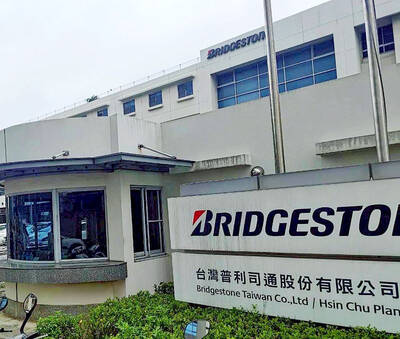
TRANSITION: With the closure, the company would reorganize its Taiwanese unit to a sales and service-focused model, Bridgestone said Bridgestone Corp yesterday announced it would cease manufacturing operations at its tire plant in Hsinchu County’s Hukou Township (湖口), affecting more than 500 workers. Bridgestone Taiwan Co (台灣普利司通) said in a statement that the decision was based on the Tokyo-based tire maker’s adjustments to its global operational strategy and long-term market development considerations. The Taiwanese unit would be reorganized as part of the closure, effective yesterday, and all related production activities would be concluded, the statement said. Under the plan, Bridgestone would continue to deepen its presence in the Taiwanese market, while transitioning to a sales and service-focused business model, it added. The Hsinchu
Taiwan Semiconductor Manufacturing Co (TSMC, 台積電) has approved a capital budget of US$31.28 billion for production expansion to meet long-term development needs during the artificial intelligence (AI) boom. The company’s board meeting yesterday approved the capital appropriation plan for purposes such as the installation of advanced technology capacity and fab construction, the world’s largest contract chipmaker said in a statement. At an earnings conference last month, TSMC forecast that its capital expenditure for this year would be at the higher end of the US$52 billion to US$56 billion range it forecast in January in response to robust demand for 5G, AI and


 RSS
RSS