


Staring at a pile of freshly cut beechwood, forestry manager Johannes Brodowski wonders if he is looking at the future of Germany’s chemicals industry.
A local factory would use Brodowski’s trees and other organic material — instead of climate-harming fossil fuels — to make chemical products used to manufacture items ranging from packaging to car tires and fleece jackets.
“The innovative part of the whole thing is that a new product is getting made,” Brodowski said. “Namely, chemical materials that were originally made from fossil fuels and now can be made from renewable sources.”

Photo: AFP
Finnish group UPM Biochemicals unveiled its 1.3 billion euro (US$1.51 billion) biorefinery in Germany’s eastern state of Saxony-Anhalt this year, taking a big risk at a difficult time for the sector.
Germany’s traditional chemicals industry has been battered by high energy prices and cheap competition from Asia, with national output now at its lowest level since 1995.
Still, UPM thinks now is the right time to try, and get chemical giants to break with fossil fuels and switch to renewable biomass, in this case wood which grows abundantly in the region.
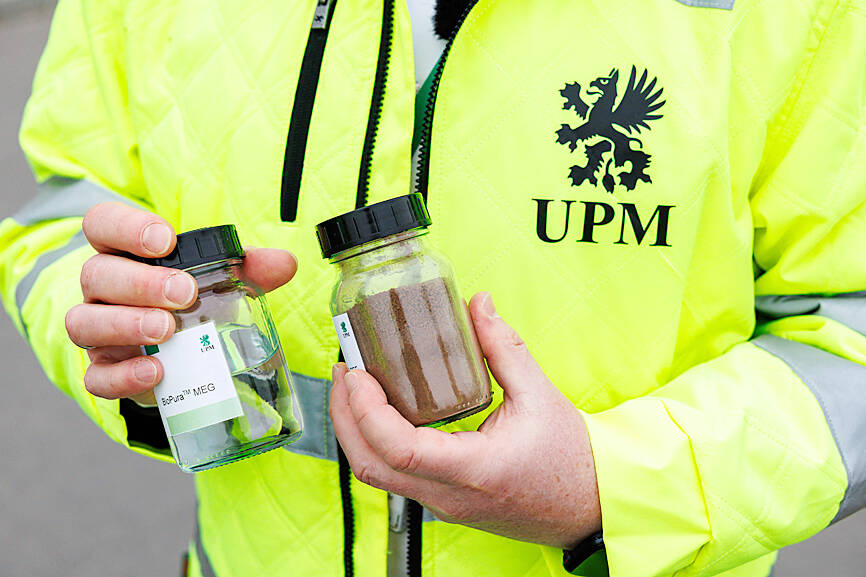
Photo: AFP
“With local supply chains, we can be competitive and meet the needs of international markets,” UPM site manager Harald Dialer said.
The opportunity is large: About 80 percent of German chemical products rely on imported fossil-based materials, said Paul Muennich of Agora Energiewende, an energy-transition think tank.
UPM has signed a supply contract with the forest-rich state of Saxony-Anhalt, making use of beech tree branches and twigs for chemical processes in its refinery.
As a result, beech wood production in this corner of Saxony-Anhalt could go up by 20-30 percent, Brodowski said.
He said that the plant uses tree branches, which are less commercially viable than trunks and usually incinerated in factories.
The wood is processed at the Leuna Chemical Park, home to more than 100 different firms.
Most of the factories give out the smell of rotten eggs, but inside some areas of the UPM site, a sweeter smell fills the air.
Wood chips are treated until they burst “like popcorn,” turning into a slurry that is fermented in huge metal tanks, UPM spokesman Martin Ledwon said.
At the end of the process, two types of products emerge: liquids used to make clothing or bottles, and a brown powder that can replace carbon black, a powder used as a filler in tires and other rubber products.
The UPM site should reach full capacity by 2027, with annual output of 220,000 tonnes of chemicals.
That would mark a rare bright spot in Germany’s otherwise stagnant chemicals industry — a trend thrown into stark focus in Leuna where the US group Dow Inc is to soon close two plants.
Opening the plant was a “very bold decision,” Dialer said, adding that the COVID-19 pandemic had doubled the timeline and the associated costs of the project.
UPM would like to count on help from the German state, highlighting that its project is more ecologically sustainable than oil-guzzling plants that also accelerate climate change.
However, the federal government led by conservative Chancellor Friedrich Merz, which took power in May, has been less enthusiastic about environmental and climate protection than its predecessors.
When the project was launched in 2020, sustainability was “more at the center of the debate,” Dialer said.
In his view, Germany and the EU should support European industry by imposing quotas on what he says are cheap but often environmentally damaging imports of Chinese chemicals.
Muennich also said that government intervention with subsidies or tariffs would be “necessary to shift from fossil fuel to sustainable biomass.”

Taiwanese firms have increased investment in the Philippines in recent years as Manila’s ties with Washington deepen and global supply chains continue to shift away from China, an expert at the Chung-Hua Institution for Economic Research (CIER, 中華經濟研究院) said yesterday. The Philippines had not been among Taiwanese investors’ top choices in Southeast Asia, CIER Taiwan ASEAN Studies Center director Kristy Hsu (徐遵慈) said at a seminar in Taipei. However, Taiwan’s investment in the country has grown significantly since the COVID-19 pandemic, reaching US $257 million last year, a high in recent years, she said. Although Taiwan’s total investment in the Philippines still lags

Intel Corp regards Taiwan Semiconductor Manufacturing Co (TSMC, 台積電) as a longstanding partner, as the US chipmaker would continue outsourcing production of advanced chips to TSMC, Intel chief executive officer Lip-Bu Tan (陳立武) said yesterday. “I don’t look at people as competitors. I look at the collaboration... Nvidia is also, you know, a good friend,” Tan told a news conference following his keynote speech at the Computex trade show in Taipei. “It’s a very trusted partnership for us... We are a big, top customer for them, and we’re going to continue doing that,” he said, referring to TSMC, the world’s largest foundry

Artificial intelligence (AI) agents would supplant smartphones as the center of people’s digital lives, fundamentally reshaping personal devices and driving a major computing upgrade cycle, Qualcomm Inc CEO Cristiano Amon said yesterday. In his keynote speech for this year’s Computex trade show in Taipei, Amon said that the rise of "agentic AI" — AI systems capable of reasoning, planning and carrying out tasks autonomously — would transform how people interact with technology across phones, PCs, vehicles and wearable devices. Describing the technology as the next major evolution in computing, Amon said that "2026 is the year of agents.” For decades, smartphones have sat

Hon Hai Precision Industry Co (鴻海精密) yesterday said it would work with US chipmaker Intel Corp to jointly develop and deploy next-generation artificial intelligence (AI) infrastructure and intelligent computing platforms in a move to capture booming demand for AI computing systems. Hon Hai, also known as Foxconn Technology Group (富士康), said in a statement that the partnership would combine its global manufacturing scale, system integration expertise and AI data center deployment capabilities with Intel’s strengths in processor architecture, silicon technologies and software ecosystem. The companies said they plan to work on equipment used in AI data centers, including server racks powered by


 RSS
RSS