


Taiwan should move swiftly to reduce a widening industrial gap and avoid leaning too heavily on the booming tech sector for economic expansion, the Taipei-based Chinese National Association of Industry and Commerce (CNAIC, 工商協進會) said yesterday, calling for broader structural upgrades to reinforce long-term resilience.
CNAIC chairman Thomas Wu (吳東亮) made the remarks during a breakfast with Premier Cho Jung-tai (卓榮泰) and several ministers, saying that the momentum created by artificial intelligence (AI) hardware exports, while impressive, cannot sustain the nation’s economy indefinitely.
“Taiwan’s AI hardware suppliers have delivered strong earnings results and underpinned robust exports, but the nation cannot lean on the AI boom indefinitely,” said Wu, who also chairs TS Financial Holding Co (台新新光金控).
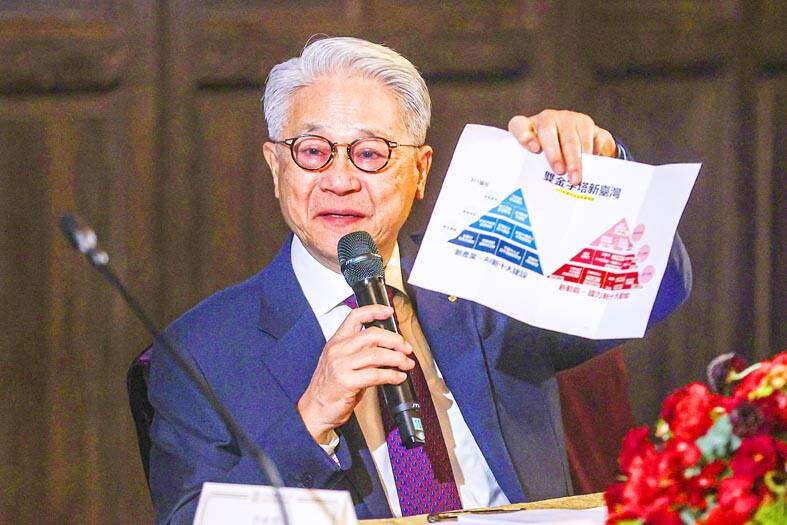
Photo: CNA
He urged the government to take the growing imbalance between cutting-edge tech industries and lagging traditional sectors seriously, saying that the latter employ most of the workforce, and provide essential goods and services.
Wu said he expected the Directorate-General of Budget, Accounting and Statistics tomorrow to raise this year’s GDP growth forecast to between 5 and 6 percent, up from 4.45 percent forecast in August, after exports exceeded expectations amid accelerating global AI demand.
Taiwan would likely outperform regional peers this year, Wu said, attributing the stronger outlook to close cooperation between the government and the private sector.
The business tycoon also expressed hope that ongoing Taiwan–US tariff negotiations would soon yield progress, allowing businesses to operate in a more predictable environment and concentrate on growth strategies.
The recent decision by Nvidia Corp to establish a subsidiary in Taiwan further underscored the nation’s strategic importance in the global AI supply chain and would add new momentum to the economy, Wu said.
However, the strength of AI-related industries contrasts sharply with the weak performance of non-AI and traditional sectors, he said, adding that policy measures should support a more balanced industrial structure.
Wu thanked the Financial Supervisory Commission for easing rules on private wealth management for high net-worth clients and for giving life insurers more flexibility in managing foreign-exchange volatility.
Several government agencies pledged to review proposals aimed at improving the business environment, but the Ministry of Finance remained reluctant to consider tax incentives to help develop Taiwan into a regional asset-management hub, or to cut stamp and business taxes to boost financial sector competitiveness, Wu added.
The ministry said it declined the proposals, as financial institutions are performing well and the revenue involved is still crucial for public finances.
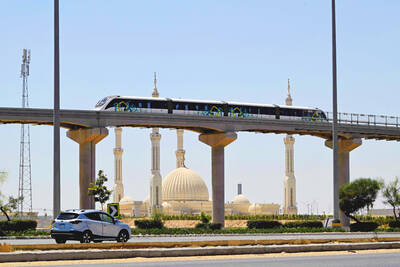
Cairo’s new monorail slices across the city skyline, running above the familiar chaos of blaring horns and aging buses’ exhaust fumes that mark rush hour below. The US$4.5 billion monorail, opened this month, is among Egypt’s most prominent new transport projects, part of a debt-funded infrastructure drive criticized for sapping state finances while bringing limited benefits to most of the country’s 109 million people. “It feels like you’re in a different country,” said Ramy Sayed, a restaurant manager, aboard a driverless Innovia 300 train. “No noise, no traffic, we’re not used to this.” The eastern line runs 56km from the bustling middle-class
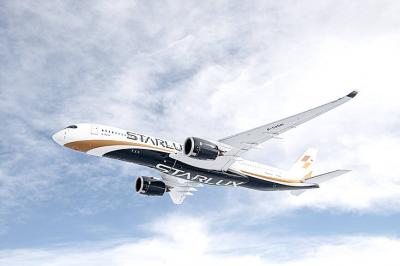
Starlux Airlines Co (星宇航空) today unveiled a long-haul network expansion plan at a shareholders’ meeting in Taipei, including direct flights to Barcelona, Spain, and Zurich, Switzerland, as well as a service connecting Taipei, Sydney and New Zealand. Starlux is to become the first Taiwanese carrier to offer non-stop services to the two European cities, while the inaugural oceanic route is expected to expand transit opportunities within the Australia-New Zealand market, Starlux said. Flight services to Chicago, Dallas, Washington and New York are under evaluation, the airline added. Prior to the shareholders’ meeting, the airline earlier this year announced that it would be
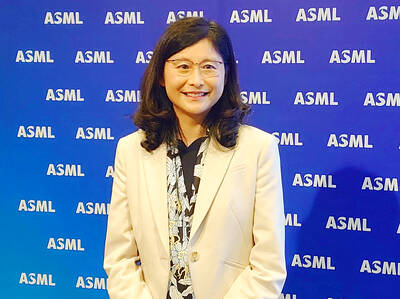
Netherlands-based semiconductor equipment supplier ASML Holding NV yesterday said that it is planning to hire an additional 1,000 people in Taiwan this year in response to growing demand from clients. ASML had previously planned to recruit 600 people this year, but that the plan has been adjusted upward, ASML vice president and ASML Taiwan general manager Grace Wang (汪佳慧) told reporters. ASML has a workforce of more than 4,500 in Taiwan, accounting for about 10 percent of its global total, Wang said. This year’s recruitment campaign would focus on adding people in the customer support, manufacturing and supply chain domains to assist ASML
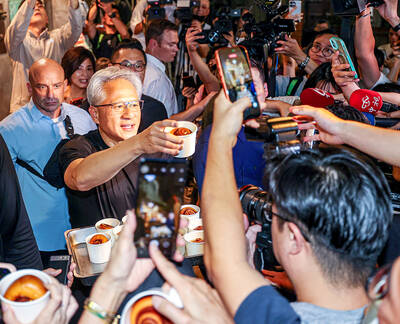
Nvidia Corp yesterday announced that CEO Jensen Huang (黃仁勳) would attend an employee meeting in Taipei tomorrow to celebrate the launch of the company’s Taiwan headquarters project. Huang would attend a gathering at the site of Nvidia’s planned headquarters in Beitou Shilin Technology Park (北投士林科技園區), the company said in a statement. After arriving in Taiwan on Saturday last week, Huang told reporters that he plans to meet with Quanta Computer Inc (廣達) chairman Barry Lam (林百里) and Taiwan Semiconductor Manufacturing Co (TSMC, 台積電) chairman C.C. Wei (魏哲家), and would attend the groundbreaking ceremony for Nvidia’s Taiwan headquarters tomorrow. Nvidia has not yet applied


 RSS
RSS