


Groups representing major automakers late on Thursday warned that a chip disruption stemming from a dispute between China and the Dutch government could quickly affect US auto production.
Automakers and their suppliers received notice from chipmaker Nexperia (安世半導體) last week that it could no longer guarantee delivery of its chips, the European Automobile Manufacturers Association said, adding that manufacturing could be significantly disrupted.
In the US, the Alliance for Automotive Innovation, which represents General Motors, Toyota, Ford, Volkswagen, Hyundai and nearly all other major automakers, urged a quick resolution.
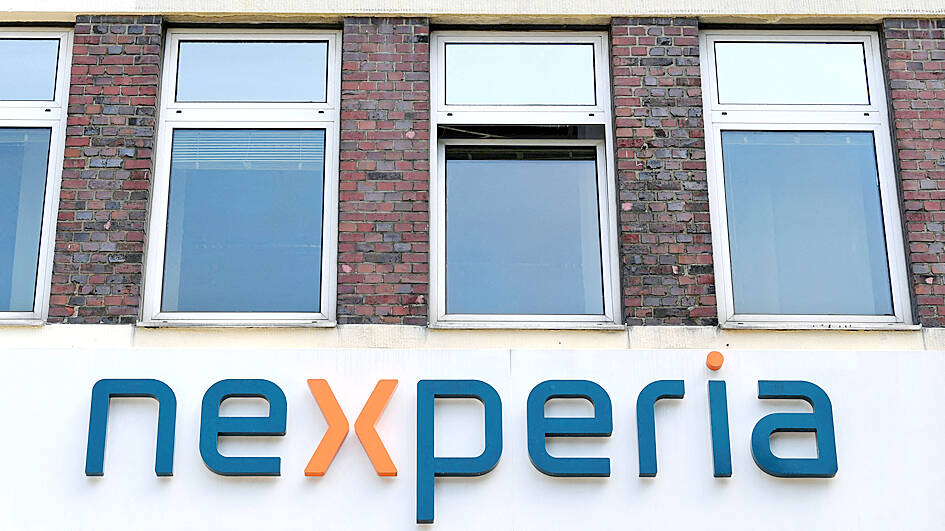
Photo: Reuters
“If the shipment of automotive chips doesn’t resume — quickly — it’s going to disrupt auto production in the US and many other countries, and have a spillover effect in other industries,” alliance CEO John Bozzella said. “It’s that significant.”
Several automakers told Reuters that US auto plants could be affected as soon as next month. They declined to be named due to the sensitivity of the issue.
The chips made by Nexperia are crucial to production of US parts and vehicles.
The Dutch government on Sunday announced that it had, as of Sept. 30, taken control of Chinese-owned computer chipmaker Nexperia, citing worries about the possible transfer of technology to Nexperia’s Chinese parent company, Wingtech Technology Co (聞泰科技).
Court documents showed the Dutch government’s move came after months of rising US pressure on the company. Nexperia was at risk of being impacted by a new US rule that extends export control restrictions to companies at least 50 percent owned by one or more entities on the US entity list.
Washington put Wingtech, which has 100 percent ownership of Nexperia, on the US list in late December last year.
The Chinese Ministry of Commerce on Oct. 4 issued an export control notice prohibiting Nexperia China and its subcontractors from exporting specific finished components and sub-assemblies manufactured in China, a statement Nexperia published on Tuesday said.
Manufacturers in Europe are holding urgent meetings to fend off potential outages that could come within a month, people familiar with the matter said.
The industry has upped inventories after the COVID-19 pandemic sparked previous chip shortages. However, automakers like Volkswagen AG and suppliers including Robert Bosch GmbH might take months to switch from Nexperia to alternative sources, the people said, who asked not to be named because the discussions are private.
“If the situation is not resolved quickly at the political level, there is a risk of a standstill in large parts of global automotive production and in numerous other industrial sectors,” said Wolfgang Weber, who heads Germany’s electrical and digital industry association ZVEI.
While Nexperia’s chips are not considered cutting edge, they are widespread and make up a key part of the automotive supply chain, with hundreds of them in a single car. Its semiconductors help operate functions like switches or steering wheel control.
The automotive sector accounts for more than 60 percent of Nexperia’s revenue, which came in at US$2.06 billion last year.
The export curbs are already prompting companies to look elsewhere.
German chipmaker Infineon Technologies AG — one of the dominant suppliers to the auto industry — is fielding calls from Nexperia customers seeking alternative supplies, the people said.
Automakers do not necessarily source chips directly, but often buy finished parts with semiconductors in them from larger suppliers such as Bosch and Aumovio, the car-parts business spun off by Continental.
Those companies also get individual components from smaller suppliers, making it difficult to quickly assess the scope of potential supply-chain disruptions.

Cairo’s new monorail slices across the city skyline, running above the familiar chaos of blaring horns and aging buses’ exhaust fumes that mark rush hour below. The US$4.5 billion monorail, opened this month, is among Egypt’s most prominent new transport projects, part of a debt-funded infrastructure drive criticized for sapping state finances while bringing limited benefits to most of the country’s 109 million people. “It feels like you’re in a different country,” said Ramy Sayed, a restaurant manager, aboard a driverless Innovia 300 train. “No noise, no traffic, we’re not used to this.” The eastern line runs 56km from the bustling middle-class
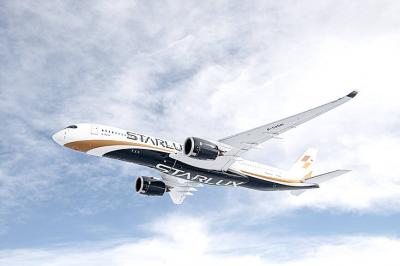
Starlux Airlines Co (星宇航空) today unveiled a long-haul network expansion plan at a shareholders’ meeting in Taipei, including direct flights to Barcelona, Spain, and Zurich, Switzerland, as well as a service connecting Taipei, Sydney and New Zealand. Starlux is to become the first Taiwanese carrier to offer non-stop services to the two European cities, while the inaugural oceanic route is expected to expand transit opportunities within the Australia-New Zealand market, Starlux said. Flight services to Chicago, Dallas, Washington and New York are under evaluation, the airline added. Prior to the shareholders’ meeting, the airline earlier this year announced that it would be

Netherlands-based semiconductor equipment supplier ASML Holding NV yesterday said that it is planning to hire an additional 1,000 people in Taiwan this year in response to growing demand from clients. ASML had previously planned to recruit 600 people this year, but that the plan has been adjusted upward, ASML vice president and ASML Taiwan general manager Grace Wang (汪佳慧) told reporters. ASML has a workforce of more than 4,500 in Taiwan, accounting for about 10 percent of its global total, Wang said. This year’s recruitment campaign would focus on adding people in the customer support, manufacturing and supply chain domains to assist ASML

Nvidia Corp yesterday announced that CEO Jensen Huang (黃仁勳) would attend an employee meeting in Taipei tomorrow to celebrate the launch of the company’s Taiwan headquarters project. Huang would attend a gathering at the site of Nvidia’s planned headquarters in Beitou Shilin Technology Park (北投士林科技園區), the company said in a statement. After arriving in Taiwan on Saturday last week, Huang told reporters that he plans to meet with Quanta Computer Inc (廣達) chairman Barry Lam (林百里) and Taiwan Semiconductor Manufacturing Co (TSMC, 台積電) chairman C.C. Wei (魏哲家), and would attend the groundbreaking ceremony for Nvidia’s Taiwan headquarters tomorrow. Nvidia has not yet applied


 RSS
RSS