


Global chipmakers saw their market value soar as investors rushed to get exposure to artificial intelligence (AI), the latest sign of a frenetic bull run that is pushing tech stocks to all-time highs.
The sector is being swept up by a wave of good news from AI companies, including ChatGPT-owner OpenAI’s record US$500 billion valuation on an employee share sale and its pacts with a group of South Korean chipmakers, as well as a report that Intel Corp is in talks to add Advanced Micro Devices Inc (AMD) as a customer.
The bullishness has pushed the combined market capitalization of the Philadelphia Stock Exchange Semiconductor Index and a gauge tracking Asia chip stocks up by more than US$200 billion in the latest session, according to Bloomberg calculations.
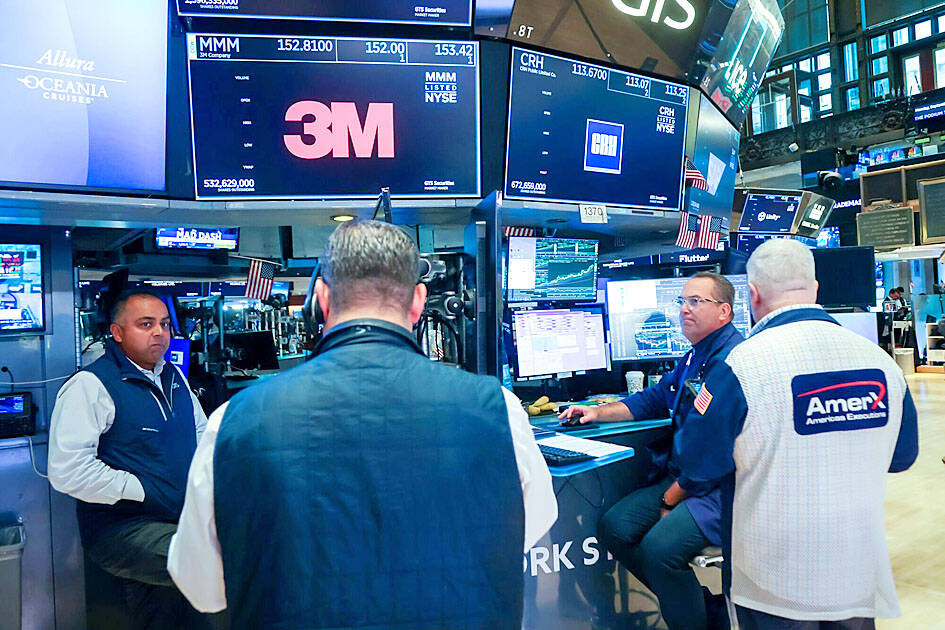
Photo: Bloomberg
South Korean chip stocks were among the biggest gainers yesterday, surging on the OpenAI deal and sending the KOSPI to a record high. Shares of SK Hynix Inc jumped 10 percent, while Samsung Electronics Co advanced 3.5 percent.
Analysts say the bull run is being driven by a “fear of missing out” (FOMO), with investors largely dismissing concerns about a bubble developing in the AI sector.
“Tech momentum shows no sign of fading — as if gravity doesn’t exist — with headwinds brushed aside and every AI headline sparking bursts of euphoria,” said Hebe Chen (陳碧菲), an analyst at Vantage Markets Pty Ltd in Melbourne. “Bubble talk lingers, but it’s FOMO that’s clearly running the show. Momentum looks self-sustaining until upcoming fourth quarter earnings may force the reality check.”
Since ChatGPT launched the modern AI era, investors have scrambled to get exposure to technology that has the potential to shake up the global economy. They have piled into big infrastructure providers, such as chip linchpins Nvidia Corp and SK Hynix Inc, pushed up valuations of start-ups like OpenAI and Anthropic PBC, and poured capital into all manner of gear suppliers to the AI boom.
After striking a non-binding framework agreement with South Korean chipmakers, OpenAI CEO Sam Altman is next scheduled for Taipei, where he is reportedly scheduled to meet with Taiwan Semiconductor Manufacturing Co (TSMC, 台積電) and Hon Hai Precision Industry Co (鴻海精密). Shares of TSMC rose 3.02 percent and Hon Hai gained 2.97 percent yesterday in Taipei.
Chinese technology companies have also been on a strong upward trajectory, driven by investor enthusiasm for AI advancements. Fresh impetus came from the government’s announcement for increased support for the sector, alongside Alibaba Group Holding Ltd’s (阿里巴巴) plans to ramp up AI spending and Huawei Technologies Co’s (華為) unusual step of publicly unveiling its three-year vision for eroding Nvidia’s dominance. These developments helped push the Hang Seng Tech Index’s year-to-date gain to about 50 percent.
Overnight, Intel shares climbed as much as 6.8 percent after news Web site Semafor reported that the firm is in talks to add AMD as a customer for its manufacturing business. AMD currently depends on TSMC for much of its manufacturing needs.
The surge in valuations worldwide has worried some market observers who argue that, while datacenter spending and construction is accelerating, AI services have yet to go mainstream and earn the revenues needed to justify the near-unprecedented rally.
It remains uncertain if there would be eventual demand for all the computing power now under construction. Any setback in earnings from mega tech firms might spark a sell-off given their stretched valuations, as seen during the meltdown in April, JPMorgan Asset Management said.
For now, though, investors see more upside for tech shares, despite the lofty valuations.
“Tech stocks continue to defy gravity,” KB Securities Co managing director Peter Kim said in a Bloomberg TV interview. “I don’t see significant headwinds against Asian tech, possibly extending into next year.”
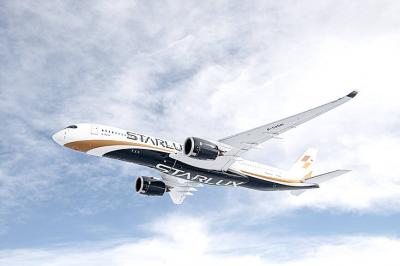
Starlux Airlines Co (星宇航空) today unveiled a long-haul network expansion plan at a shareholders’ meeting in Taipei, including direct flights to Barcelona, Spain, and Zurich, Switzerland, as well as a service connecting Taipei, Sydney and New Zealand. Starlux is to become the first Taiwanese carrier to offer non-stop services to the two European cities, while the inaugural oceanic route is expected to expand transit opportunities within the Australia-New Zealand market, Starlux said. Flight services to Chicago, Dallas, Washington and New York are under evaluation, the airline added. Prior to the shareholders’ meeting, the airline earlier this year announced that it would be

Netherlands-based semiconductor equipment supplier ASML Holding NV yesterday said that it is planning to hire an additional 1,000 people in Taiwan this year in response to growing demand from clients. ASML had previously planned to recruit 600 people this year, but that the plan has been adjusted upward, ASML vice president and ASML Taiwan general manager Grace Wang (汪佳慧) told reporters. ASML has a workforce of more than 4,500 in Taiwan, accounting for about 10 percent of its global total, Wang said. This year’s recruitment campaign would focus on adding people in the customer support, manufacturing and supply chain domains to assist ASML

Cairo’s new monorail slices across the city skyline, running above the familiar chaos of blaring horns and aging buses’ exhaust fumes that mark rush hour below. The US$4.5 billion monorail, opened this month, is among Egypt’s most prominent new transport projects, part of a debt-funded infrastructure drive criticized for sapping state finances while bringing limited benefits to most of the country’s 109 million people. “It feels like you’re in a different country,” said Ramy Sayed, a restaurant manager, aboard a driverless Innovia 300 train. “No noise, no traffic, we’re not used to this.” The eastern line runs 56km from the bustling middle-class

UNDER MICROSCOPE: Taiwan detained three people who allegedly conspired to buy servers in Taiwan and export them using fraudulent documentation, prosecutors said Nvidia Corp chief executive officer Jensen Huang (黃仁勳) on Saturday urged Super Micro Computer Inc to tighten up on compliance after Taiwan detained three people this week for allegedly making fraudulent declarations about artificial intelligence (AI) servers made by its US partner. The development marked the nation’s first crackdown on semiconductor smuggling, which grew after the US slapped restrictions on exports of high-end chips such as Nvidia AI accelerators to China. Nvidia is “rigorous” in explaining regulations to all of its partners, Huang told reporters after arriving in Taipei. “Ultimately Super Micro has to run their own company,” he said in response to


 RSS
RSS